Showing posts with label 2030. Show all posts

Tuesday, May 26, 2015

Toilets for 50,000 - Money woes for Cape stadium

Cape Town - Cape Town Stadium continues to be a massive financial drain on the City of Cape Town, and it doesn’t appear things will get better any time soon.

The stadium’s operational budget for the 2015/2016 financial year is a staggering R13 758 7954, while expected revenue is a just a tenth of that – R14 843 871.

A substantial portion of the stadium’s operating budget expenditure for the 2015/2016 financial year – more than R20 million – has already been allocated to salary related costs.

The bill is already nearly R6m higher than the expected revenue which is brought in by the hire or rental of portions of the stadium.

Running at a loss of more than R40m a year, the city is considering various commercial models that would make it financially viable.

However, this plan has not been finalised, and the city can’t afford to let the current management arrangement lapse. The temporary management arrangement, which was extended from June 2014, expires at the end of June.

In the absence of a long-term business plan that deals with staffing issues and commercial rights, the City of Cape Town has no option but to extend its current contracts and management plan for another year.

“The retention of the status quo will reduce any down time through the recruitment of a new team, thus reducing operational, infrastructural, safety and reputational risks,” said Lesley de Reuck, of the city’s tourism, events, and economic development directorate. The current staff was familiar with the stadium and the park, as well as their processes and standards.

“Events already booked for the 2015/2016 financial year require contractual fulfilment. These represent potential repeat clients and are critical revenue generators that must be nurtured. The facility cannot cease to operate on June 30, 2015,” said De Reuck.

In a report considered by the mayoral committee last week, De Reuck said a substantial portion of the stadium’s operating budget expenditure for the 2015/2016 financial year – R20 127 130 – had already been allocated to salary-related costs.

“The retention of the status quo will reduce any down time through the recruitment of a new team, thus reducing operational, infrastructural, safety and reputational risks.”

The current staff were familiar with the stadium and the park, as well as their processes and standards.The stadium has also been booked for events in the next financial year. “Current contractual and partnership agreements with event organisers must be honoured. Failure to do so may result in breach of contract and goodwill,” said De Reuck.

The team of external consultants appointed in 2011 to do a business modelling exercise on the stadium recommended that the land use and environmental conditions for the use of the stadium and its precinct should be changed to allow for commercial activity.

These processes are already under way and De Reuck said the submission of the formal application for amended land use planning conditions was “imminent”. The proposed amendments to the current environmental conditions were released for public comment last month.

He said both processes would be concluded by December, if there were no appeals.

Once these provisions have been granted, steps will be taken to release the Granger Bay Boulevard site into the property development market, he added.

Although the report called for a three-year extension of the management plan, until June 2018, Mayor Patricia de Lille amended the time frame, during Friday’s mayoral committee meeting, by just one year, to next June.

She also called for a progress report on the business plan to be submitted to the council by next March.

Also on the operational budget is a depreciation cost of more than R58m and repairs and maintenance costs of more than R192m. The total operating budget is more than R137m, but the expected revenue for the stadium for the next financial year is more than R148m. Most of this comes from the hire or rental of portions of the stadium.

anel.lewis@inl.co.za

- Cape Argus

Saturday, May 23, 2015

Dilemma of Cape’s homeless

Cape Town - When Nomanindia Mfeketo was Cape Town mayor she made a commitment that within a year there would be no more children sleeping on the city’s streets.

That was in 2004 and, as she later acknowledged, the problem was a lot more complex than she had originally realised.

There have been a number of efforts since then to reduce the number of homeless people on the streets.

Before the World Cup in 2010, NGOs accused the city of rounding up street children and the homeless and dumping them at Blikkiesdorp near Delft. The city denies this, though, saying Blikkiesdorp was established as a Temporary Relocation Area in 2008 to house people who were evicted after invading N2 Gateway houses.

And last year there was a talk of the establishment of “community villages” outside the city centre where people could live and have access to skills training and drug rehabilitation programmes.

Greg Andrews, convener of the Street People’s Forum, said this proposal had since been canned.

The forum is a collective of several organisations working with street people in the city.

Andrews said the city’s “community village” idea was a perennial proposal that had surfaced in many guises over the last two decades.

“Even if such a community village were established, why would people want to go there? Would they be compelled against their will?

“On the other hand, perhaps it would be a really attractive proposition which someone on the streets would love to go to, in which case why would people leave once they have entered?”

Hassan Khan, chief executive of the Haven Night Shelter, believes the streets are no place for people to live.

“The streets should be a cold place, a place where you are hungry, so people come for help.”

But he says people are given permission to be there by politicians and some encouraged by NGOs who go out and give blankets and food to the poor.

“People are pre-programmed to help. They also pay someone just to be left alone.”

Not that he believes that poverty should be policed like the CCID with their private armies who force people to the edge of the CBD.

Khan said there were an increasing number of people coming to the streets, mainly adults.

“There are guys in their 50s from Welkom who have worked their whole lives in the Post Office and are virtually unemployable now.”

There is a large gay population, people who are not accepted by their families, and youngsters lured by the bright city lights.

“The important thing is how quickly a child on the street is identified and helped. The same with adults.”

Zara Nicholson, spokeswoman for mayor Patricia de Lille, said the City of Cape Town was the first city in the country to have adopted a policy for people living on the street.

“The city’s strategy is to reduce the number of people living on the street and to place them back with their families and communities of origin.”

Part of this reintegration effort included attempts to secure employment opportunities via the Expanded Public Works Programme.

Nicholson said that street people could not, however, be forced into accepting the city’s offers of assistance.

The City of Cape Town’s Reintegration Unit, launched in December, had successfully assisted 85 street people in its first three months of operation.

The city is also in the final phase of its Street People Survey which would include conducting a headcount of street people. The last comprehensive survey conducted by the city was in 2001 and there are estimates that there are around 7 000 transient people either living or begging on the street (across the whole city).

Councillor Suzette Little, the city’s mayoral committee member for social development and early childhood development announced recently that the city had nearly doubled its budget for its winter street people programme this year. The budget for the 2014 programme was R280 000, but this year R600 000 had been allocated.

Little said they also ran a number of programmes in communities most at risk to prevent more people migrating to the streets.

“These programmes are focused on issues in the home, truancy and substance abuse and to provide support to street people who are reintegrated into their communities to prevent a return to their former life.”

But Andrews doesn’t believe the city’s Street People Policy is actually effective.

“The central aim of its current policy boils down to the removal of people from the streets, though this is couched in gentle terms like ‘reintegration’ and ‘reunification’ so it’s quite palatable.”

But he explains that reunification or reintegration only worked if it was self-determined.

“Take for instance the typical example of someone who has come to the city centre desperate for work. Precious few opportunities exist and eventually he either is begging or parking cars, scrounging a pittance any way he can.

“Even if he never makes enough money to support his family, at least he feels he is not a burden to them – another mouth to feed, a body taking up precious space.

“But sometimes, he may be able to get a bag of groceries back home, maybe for someone’s birthday or for Christmas. Now the city’s Reintegration worker finally compels this man to go home.

“Imagine the shame of being escorted home by the larney from the welfare with nothing to support your family and them being told they must look after you. This is not sustainable.”

Andrews believes reintegration was only possible once the “40 percent unemployment and intractable brutal violence” that characterises daily life in the home communities that people on the streets run away from, are addressed.

“Furthermore, we need to address the bottleneck of over-full shelters, over-stretched services and inadequate social housing. Reintegration is meaningless when we have nothing to reintegrate a person into.”

Andrews says it would be refreshing if the city were to admit that people on the streets are not the problem and they’re not going away any time soon.

“The real problem is that 20 years into freedom, poverty is worse and it’s high time we stop trying to remove the poor from our well-to-do areas just because they make us feel uncomfortable or threaten our illusion of security.”

helen.bamford@inl.co.za

- Cape Argus

Saturday, November 30, 2013

Mass urbanisation a development challenge

The search for a better life prompted South Africans to flock to urban centres - and there are now more people living in metropolitan areas than rural ones. And the trend is expected to continue.

“In the latest assessment of the numbers, about 60% of our people in South Africa, a 50 million population, already live in the urban areas. And the national development plan suggests that by 2030 or so, 70% I think, roughly, will be living in the urban areas,” Cooperative Governance Minister Lechesa Tsenoli explained.

But urbanisation has its pitfalls, exacerbating socio-economic challenges.

These include the increasing demand for housing sparked by an increase of informal settlements in urban areas.

Alarming levels of youth unemployment and infrastructure backlogs are also causes for concern. 

The problems can be aggravated by a lack of foresight.

“All those challenges are challenges that we have to address, those social issues, crime, the influx, disease and many other things that as a result of not properly planning,” Nomusa Dube, kwaZulu-Natal MEC for Cooperative Governance said.

Such problems are not unique to South Africa. Other parts of Africa, as well as Asia and South America, have experienced similar problems.

- enca

Friday, May 24, 2013

Gigantic effort needed to de-racialise residential spaces - Tokyo Sexwale

Department of Human Settlements budget speech by Minister Tokyo Sexwale in the National Assembly

1. Introduction

In his inaugural State of the Nation Address (SONA) President of the Republic, Mr Jacob Zuma made three pronouncements in respect of the then Department of Housing. These are, name change from housing to human settlements, policy change and the practicalisation of this new paradigm to transform the landscape of housing in South Africa forever.

Over the last four years, we remained seized with the implementation of this new mandate (Outcomes 8). Without any equivocation we state: A firm foundation has been laid towards a sustainable and integrated human settlements objective: Vision 2030.

Consequently, we have a comprehensive strategy premised upon three segments: Housing for the poor; for the GAP Market; and for the middle to the high income earners.

2. Implementing the Vision 2030 Strategy

2.1 Housing for the poor - grant beneficiaries

The main focus of our housing delivery strategy remains the poorest of the poor, many of whom are in and around informal settlements. At this stage, the following message must be clear: Our government does not build slums, imikhukhu, amatyotyombe! These squalid areas have their roots in the Wars of Dispossession, the 1913 Land Act whose centenary is commemorated this year and in subsequent apartheid policies. These policies gave rise to landlessness and joblessness which saw, and continues to see, the destitute escaping rural poverty towards urban areas.

Let me repeat what I said at the Nelson Mandela Metropolitan University concerning slums.

"They are essentially shanty towns littered across all provinces particularly around the more affluent Metros and municipalities. This therefore results in a situation of the classic undesirable urbanisation, which is driven less by economic growth and more by the rural-urban migration of the poor and jobless."

Question: What steps have we taken to address this? As stated, our focus remains the poor. Over the last four years, our department has thus far, delivered, through grants, over 750 000 houses and housing opportunities.

This has made it possible, during this term of government, for the total housing provided since 1994 to break for the first time, into the 3 million units threshold for those earning from R3 500 to zero; to be precise 3,3 million houses and opportunities now at the cost of R85 000 each towards breaking the backlog of 2,1 million houses for 8 to 10 million people.

2.2 GAP Market Housing - The financially assisted.

The second element of our strategy concerns financial guarantees for affordable housing. This policy for citizens who earn above R3 500 to R15 000 was announced by the President in his 2012 SONA. The department's task is to implement this Finance Linked policy which covers housing for, amongst others, school teachers and principals, police and members of the armed forces, nurses, firemen, prison warders, and blue collar workers. The good news is that this is now a reality and is being rolled out in all provinces via the National Housing Finance Corporation (NHFC).

Our implementing agency is the National Housing Finance Corporation (NHFC) through a financial instrument called FLISP - Finance Linked Individual Subsidy Programme. This supports all qualifying beneficiaries with the certainty of being granted loans, bonds or mortgage facilities by Banks and other financial institutions.

At this amount, beneficiaries have an option to buy an existing house, to build a new one or to purchase land. Therefore, to all those people lost in the GAP Market, earning too much to qualify for an RDP house and too little to access Bank finance we say: Rest assured. This government cares - we back you to get your bond!

2.3 Housing for middle to high income earners

We rely upon three instruments which are the Home Loans and Mortage Disclosure Act, the Community Schemes Ombuds Services Act and the Estate Agency Affairs Act. Thanks to the sterling work of the EAAB Administrator, Mr Taswell Papier, this structure has been stabilised.

In summary, the three elements of our strategy are all critical and applicable for different requirements within the comprehensive human settlements environment. Quite clearly, the continuous allocation of grants for free housing to the poorest of the poor is unsustainable going forward. Strictly speaking, this is more of a welfare programme approach than a long lasting housing policy as this programme is driven by the triple evils of unemployment, poverty and inequity. For as long as this is the case, so long shall this programme remain because we as the ANC government are committed to the poor and shall not abandon them through no fault of their own.

It stands to reason therefore, that given the current socio-economic circumstances, the most optimal and practical human settlements strategic approach is that of the enhancement of the Finance Linked programme.

It is noteworthy that the assistance we provide to our citizens in this regard - black and white - empowers them to become real estate owners; to become real participants in the capital markets as asset owners; real players in the property market as sellers or buyers; as well as in the financial markets where they can borrow against their assets to advance other economic interests. The need therefore, to speed up the issuing of Title Deeds to home owners can never be more emphasised.

3. Integrated human settlements development challenges

3.1 Deracialisation of Residential Areas

Top of the list of all budgetary challenges that confront the entire country is that of having to tackle the unique question of deracialising residential space. This, more than anything else, reflects the real evil of apartheid social engineering which motivated the United Nations in 1973 to pass a unanimous resolution declaring apartheid a crime against humanity. To undo this will take gigantic efforts over a long period, requiring major resources.

At this stage, it is noteworthy to indicate that the United Nations Habitat has requested South Africa to host its next conference on human settlements issues later this year.

Our residential deracialisation strategy is underpinned by seven elements.

3.1.1 Firstly, Deracialising White Suburbs by continuing to oblige Banks through Home Loans and Mortgage Disclosure Act (HLAMDA) and to provide loans to black people desiring to purchase property previously exclusive white suburbs.

3.1.2 Secondly, Inner City Housing

Spearheaded by our agency, Social Housing Regulatory Authority (SHRA), the department has over a period been purchasing many high rise buildings in the centres of major towns and cities. They are refurbished and transformed from office space to rented family units, some with an option to buy. This social housing is popular amongst young couples, students and single mothers.

3.1.3 Thirdly, Inner City Land

Through our Housing Development Agency (HDA), the department has acquired land parcels inside the cities from other government departments and State Owned Enterprises. These strategic pieces of land have been used for settling families.

3.1.4 Fourthly, Outer City Districts

Outer City Districts within the immediate proximity of city boundaries is land which is acquired from other Departments, or in partnership with the private sector, for housing construction. This is earmarked at integrating people within the expanding outer city parametres, a walking distance to vital amenities and facilities.

We congratulate companies that have come on board the Each-One-Settle-One campaign by building thousands of homes upon our subsidies for their employees, particularly in the mining industry.

3.1.5 Fifthly, "No-Man's-Land": Town and Township

The evil utilisation of land as a buffer by the architects of apartheid resulted in the creation of "no man's land" between Johannesburg-Soweto, Cape Town-Gugulethu, Pretoria-Mamelodi, Durban-Umlazi, Port-Elizabeth-KwaZakhele, to name a few, resulting in the black areas having little or no amenities and facilities.

Our approach is to focus on building integrated human settlements in this space to locate people closer to the towns and cities.

3.1.6 Sixth, Townships Upgrading Strategy

It is inevitable that the black townships which were created as a reservoir of labour far away from white cities must be upgraded to improve the quality of life of the inhabitants. On our part, we empower municipalities through the accreditation process by giving them direct funds and authority to construct human settlements within their jurisdiction.

It is for this reason, among others, that in partnership with the Department of Higher Education and the Nelson Mandela Metropolitan University, we launched a four-year Bachelor's Degree in Human Settlements Development, the first of its kind, which will later extend to Masters and Doctoral levels. The same degree will be offered by the Universities of Fort Hare and UNISA in the future.

3.1.7 Seventh, new non-racial towns and cities

Our mandate is to establish new non-racial towns and cities to concretise the principle of a united people in non-racial residential areas.

The new town of Lephalale - Joe Slovo City -under construction in Limpopo, driven by the economies of the Medupi Power Station, is an example in point.

3.2 Other Human Settlements development challenges

3.2.1 Other challenges confronting us are about greater coordination together with other related government departments responsible for big ticket items like bulk services, electrification, water and sanitation, sewerage plants, roads, transportation, etc.

The Presidential Infrastructure Coordinating Committee (PICC) whose efforts are beginning to bear fruit is the answer to the required coordination.

3.2.2 It is unacceptable given the fact after the passing of budgets by this House, we always speedily transfer funds to provinces and accredited municipalities. Many of them discharge their responsibilities perfectly well and are applauded. Yet some fail to spend.

Where some of them do, they sometimes resort to fiscal dumping which often results in shoddy workmanship leading to the wasteful practice of rectification amounting to billions of rands. The newly appointed Board of the National Homebuilders Regulatory Council (NHBRC) carries a huge responsibility in respect of safeguarding proper procedures in the construction industry countrywide.

Furthermore, mindful of the positive work by the Portfolio Committee led by Chairperson Dambuza in its oversight responsibilities, I urge the committee, including the Select Committee to redouble its efforts in coming down hard upon those responsible. On our part, we have taken some of the severest actions against those who engage in shoddy workmanship or fail to adhere to norms and standards on, for example, sanitation.

It is totally unacceptable that although we provide funds, responsible government entities and certain municipalities fail to even build a simple toilet whilst there is a serious stench of the bucket system in some parts of the country. Where they are built, some are left uncovered such as in the recent scandalous cases in Makhaza and Moqhaka, in the Western Cape and Free State respectively, even prompting the Human Rights Commission to get involved!

Our response of taking away funds from poor performers, as required by the law, will continue but is inadequate. Capacity issues need to be addressed. Most importantly, political parties must ensure that their deployees are capable - and there is nothing the matter with cadre deployment - and in turn such deployees should select appropriately qualified employees for the public service.

Our commitment and resolve to rooting out and exposing corruption remains undiminished. We continue to take a dim view of those housing beneficiaries who are engaged in double dipping - a practice of people coming from other parts of the country where services such as sanitation and housing have already been provided for them, yet they flock to informal settlements. This is wrong.

Others engage in the corrupt conduct of selling their houses before the expiry date, including to foreigners, with the help unscrupulous lawyers and fly-by-night estate agents. This is fraudulent. We implore members of civil society to expose such chance takers who, like many we have caused to be prosecuted, should face the full might of the law.

4. Budget focus 2013/14 to 2015/16

The department has been allocated a budget of R28.1 billion for the 2013/14 financial year representing an increase of R2,9 billion. The allocation is expected to grow to R32,7 billion in 2015/16. The conditional grants to provinces constitute a R53, 7 billion over the Medium Term Expenditure Framework (MTEF) period while the Urban Settlements Development Grants to municipalities will be receiving an allocation of approximately R30 billion in three years of MTEF.

The conditional grants and transfers to Human Settlements Institutions constitute 97% The total capital grant allocation amounts to R26.1 billion which consists of the Human Settlements Development grant of R16.9 billion, the Urban Settlements Development Grant of R9 billion and the Rural Households Infrastructure Grant of R107 million in 2013/14.

To conclude, the National Development Plan states: "The inefficiencies and inequalities in South Africa's settlement patters are deeply entrenched. Bold measures are needed to reshape them."

In the context of all we have articulated, the 2013-2014 human settlements budget is important to the extent that it's a continuation of the critical stimulus we provide to the total economic development of the country. Our budget should be seen as a catalyst in this process including job creation through our twin empowerment and construction programmes of Women and Youth Builds.

Incrementally throughout our term, the budget has been earmarked primarily to address the poorest of the poor. In continuing to do so, let there be no doubt that our quest is not to be patted on the back for chasing numbers at the cost of quality.

We are mindful that in addressing the unique challenges of reengineering integrated human settlements in our country, there can be no socio-economic equality without providing our people with quality. On this, there is no compromise.

I thank you.

Friday, June 1, 2012

Sexwale cites homelessness as a major challenge

Human Settlements Minister Tokyo Sexwale says the biggest challenge for his department is to make sure that South Africans are not homeless, or refugees in the various squatter camps dotted around the country. Sexwale says the provision of sanitation is also an important element in restoring people's dignity.

He was speaking at the Govan Mbeki Human Settlements Awards held in Midrand last night.
The embattled Limpopo province won top honours for being the best province at delivering houses in the country. The announcement was made at the Govan Mbeki Human Settlements Awards Ceremony held in Midrand, Johannesburg last night. Last year the auditor general's report brevealed that the Limpopo province had incurred R2.7 billion in unauthorised expenditure under Premier Cassel Mathale and five departments were placed under administration.

But MEC for the Department of Co-operative Governance and Human Settlements, Clifford Motsepe, says Limpopo beat other provinces because they were the only Human Settlements Department to receive a clean audit for 2010/11.

The award comes at a time when everybody has got doubts about what is happening in the province of Limpopo.
"The award comes at a time when everybody has got doubts about what is happening in the province of Limpopo. We are delighted that because of hard work, commitments and visionary leadership of the province under Cassel Mathale once more we have been declared as the best performing province in terms of service delivery of housing in the country," says Motsepe.

Meanwhile, breaking down the gender barriers in housing, Malebo Magasa, from the North West province won the award for the best woman contractor. She says the project in which her company built 50 low cost houses in five months, instead of six months in Rasimoni near Rustenburg, is what gave her the edge.

"It is a lot of work, a lot of dedication. It was not easy, we have been through highs and lows in the last nine years of the business. Men do not believe that a woman can build, every step of the way you have got to prove yourself. You have got to build good houses, it has got to be the best."

- SABC

Thursday, May 10, 2012

'Free housing won't last forever'

Human Settlements Minister Tokyo Sexwale inspected a R400-million housing project in Langa on the Cape Flats hours before his budget vote speech in parliament yesterday.

He spoke about plans to restore dignity to the poor by helping them own homes through the Joe Slovo Housing Project.

The third phase of the project, which saw the construction of more than 2000 units, was the subject of a legal battle between residents and the government last year.

The Constitutional Court found that consultation was crucial for the development's success.

Sexwale said his visit was in compliance with the court ruling.

Sexwale boasted that the new homes are within easy reach of the public transport network and close to places of work.

He said the residents will move in next year.

"By that time it will be paved, it will be greened and it will be providing dignity to whoever is coming to live here," Sexwale said.

He emphasised, however, that it would be unsustainable for the government to continue providing people with free housing.

"It is true that you cannot continue providing free houses forever ... [but] we can't let the people who fall through the cracks get a hard landing. That's why there is assistance in terms of subsidies," he said.

Sexwale said the government was also working with banks to provide finance for "people who are in the gap market".

Sexwale moots state construction firm

Cape Town - The Department of Human Settlements is considering establishing a state-owned construction company, Minister Tokyo Sexwale said on Wednesday.

Sexwale said when houses were built in the government housing programme, the department relied “by and large” on inexperienced shovel, wheelbarrow and bakkie brigades.

“Many of these discredit the good name of genuine and committed small to medium emerging contractors,” he said.

“This does not take away the fact that some small companies have experience, but a lot of fly-by-nights take the taxpayer to the cleaners with their shoddy workmanship.

“Is it perhaps not time to establish a state-owned construction company? We at Human Settlements are exploring this idea together with Public Works.”

Sexwale said the department was a key player in the property market, with a recent study finding that 1.44 million of the six million registered residential properties in the Deeds Registry were government subsidised.

This represented 24 percent of the total number of registered residential properties.

Sexwale said this could increase to 35 percent if the backlog in issuing title deeds was overcome.

The department, he said, would focus on low-cost housing construction projects in its attempt to root out corruption and maladministration.

More than 50 housing projects, valued at R4.2-billion, had been identified as the targets of an investigation, Sexwale said.

“The new focus in our current investigations is on low-cost housing construction contracts.

“In this regard, more than 50 housing projects with the value of R4.2-billion were identified. Over 40 investigations have been completed and 17 are ongoing.”

Sexwale said Limpopo had “taken the lead” in the fight against corruption by blacklisting 24 contractors for shoddy workmanship, non-delivery and incompetence, and recovering more than a million rand from these companies.

More than 290 public servants who had committed housing subsidy-related misconduct and fraud had been arrested.

Nearly R30-million lost through corrupt activities had been recovered, Sexwale said. - Sapa

----- Funny this, the fanciful Flagship N2 Gateway disaster producers One Lindiwe Sisulu and her corrupt advisor Saths Moddley mooted this all the way back here already...

State mulls creation of own cement, brick factories


Moot moot moot ~ Mute.

State eyeing construction pie?

The Department of Human Settlements was considering establishing a state-owned construction company, Human Settlements Minister Tokyo Sexwale said yesterday, noting that when houses were built in the government housing programme, the department relied "by and large" on inexperienced shovel, wheelbarrow and bakkie brigades.

"Is it perhaps not time to establish a state-owned construction company? We at human settlements are exploring this idea together with (the Department of) Public Works," he said as he delivered his budget vote in Parliament yesterday. 

The entry of a state construction company would come as a blow to SA’s existing companies, which are battling for scarce contracts. Mr Sexwale said the department was a key player in the property market. 

A recent study found that 1,44-million of the 6-million registered residential properties in the Deeds Registry were subsidised by the government, representing 24% of the total number of registered residential properties. 

Mr Sexwale raised eyebrows when he said Limpopo was taking the lead in the fight against corruption in housing delivery. His statement came despite Limpopo having gained a reputation as "the most corrupt province" in SA. Some of its departments were placed under administration late last year.

Corruption, maladministration and fraud have been generally identified as the main obstacles in the government’s drive to deliver housing to the poor. 

Mr Sexwale said provinces were participating in the fight against corruption, with Limpopo taking the lead. He said 24 contractors in Limpopo had been blacklisted for shoddy workmanship, nondelivery and incompetence. 

"More than R1-m has already been recovered from these companies. These cases have also been referred to the Special Investigating Unit for further action," he said.

"The focus in our current investigations is on low-cost housing construction contracts. In this regard, more than 50 housing projects with the value of R4,2-billion were identified. Over 40 investigations have been completed and 17 are ongoing." 

He went on to paint an impressive picture in the fight against corrupt public servants. He said more than 290 were arrested, more than 240 found guilty and more than 220 were facing internal disciplinary action. Nearly R30-million lost through corrupt activities had been recovered. 

He said Thami Mpotulo, the former chief director of the national sanitation programme, had been found guilty of dereliction of duty and improper conduct. She has since been dismissed.

Mr Sexwale said Sipho Mashinini, suspended CEO of the National Home Builders Registration Council, had been found guilty of financial misconduct. "The presiding chairperson of the inquiry - recommended a summary dismal." 

The council is a statutory body created to protect housing consumers against unscrupulous home builders and manage a warranty fund in the event of claims by home owners against builders who do not fulfil their obligations.

Mr Sexwale also said Vanessa Somiah, the former South African Police Service detective and a prominent Special Investigating Unit investigator who was "irregularly" employed at the council by Mr Mashinini, had been dismissed from her position on the board with immediate effect.

Wednesday, March 21, 2012

Youth ‘should help in social and economic change’

Addressing a group of young people in Cape Town yesterday, as part of a housing summit, Deputy Minister of Human Settlements Zoe Kota-Fredericks said the government wanted the youth to be part of social economic transformation.

Kota-Fredericks was addressing about 100 young people at the Provincial Youth in Human Settlements Summit at the Cape Town International Convention Centre.

She said in deepening the country’s democracy “we also need your participation in building human settlements in this country as the government cannot deliver housing alone”.

“My department has a lot of programmes for youth. For instance, there is the volunteer project whereby young people can help build houses for the elderly and sick.

“And there are also bursaries available for those who wish to follow a career in construction,” Kota-Fredericks said.

Cannabrick: Reduce carbon footprint naturally.
Premier Helen Zille said while on a walkabout in Nyanga recently she was approached “by a girl who could have been 12 or 14 years old and she asked me: ‘Where is my house’?

“Young people must not say things like this. What she should have said was: ‘I demand that my school is of a high standard.’

“We cannot spend more money on human settlements. We can either do a great deal for a few billion people or spend billions on doing little for few people.

“So we are trying to do a lot for less. This is why we have decided to spend more money on basic services so that a lot of people have access to water and toilets,” Zille said. Human settlements MEC Bonginkosi Madikizela said there was a backlog of 500,000 houses in the province.

He said a look at the budget allocation to human settlements showed that it would take about 30 years to provide houses for everyone at the current rate of delivery, and that was assuming the backlog did not grow.

“Our strategy is to ensure that at least everyone in the Western Cape has access to basic services by 2014,” Madikizela said.

Thursday, March 15, 2012

HRC hears about grim realities in Makhaza

Waste-filled buckets, blocked and leaking open toilets and people using vacant plots to relieve themselves with nothing but bushes for cover.

These were some of the realities outlined on Wednesday by Makhaza residents at the launch of Human Rights Commission (HRC) national public hearings on water and sanitation.

The hearings came a day after city officials and the HRC visited Makhaza, where residents complained that problems with sanitation persisted, even though the city had largely complied with a court order to enclose 1 316 toilets.

Kayum Ahmed, the chief executive of the HRC, identified “lack of consultation with communities” as a key challenge.

Cameron Jacobs, of the HRC, presented preliminary findings on sanitation in Makhaza in 2011. While the report found that 98 percent of households had access to toilets, Jacobs said “this statistic masked the realities”. Leaking toilets, lack of privacy and protection from the elements and criminals, and large numbers of people forced to share a toilet showed facilities were inadequate.

HRC deputy chairwoman Pregs Govender

said the government had fallen behind on its target of achieving national access to sanitation by 2014.

Thursday, February 16, 2012

Are Sexwale & Ramaphosa really white land owners? - Pieter Mulder

FF+ leader says Zuma's figures on land ownership are questionable, as is his history

Dr. Pieter Mulder, FF Plus Leader and deputy minister of Agriculture, Forestry and Fisheries, Reply to President Zuma's State of the Nation Address of 9 February 2012, February 15 2012

Mr. Speaker, honourable President,

What do the people of South Africa need at present? They need hope for the future. On my desk I have the slogan: "The poorest of all persons is not the person without a cent but the person without a dream."

The president and the speakers in this debate each spoke about of his/her dreams for the future. If only a quarter of those plans came to fruition, there is hope for the future.

Sir, make no small plans, because they have no magic to stir people's blood.

In the president's address there are big plans and big dreams for 2030.

The Freedom Front Plus welcomes the infrastructure announcements. This is a sign of long term planning and thus gives some hope for the future.

What is the most dangerous thing a government can do? It is to create expectations with citizens which cannot be realised. This is a recipe for revolutions.

Real leadership and statesmanship is that rare combination of the idealistic with the severely practical.

Why did the world cup projects succeed? Because there were deadlines. Because unnecessary red-tape was avoided. Because the best people for the projects were used. Because black empowerment rules and labour rules were applied flexibly.

Is the government prepared to do this? Or are we going to get stuck in the current climate of corruption, self-enrichment, inflexible labour laws, ineffectiveness and populist debates about nationalisation?

I mention two examples:

Mining and agriculture have the potential to create thousands of employment opportunities. Why did specifically these two performed poorly recently. Is it per chance that the calls for nationalisation from amongst the ANC are directed at specifically mines and agricultural land?

It is estimated that South Africa has mineral riches of $2,5 trillion. That is the mineral wealth of Australia and Russia combined. Yet South Africa's mining sector is in decline. South Africa's mining sector shrunk at a rate of 1% a year while mining sectors in other countries grew by 5% a year on average. The nationalisation debate definitely plays a role in this.

The past week's comments of the president against the nationalisation of mines brought more certainty. If the ANC's policy conference takes the correct decision in June, I predict good growth in the mining sector.

But in the same week the president repeated the statement that the "willing buyer-willing seller option has not been the best way to address the land restitution question." In plain language it means that the government believes in the nationalisation of agricultural land. Where there is now more certainty in the mining sector, there is less certainty in the agricultural sector today.

Anybody who has anything to do with the redistribution of land will prove that the problem does not lie with the willing buyer-willing seller principle. The problem is the disastrous way in which land redistribution has been implemented in the past 18 years. On my desk there are numerous letters of white commercial farmers who had offered their land to the department of Rural Development and Land Reform but have not received any response. Numerous letters from commercial farmers who had concluded purchasing contracts with the department and after three years go bankrupt because the department does not pay out their money.

The president quotes in his address the Department of Rural Development's figures on land reform. According to that, white people possessed 87% of the land and the government had reached only 8% of its 30% target. I seriously differ from these figures. As do I seriously differ with the statement that white people had stolen their land.

Land is a very emotional issue which have led to numerous wars. The president asks for a national dialogue about this issue. Such a discussion cannot be undertaken with propaganda facts, twisted history and emotional slogans. Next week this book, "Omstrede Land" (Disputed Land) will be released by prof. Louis Changuion (and Bertus Steenkamp). It deals with the land issue dating from 1600 until the present times. There are plans to also release it in English.

The ANC readily speaks of "Black people in general and Africans in particular." Sir, Africans in particular never in the past lived in the whole of South Africa. The Bantoe- speaking people moved from the equator down while the white people moved from the Cape up to meet each other at the Kei River. There is sufficient proof that there were no Bantoe-speaking people in the Western Cape and North-western Cape. These parts form 40% of South Africa's land surface.

There are also differences of opinion about the influence of the Difaqane on land ownership. Read the diaries of the Voortrekkers about what they found when they moved into the interior.

How does the department calculate the 8%? There isn't a completed land audit against which we could correlate these facts.

What does the ANC mean by 30% land in the hands of black people? Does it include state land and urban land? It is accepted that the state owns about 25% of the total land surface. State land certainly does not count as white land? Twenty five per cent state lands should then be added to the 8%. What about the Ingonyama trust land of more than 2,8 million ha of the Zoeloe king? Where is this and all the other communal land added? Mr. Ramaphosa and Minister Tokyo Sexwale recently bought a number of farms from white farmers. My source in Vryburg says that a company of minister Sexwale recently bought 30 farms in that area. This also has to be added to the 8%? In the Karoo and Kalahari huge farms are available. Why does the department not buy some of that land to reach their 30% quicker? These semi-desert lands are however added to the 87% propaganda percentage as white land.

The Development Bank calculated in 2001 that 44% of the land belongs to whites, 20% to blacks, 9% to brown people and 1% to Asians.

The way in which the department had calculated the 30% and 8% figures creates the impression that they are setting themselves up to fail.

I said land is an emotional issue. Propaganda figures and emotional slogans will not bring us to answers. Realistic debates with real figures however will.

The size of arable land under production dropped by 30% from 1994 up to 2009. Failed land reform, where 9 out of 10 farms are not successful, played an important role in this. Farmers now have to produce more food on less land for South Africa's population of 50 million.

I agree when minister Nkwinti says it does not help to merely chase after hectares. If that land does not produce food, we will have famine very shortly and then people will be running in the streets as they recently did in Mozambique when bread prices increased due to shortages.

In 2000 Zimbabwean farmers produced 2 million tonnes of maize. Last year, following land reforms they produced only 900 thousand tonnes. In 2000 Zimbabwe had 250 thousand tonnes of grain, last year they only had 10 thousand tonnes. It is not the result of drought. In the same time Zambia grew to where it has started exporting maize.

I want to repeat a quote which I used in the Cabinet Lekgotla. Mondli Makhanya wrote in the Sunday Times: (28/2/2010)

"...we are wasting valuable time and energy trying to restore people to their peasant ways.

Ordinary South Africans either do not want land or just do not have the capacity to work it. They want to go to cities and work in the modern economy... Large-scale, highly mechanised commercial farming is now the way of the world. You cannot turn the clock back four decades. That is just the reality. Furthermore, the young people would, as has happened elsewhere, have simply upped and headed for the towns and cities. Yet we continue to nurse the notion that we can reverse the inevitable march to an urban future. We keep wanting to fight the logic of large scale commercial farming... The money and energy that is spent on getting peasants back into subsistence (farming) would be better used to create a strong class of black commercial farmers who actually do farm for commercial rather than sentimental reasons."

I dream of white and black commercial farmers who do not have to go to Africa for opportunities. The children who were born in 1994 are 18 years old this year and can vote. They only know an ANC government. There is no reason why such a child should not be able to buy a farm or obtain a bursary, just because he/she is white. Yet this is still happening.

Sir, I want to give notice here today already that the FF Plus will be asking for a special language debate about the permanent onslaught against Afrikaans and the deterioration of all the indigenous languages in South Africa.

In politics one finds small people and great people. Small people are opportunistic and talk and gossip about other people. Great people talk and dream about ideas and the future. When we look back in 2030 to this debate, we will be able to determine who was busy with opportunistic small politicking and who was busy with realistic future plans in the interest of all. These are the dreams of the FF Plus and what we are busy with.

Issued by the Freedom Front Plus, February 15 2012 - Politicsweb

Friday, January 20, 2012

Housing backlog ‘stretches back 24 years’

If you submitted a housing application after 1988, which was 24 years ago, chances are the City of Cape Town has not yet got around to it.

This emerged in an affidavit, which was submitted to the Western Cape High Court this week as part of a court wrangle to evict a group of Mitchells Plain families.

The families were among the hundreds of backyard dwellers who illegally invaded four pieces of city-owned land in Tafelsig in May.

The high court evicted them in August, and while most of them have since moved, about 50 people moved on to a nearby piece of land owned by the Passenger Rail Agency of South Africa.

The agency is now trying to evict them, and when the matter last appeared in court, the city’s legal team said all its temporary relocation areas (TRAs) were filled to capacity.

Acting Judge Pearl Mantame ordered the city to submit a report as to why there was no alternative accommodation available for the families. The city this week submitted the report, which laid bare its mounting challenges in rolling out its housing plan.

In the accompanying affidavit by Gregory Goodwin, the city’s head of sub-councils and area co-ordination for human settlements, he said any vacant accommodation was offered to people on their housing database, according to when they had lodged their applications.

The city was currently dealing with applications which had been submitted between 1983 and 1988.

The report showed that there had been an “enormous migration of people” into Cape Town over a number of years.

“The population of Cape Town will continue to grow significantly each year, from both natural birth as well as in-migration. By 2030, the city’s population is expected to have grown by 13 percent to 4.2 million. The challenge of providing various forms of housing… and municipal services within the constraints of the resources available to the city is obvious,” the report said.

There were about 400 000 households in Cape Town that needed adequate housing, and this figure increased by between 16 000 and 18 000 households a year.

In addition, the city’s TRAs were full, with the exception of Blikkiesdorp in Delft, leaving no other site but Blikkiesdorp for the Tafelsig families to be placed.

This was an about turn from the city, which last told the court that the families could no longer be accommodated because all its TRAs had been filled.

The city has two TRAs – one in Delft and the other in Mfuleni, known as Bosasa settlement.

The province also has three other emergency housing sites, namely Bhekela in Philippi, Tsunami in Delft and another site in Langa.

The city’s report said eight other areas had been identified as possible locations for emergency housing; however, these would only be developed within three years. The case resumes on Tuesday. 

Friday, December 16, 2011

Minister too busy to worry about shacks

The title of Minister of Housing changed to Minister of Human Settlements and the present incumbent is Tokyo Sexwale.

Since the very first free elections, housing in South Africa has largely been beset by badly built or nonexistent Reconstruction and Development Programme houses, corrupt contracts or simple pipe dreams. Former Minster Lindile Sisulu promised in Cape Town to build 20 000 houses in three years . . . nope, it was 18 months. Nope, it was 12 months. Anyway, it did not happen – not even 2 000 houses and now she is Minister of Defence, where she can make much bigger promises.

The reason for the change of title to Minister of Human Settlements is, I think, that nobody could dignify the dwellings in which half the population lives as houses and it would probably be politically unwise to have a Ministry of Miserable Shacks and Mansions, as appropriate as this may be.

One has to admire Tokyo S. He is a very busy man. He was very much part of the recent African National Congress disciplinary hearing into the actions of Julius Malema, which function must have rated way above worrying about Human Settlements. He certainly was not present at that most important recent event (in our lives here at home) – the burning down of Morris’s shack.

Morris works for my practice and has four children. All were, fortunately, spared when the youngest child lit the ‘flame stove’ in Morris’s shack in the wrong way and the shack caught alight and burned down.

I did some investigation (after getting the Morris family back in business) and found out this: 95% of shack fires are caused by electrical faults or stoves or lamps. The electrical faults occur since illegal taps to power lines feed a whole series of extension cords strung together to bring power (at a fixed rate) to shack after shack. When the cords overload, they melt and stuff catches fire. In Cape Town, they are quite prepared to supply safe low-cost power connections (even to a shack) but they want the way clear so they can easily service these connections. This doesn’t happen, so it doesn’t happen.

Paraffin lamps get knocked over and . . . well . . . fire.

The simple way forward is this: ask consulting firms around the country to let contracts to build houses which have a low fire load (the self-build houses in Mossel Bay are an excellent example). Contract on open (really open, no rubbish) tender and build houses. Trust me, a trained matriculant could administer this.

As for lights, we have been testing some solar lights which consist of a panel with a battery, a solar panel and lamps. Some of them are good, some not so good. But the good ones we have tested are very good – durable, reliable and simple, and cost about R900 per set of two lamps.

Now, since the power for lighting in shacks is going to be stolen anyway, why do municipalities and Eskom not just buy a whole lot of these and free-issue them to those who need lights? I can let whoever wants see the results of our tests on various solar lights. If they supplied 100 000 solar lights, then, at a cost of R800 each, with each set replacing 120 W of incandescent light, for R80-million you would knock 120 MW off the power system.

Think about it – each of those ghastly wind turbines produces about 2 MW and costs R12-million; the solar lights are a significantly better idea. Will it happen? I am certain not. Our Minister is too busy giving evidence for comrades and being president of the South African-Japanese Business Forum, honorary consul general of Finland in South Africa, honorary colonel in the South African Air Force . . . and Morris, after all, is just a bricklayer. But now a bricklayer with solar lights.

- Engineering News

Thursday, October 27, 2011

How to build a Cannabrick Home - Cop17 Cape Design Solution


Peacefully Demonstrated outside the Department of Housing May 7 2005

  1. Plant a cannabis seed. Water and allow the plant to grow and produce seed. Plant and water these seeds. Your goal is to grow enough to build a house, you will need about 1 acre to build a 5 roomed home.

    Tyala imbewu ntsangu (ye-cannabis). Nkcenkceshela imbewu uze uyinike ithuba lokuba ikhule ide ikhuphe eyayo imbewu. Uyothi ke uyityale nalembewu uyinkcenkceshele njalo. Injongo yakho kukukhulisa izityalo ezothi zonele ekwakheni indlu, uyakudinga i-acre (malunga nentsimi) enye ukuze wakhe indlu enamagumbi amahlanu.

    Plant 'n hemp saad. Water en laat die plante om te groei en saad te produseer. Plant en water hierdie sade. Jou doel is om te groei genoeg is om 'n huis bou, jy sal ongeveer een aker benodig om' n 5-kamer huis te bou.

  2. Consider the many relevant points presented in the guidelines of Build your house step-by-step.

    Qwalasela yonke imigaqo oyibekelweyo kwincwadana i-Build Your House Step By Step.

    Oorweeg die baie relevante punte in die riglyne van die bou van jou huis stap aangebied-vir-stap.


  3. Start planning where your house will stand. Consider everything about the environment you’ll be building in, like winter and summer sunshine, wind and rain – you don’t want to build on a floodplain, or your house will wash away. Be sure to plan all your water and waste requirements.

    Ceba indawo ozokwakha kuyo indlu yakho. Qwalasela yonke into ngomhlaba lo uzokwakha kuwo indlu yakho, izinto ezinje ngemimoya, ilanga, neemvula zehlobo nobusika, akekho umntu ofuna ukwakha indlu yakhe emgxobhozweni okanye apho iyothi ibe lilifa lezikhukhula khona. Uqiniseke ukuba unamanzi akulungeleyo ukwenza oku.

    Begin met die beplanning, waar jou huis sal staan. Oorweeg dit alles oor die omgewing en jy sal gebou in, soos winter en somer son, wind en reën - jy nie wil bou op 'n vloedvlakte, of jou huis sal wegspoelen nie. Maak seker om te beplan al jou water en afval vereistes voldoen.

  4. Cut the grown cannabis plants down and leave in the field to rhett for a week. The morning dew and natural rotting process will loosen the fibers from the plant.

    a. Process the plant matter by cutting leaves and branches off, then hit small bundles the length of the plant over and upturned rake.
    b. The long fiber parts that remain in your hand are good for weaving rugs and making various other items your skills can accomplish.
    c. The seed can be gathered for more housing.
    d. Gather the small woody bits (the hurd) that have fallen, this waste is what will be used in the construction material.

    Sika / sarha izityalo uzibeke egadini ixesha elingangeveki ukuze zibole. Umbethe wasekuseni nezinye izinto zendalo ezibolisayo ziya kuyikhulula I-fibre ezityalweni.

    a. Yikhawulezise ngohlukanisa intonga zezityalo namagqabi, uhlale uyiharika rhoqo.
    b. Intonga ezi zinothi zincede kwezinye izinto ezifana nokwenza ingubo nezinye izinto onothi uzibonele zona ngokolwazi lwakho.
    c. Imbewu inokuqokelelwe ukwakha ezinye izindlu.
    d. Qokelela imithana ethe yaziwela njengokuba uzoyisebenzisa xa usakha indlu yakho.

    Sny die gegroei hemp/cannabis plante af en in die veld verlaat om rhett vir 'n week. Die oggend-dou en die natuurlike verrotting proses sal die vesel van die plant los te maak.

    a. Proses van die plantmateriaal deur te sny blare en takke af, dan is getref klein bundels die lengte van die plant oor en omgekeerde hark.
    b. Die lang vesel dele wat in jou hand bly is goed vir die matte weef en die maak van verskeie ander items jou vaardighede kan bereik.
    c. Die saad kan vir meer behuising ingesamel word.
    d. Versamel die klein houtagtige bits (die hurd) wat gedaal het, die afval is wat sal in die konstruksie materiaal gebruik kan word.


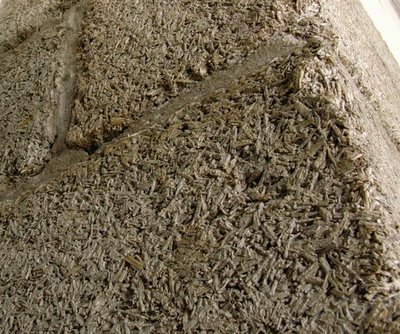
  5. Wash the hurd, dry it, then wash it again. Be careful not to allow the matter to rot or decay during this process, by turning, airing and allowing the African sun to dry the hurd properly. Now combine in proportions 10:2:3:3 combine the cannabis/ntsangu/dagga Hurd(10), washed river sand 0.5mm(2), hydraulic lime(3) and water(3) to make the mulch (This process may need tweaking depending on your geographic location, humidity, rainfall etc)

    Hlamba ingqokelela yakho, uyomise, uphinde uyihlambe.Ulumkele ukuba lengqokelela ibole kwelithuba, yiguquguqule, uyivumele ibethwe ngumoya uvumele nelanga lase Afrika liyomise lengqokelela. Dibanisa ngokwalo mgaqo 10:2:3:3, dibanisa ke lemvuno yakho yomgquba wentsangu (10) kunye nesanti yasemlanjeni 0.5mm(2), ikalika (3) kunye namanzi (3) ukwenza udaka (Nale into ke iyokuthi ixhomekeke kwindawo leyo ukuyo nemvula zakhona njalo-njalo).

    Was die kudde, droog dit af, dan was dit weer. Wees versigtig om nie toe te laat die aangeleentheid te verrot of verval gedurende hierdie proses, deur die draai, voorlê en laat die Afrika-son om droog die kudde goed. Nou kombineer in verhoudings 10:2:3:3 kombineer die cannabis / ntsangu / dagga Hurd (10), gewaste riviersand 0.5 mm (2), hidrouliese kalk (3) en water (3) aan die deklaag te maak (Hierdie proses kan tweaking nodig, afhangende van jou geografiese ligging, humiditeit, reën, ens)

  6. Now build your house! Ngoku ke yakha indlu yakho! Nou bou jou huis!

  7. Teach others. Fundisa abanye. Onderrig ander.


You can use this “dagga-cement” for making bricks, shutter casting or the proven “pole-and-dagga” method. This last method allows for a sturdy, warm, fireproof and water proof home – built with pride and intuitive engineering, not a ‘uniform box’.

Be sure to consider all aspects of your house design and structural requirements. Although the cannabis-cement will become stronger than steel in time, it is not advised to build over 2 floors high without considering structural implications. With planning this cement can be used to build up to 4 floors high.

The cannabis-cement will dry over a period of a month (depending on the weather). At this point you will be able to add the roof. Seal your home’s walls with lime; lime external walls annually. Decorate your house with masonry to make it unique, and paint with coloured lime as per custom.

Always PLANT A TREE in a place that will provide shade, to commemorate this accomplishment.

Council will plant trees if citizens care for them. Call (021) 689-8938 http://www.trees.org.za/

Assist your family, friends or neighbors with your experience and expertise. Share information and technique; you can uplift yourself and your community.


Tuesday, September 27, 2011

Human Settlements Minister Sexwale: 'housing for poor is not sustainable'

Minister says the private sector must contribute to the provision of housing for the poor, and that is why he will launch the "each one, settle one" campaign at the Johannesburg Stock Exchange on Thursday...


HUMAN Settlements Minister Tokyo Sexwale says the government must have a cut-off date on which it will stop building free houses for the poor.

"We can't sustain what we are doing. There has to be a cut-off date. We are discussing that. But you can't cut off the poor right now, particularly not in the current national economic environment," Sexwale told the 12th international housing and home warranty conference at Cape Town's International Convention Centre yesterday.

He said the private sector would have to contribute to the provision of housing for the poor, and that was why he would launch the "each one, settle one" campaign at the Johannesburg Stock Exchange on Thursday.

The campaign would ask "captains of industry" to "empty their pockets" to build houses, Sexwale said.

He also called on conference delegates to come up with innovative ways to build houses for the poor.

"Talking about good quality products means you don't take the poor for granted. Quite often people build houses, but if it is for the poor the quality tends to be lower."

Sexwale also called for an end to racialised human settlements.

"The task, if we have to be a common people bound by our humanity, is to create a situation in which people can live together."

He also warned that climate change could destroy the work of housing ministers.

Calling for a minute of silence for Kenyan environmental activist and Nobel laureate Wangari Maathai, who died on Sunday morning, Sexwale said "cities are threatened".

"If we continue to emit negative gases into the air ... at this rate ... whatever we plan climate change might negate," he said.

- Sowetan

Monday, September 26, 2011

Sexwale calls for free housing deadline

Free housing for the poor has to have a cut off date, Human Settlements Minister Tokyo Sexwale said in Cape Town.


The solution to South Africa's backlog of 2.3 million houses was not in providing free homes, he told the International Housing and Home Warranty Conference.

He added however, that now was not the time to "cut off the poor".

"The solution will come not from free housing. There has to be a cut off date for discussing that. But we can't cut off the poor right now, particularly in the current national economic environment."

The answer to all housing problems lay in having a growing economy, where people had jobs and could access finance.

"We can't sustain what we are doing for a long time."

Sexwale said South Africa, which had around 2500 slums, faced added problems from its growing population of immigrants, from countries such as Nigeria and Zimbabwe.

"We have natural population growth as well as growth because people are coming here."

Another difficulty lay in the provision of social housing. South Africans, Sexwale said, preferred standalone houses with their own gardens, but a shortage of land around cities was making that impossible.

"The challenge is to develop social housing and planning for new towns and cities," he said.

"The challenge is for densification. We are having to go higher and higher and higher. The challenge is quite big."

- Timeslive

Tuesday, September 6, 2011

More empty Sexwale promises

Human Settlements Minister Tokyo Sexwale on Tuesday said that the development of sub-Saharan Africa’s housing market could help cushion the region against the impact of global economic uncertainties.

Speaking at the opening of the African Union Housing Finance’s yearly meeting, the Minister said that housing was an “economic dynamo” that stimulated other market sectors such as mining and construction.

He said that the development of housing would assist sub-Saharan Africa in generating the economic growth that was needed to protect it from the devastating effects of a potential second global recession.

Sexwale said that while the first global recession was brought on by the collapse of the developed world’s housing market, the successful development of a housing market in could possibly save sub-Saharan Africa, one of the poorest regions in the world, from a total financial collapse.

Also at the event, United Nations (UN) Habitat director Barbara Hewson said that the organisation would focus on creating vibrant cities and overall quality housing developments in the region over the next five years.

She said that a mixed-use development seemed to be the most promising model to implement in the region.

Hewson also noted that it was important to get banks more directly involved in municipal and infrastructure finance.

“One of the things that have really impressed me in South Africa is the commitment from its government to develop human settlements and provide housing to the poor,” she commented.

But, Hewson added that it was important to attract investment from the private sector, as no government’s budget was big enough.

During the past five years, UN Habitat had provided initial funding of $10-million, stimulating overall investment from development funds and the private sector of more than $500-million into 30 different housing projects.
“To bring such pilot projects to the scale needed in the next five years, it will be essential to attract further private sector investment,” said Hewson.

Sexwale suggested that further regional partnerships for the development of housing and securing access to finance should also be strengthened through the use of the New Partnership for Africa's Development, or Nepad.

- Engineeringnews