Wednesday, January 21, 2015

Friday, January 24, 2014

Friday, September 13, 2013
HEMP SEMINAR ON TRANSFER OF HEMP TO COMMERCIAL REALITY
Challenges on transfer of hemp (Cannabis sativa) from agricultural feasibility to commercial reality, by Monde Sotana, Rural Development Centre (RDC) training coordinator at Fort Cox College of Agriculture & Forestry on the 6 September 2013.
The way-forward:
- The co-ordination of private sector, public, government agencies, farmers, in a systematic and productive way. Action: Mr Sotana’s office.
- Establish three hemp shops in E.C. province at the college and two other areas. Start with Market outlet at college, as a point of departure, then start a hemp factory. Agro-processing activities to be undertaken. Action: Mr painter
- The hemp conference at the college once a year every August.
- Awareness campaign to be led by Ms Ngcofe.
- Appropriate action plan to be drawn.
- Registration and access to permit and Licencing arrangement.
- Seeds multiplication led by ARC-IIC, farmers and HoH.
- Re-structure hemp into Hemp-Eastern Cape at provincial and local affiliation.
- Next meeting will be held on the 26 September 2013 at 10h00 at RDC at Fort Cox College of Agriculture & Forestry.
Monday, August 12, 2013
R15m hemp project goes to seed
Wednesday, October 10, 2012
Hemp in South Africa - 567 Cape Talk Calls Government
 |
| Click image for how to build a Cannabrick home |
Friday, July 13, 2012
State environmental body to be shut
Thursday, June 7, 2012
SA's economy cleans up with green jobs for greenhorns

Friday, March 30, 2012
Africa: Natural Fibres Key to Environment and Tackling Poverty
Tuesday, November 29, 2011
Gov Funds██ █ ████ ███ Cannabis (sic ████) research


Thursday, August 25, 2011
Bid to tap into bamboo
The Eastern Cape Development Corp (ECDC) and the Industrial Development Corp (IDC) have been exploring opportunities in the industry — which has been introduced successfully in a number of developing countries — and last week held a two-day symposium and exhibition in East London.
Each of the development agencies has invested about R1m in exploratory work and the IDC will soon finalise a study to identify opportunities for the role of bamboo in rural economic development , says senior project manager Bertie Strydom.
ECDC regional head Ken Bern says the bamboo project is one step in a bid to grow a number of diverse industries in the countryside with the aim of securing the participation of rural communities and bringing them, through these products, into the mainstream economy.
In the Eastern Cape, bamboo may be grown together with crops such as pineapples, hemp or flax — crops which are being promoted in an attempt to rebuild the province’s agriculture sector.
“Bamboo as an emerging crop in Africa is already turning fortunes around in countries such as Ethiopia, where leather and sugar are also contributing to rising wealth,” says Bern.
Louis de Lange, a founder of Gaia Carbon Sciences, says bamboo is a versatile non invasive crop that can help develop the agricultural sector without threatening the environment.
“It can be used in a number of applications, including renewable energy. It is fast-growing and can build large biomass stock.”
Bhargavi Motukuri, from India, introduced the symposium to the work of the International Network for Bamboo & Rattan. Established by a UN treaty, this 37-member intergovernmental body promotes global trade in the crop with the aim of helping the poor communities which grow it.
“Unlike trees, where planting to harvest takes years or even decades, bamboo provides steady income for farmers on a monthly or even weekly basis.
“It can be cut and transported by a single person, splits linearly and can be processed by hand with a knife. ”
The crop has a wide variety of uses, including construction, making all types of furniture, fittings such as window blinds, fencing, flooring, arts and crafts and charcoal production.
It is a viable alternative for all types of housing, with the costs of bamboo dwellings comparing very favourably to conventional construction.
A notable advantage of bamboo is that it can replace the use of trees as a source of wood, with environmental benefits.
In addition, it can be grown in marginal soils, uses groundwater efficiently and thrives even in drought conditions. It is a multibillion-dollar industry in China, India and Brazil.
China leads world exports with 46% of the total, followed by Indonesia with 16%.
And though studies have been carried out primarily with the Eastern Cape in mind, they have revealed that two other provinces might have even greater potential for bamboo cultivation.
Hamman Oosthuizen of Optimal Agriculture Business Systems, the lead consultants in the project, says only about 10% of SA land is suitable for rain-fed bamboo cultivation. About half of this has “marginal potential” and only 0,5% of SA land is “high potential”.
Of this high-potential land, about 80% is in KwaZulu Natal (45% or 188000ha) and Mpumalanga (35% or 148000ha). Just 10% of SA land, or less than 43000ha, is seen as having high potential for the cultivation of bamboo in the Eastern Cape, with a slightly smaller area also suitable in Limpopo.
As it stands, the cultivation of bamboo is limited in SA. Three pilot projects near Port Elizabeth, Stutterheim and Centane will be extended when the project is expanded in three or four years.
Pelo Gabaraane, director of SA Bamboo, which has been commissioned by the ECDC to manage the pilots, says 12 people have already been employed.
“We look forward to more of the local people gaining employment and skills when the project goes full scale.”
- Financial Mail
Thursday, April 28, 2011
Eastern Cape pioneering new fibre processing possibilities
- Cashmere: The combed hair from the three million goats in the province will be used to spin into luxury yarns in the manufacture of garments.
- Hemp and flax: Using crops new to South Africa and with established uses in other countries, hemp and flax could help revitalise the textile industry and be used as a source of seeds and oils.
- Agave Americana: The sisal plant, which grows in the Karoo and which has been used to make a tequila-type liquor, could help develop markets particularly as a raw material for several industrial uses.
- Pineapple: Having learnt from the innovative projects which make commercial use of the leaves, stems and roots of the pineapple plant, there are fibre opportunities for a plant which already has a solid base in plantations and has the involvement of black commercial farmers.
- Mohair and wool: New opportunities are being investigated for an old industry that will involve people previously (and currently) excluded from direct benefit in the beneficiation of the Eastern Cape‘s extraordinary resources of mohair and wool.
Saturday, March 5, 2011
City gives approval for hemp farming
According to Tony Budden of Long Street’s Hemporium, hemp is an enormous untapped industry with the potential to address many of the city’s social woes, including in the areas of housing, unemployment and health.
Budden presented his views on the hemp industry to the committee yesterday.
Hemp products are mostly imported and crops may be cultivated locally only with a permit allowing the cultivation of narcotic drugs, issued by the Department of Health.
Industrial hemp contains only negligible amounts of the psychoactive substance tetrahydrocannabinol, which is found in dagga.
Budden was bombarded with questions yesterday from curious committee members.
After Budden’s presentation, chairman Pat Hill confirmed that the committee supported – “with some enthusiasm” – Hemporium’s plan to apply for a licence to grow hemp commercially.
Budden said the Western Cape was the ideal place to cultivate hemp crops. However, he said the country was being left behind in the wake of other countries that were already reaping the commercial, social and ecological rewards of industrial hemp production.
More than 30 countries produced industrial hemp, including Australia, Austria, Canada, Great Britain, France, Germany, Russia, Chile, North Korea, Uruguay and nine US states.
The world’s leading producer of hemp was China, which, according to Budden, had set a target of creating 3 million jobs in the industry over the next 10 years.
Budden said hemp had the potential to create “an entire new industry for the Western Cape, and particularly for the City of Cape Town”.
It also had the potential to create up to four times the number of jobs associated with wheat cultivation.
Processed hemp had many uses and over the past 15 years several business, including Woolworths, Nando’s, Levi’s, Billabong, Clicks, Sappi, DaimlerChrysler, Unilever and Concretex, had shown “a genuine interest in locally grown hemp”.
Even in the government there was no shortage of people who supported industrial hemp production, Budden said.
“All we are asking for is to create an enabling environment for research so we can prove it is viable,” he urged.
While a sceptical Koos Bredenhand, of the ANC, initially put Budden through his paces, he was apparently won over after being shown raw hemp products, one of which he declared to be “beautiful”.
It also helped changed his mind when Budden explained the difference between hemp and dagga.
With the support of the city, Hemporium will now attempt to obtain the necessary permits for local hemp production.
- Cape Argus
Saturday, January 1, 2011
How to build a Cannabrick Home
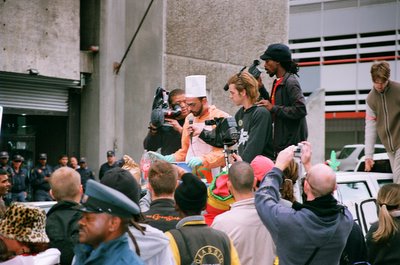 Peacefully Demonstrated outside the Department of Housing May 7 2005
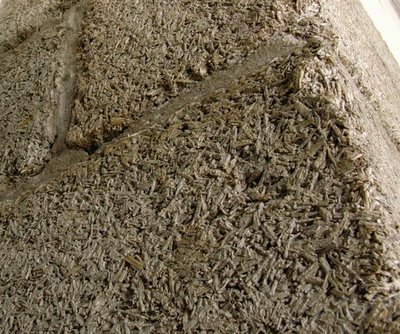
- Plant a cannabis seed. Water and allow the plant to grow and produce seed. Plant and water these seeds. Your goal is to grow enough to build a house, you will need about 1 acre to build a 5 roomed home.
Tyala imbewu ntsangu (ye-cannabis). Nkcenkceshela imbewu uze uyinike ithuba lokuba ikhule ide ikhuphe eyayo imbewu. Uyothi ke uyityale nalembewu uyinkcenkceshele njalo. Injongo yakho kukukhulisa izityalo ezothi zonele ekwakheni indlu, uyakudinga i-acre (malunga nentsimi) enye ukuze wakhe indlu enamagumbi amahlanu.
Plant 'n hemp saad. Water en laat die plante om te groei en saad te produseer. Plant en water hierdie sade. Jou doel is om te groei genoeg is om 'n huis bou, jy sal ongeveer een aker benodig om' n 5-kamer huis te bou. - Consider the many relevant points presented in the guidelines of Build your house step-by-step.
Qwalasela yonke imigaqo oyibekelweyo kwincwadana i-Build Your House Step By Step.
Oorweeg die baie relevante punte in die riglyne van die bou van jou huis stap aangebied-vir-stap.

 Start planning where your house will stand. Consider everything about the environment you’ll be building in, like winter and summer sunshine, wind and rain – you don’t want to build on a floodplain, or your house will wash away. Be sure to plan all your water and waste requirements.
Ceba indawo ozokwakha kuyo indlu yakho. Qwalasela yonke into ngomhlaba lo uzokwakha kuwo indlu yakho, izinto ezinje ngemimoya, ilanga, neemvula zehlobo nobusika, akekho umntu ofuna ukwakha indlu yakhe emgxobhozweni okanye apho iyothi ibe lilifa lezikhukhula khona. Uqiniseke ukuba unamanzi akulungeleyo ukwenza oku.
Begin met die beplanning, waar jou huis sal staan. Oorweeg dit alles oor die omgewing en jy sal gebou in, soos winter en somer son, wind en reën - jy nie wil bou op 'n vloedvlakte, of jou huis sal wegspoelen nie. Maak seker om te beplan al jou water en afval vereistes voldoen.- Cut the grown cannabis plants down and leave in the field to rhett for a week. The morning dew and natural rotting process will loosen the fibers from the plant.
a. Process the plant matter by cutting leaves and branches off, then hit small bundles the length of the plant over and upturned rake.
b. The long fiber parts that remain in your hand are good for weaving rugs and making various other items your skills can accomplish.
c. The seed can be gathered for more housing.
d. Gather the small woody bits (the hurd) that have fallen, this waste is what will be used in the construction material.
Sika / sarha izityalo uzibeke egadini ixesha elingangeveki ukuze zibole. Umbethe wasekuseni nezinye izinto zendalo ezibolisayo ziya kuyikhulula I-fibre ezityalweni.
a. Yikhawulezise ngohlukanisa intonga zezityalo namagqabi, uhlale uyiharika rhoqo.
b. Intonga ezi zinothi zincede kwezinye izinto ezifana nokwenza ingubo nezinye izinto onothi uzibonele zona ngokolwazi lwakho.
c. Imbewu inokuqokelelwe ukwakha ezinye izindlu.
d. Qokelela imithana ethe yaziwela njengokuba uzoyisebenzisa xa usakha indlu yakho.
Sny die gegroei hemp/cannabis plante af en in die veld verlaat om rhett vir 'n week. Die oggend-dou en die natuurlike verrotting proses sal die vesel van die plant los te maak.
a. Proses van die plantmateriaal deur te sny blare en takke af, dan is getref klein bundels die lengte van die plant oor en omgekeerde hark.
b. Die lang vesel dele wat in jou hand bly is goed vir die matte weef en die maak van verskeie ander items jou vaardighede kan bereik.
c. Die saad kan vir meer behuising ingesamel word.
d. Versamel die klein houtagtige bits (die hurd) wat gedaal het, die afval is wat sal in die konstruksie materiaal gebruik kan word. - Wash the hurd, dry it, then wash it again. Be careful not to allow the matter to rot or decay during this process, by turning, airing and allowing the African sun to dry the hurd properly. Now combine in proportions 10:2:3:3 combine the cannabis/ntsangu/dagga Hurd(10), washed river sand 0.5mm(2), hydraulic lime(3) and water(3) to make the mulch (This process may need tweaking depending on your geographic location, humidity, rainfall etc)
Hlamba ingqokelela yakho, uyomise, uphinde uyihlambe.Ulumkele ukuba lengqokelela ibole kwelithuba, yiguquguqule, uyivumele ibethwe ngumoya uvumele nelanga lase Afrika liyomise lengqokelela. Dibanisa ngokwalo mgaqo 10:2:3:3, dibanisa ke lemvuno yakho yomgquba wentsangu (10) kunye nesanti yasemlanjeni 0.5mm(2), ikalika (3) kunye namanzi (3) ukwenza udaka (Nale into ke iyokuthi ixhomekeke kwindawo leyo ukuyo nemvula zakhona njalo-njalo).
Was die kudde, droog dit af, dan was dit weer. Wees versigtig om nie toe te laat die aangeleentheid te verrot of verval gedurende hierdie proses, deur die draai, voorlê en laat die Afrika-son om droog die kudde goed. Nou kombineer in verhoudings 10:2:3:3 kombineer die cannabis / ntsangu / dagga Hurd (10), gewaste riviersand 0.5 mm (2), hidrouliese kalk (3) en water (3) aan die deklaag te maak (Hierdie proses kan tweaking nodig, afhangende van jou geografiese ligging, humiditeit, reën, ens) - Now build your house! Ngoku ke yakha indlu yakho! Nou bou jou huis!
- Teach others. Fundisa abanye. Onderrig ander.

Council will plant trees if citizens care for them. Call (021) 689-8938 http://www.trees.org.za/
Wednesday, October 27, 2010
Right2Know march on parliament
 R1,3 billion could be swept under the carpet on failed housing projects, because it has been declared a secret.
Maintenance funds on inner-city prototype high-rise buildings, flagship projects and soccer stadiums could become national security issues, and we would never know.
15 Years of government Hemp (Cannabis Sativa L.) research could be classified a secret and more than the few of you who know would know even less....
Like how much it has cost so far...
 What is the Secrecy Bill?
Why should you take action?
Sign up!
Wednesday 27 October - Right2Know March to Parliament - Gathering in Kaizersgracht Street, Cape Town @ 9h30
Thursday, October 14, 2010


Monday, August 16, 2010
Services aimed at improving lives of women & children: Department of Social Development briefing
Friday, January 15, 2010
Police swoop on what could be 144 built homes raw material
Police late this afternoon swooped on a dagga plantation barely outside of the western outskirts of Pretoria. The land apparently belongs to the provincial government and the dagga will be destroyed as soon as possible. No arrests were made.
The plantation, barely 50m from a major road connecting Pretoria to the North West Province, had plants some reaching more than 2m high and is growing undisturbed on about 12 square kilometres. Police started gathering intelligence on the site late last year.
The police’s Tummi Golding says they are worried about the land itself because they want to investigate further who the land belongs to. Golding says if the land does not belong to anybody it will go back to government. The area is informally used to grow vegetables and maize, but the land, usually bustling with people working in their crops, grew eerily deserted as police arrived.
A police helicopter was also used to do an aerial survey of the dagga field. The police investigation will continue but the dagga will be destroyed as soon as possible. Captain Meshack Mthembi of the police’s Forensic Science Laboratory’s Drug Section says they will use a special kind of weed killer which will slowly kill off the plant material. Samples of the dagga plants were also collected to be tested.
- SABC
Monday, October 19, 2009
ADDRESS BY THE MINISTER OF SOCIAL DEVELOPMENT ON THE OCCASION OF THE LAUNCH OF THE HEMP PROJECT, MAPONYA MALL-SOWETO
 Master of Ceremonies, Honourable Premier of Gauteng, Ms Nomvula Mokonyana, Executive Mayor of the City of Johannesburg, Mr Amos Masondo, Honourable MEC of Social Development, Ms Qedani Mahlangu , Honourable Minister of Human Settlements, Mr Tokyo Sexwale, Director-Generals and senior government officials here present, Representatives and leaders from the private sector, Distinguished guests, Comrades and friends, Ladies and Gentlemen
Thank you for joining us this morning on this important occasion in which we seek to intensify our efforts to combat the poverty. As a department, we have looked forward to this launch because the ultimate goal of our work is to engender self reliance in our people and communities.
With us coming together as government, the development agencies, the private sector, NGOs and our international partners to launch this project, we show our willingness and commitment to confront poverty which continues to undermine people’s dignity and overshadow the achievements of the last fifteen years.
It is befitting and inspiring that we launch this project here at the Maponya Mall, the brainchild of the Soweto veteran businessman and the pioneer of black township business, Ntate Richard Maponya. What an inspiration it is to be launching the Hemp project in the presence of a man who defied his poor background and hostile apartheid policies to become one of the leading and respected black businessman who paved the way for a new generation of emerging black business leaders.
We are equally honoured to have with us, one of the leading academic minds and development activist, Dr Mamphela Ramphele who has written extensively on the subject of poverty. Many of us in the development sector draw on your knowledge to infuse thinking about the South African development trajectory. You have contributed to this effort in no small measure.
We are greatly honoured and pleased that you all took time from your busy schedules to join us in this national civil society dialogue. Our ultimate long term goal remains uprooting poverty (to borrow from the title of Dr Mamphela’s report on poverty) through building a more caring society…. together, for the mark of a noble society is found not in how it protects the most powerful, but how it defends the most vulnerable.
I do not know if it is fate or design that the launch of this project is taking place here in Soweto- a township that was the nucleus of our struggle for freedom and justice. Whatever the reason, the launch could not have happened at a more appropriate place than here.
It was in the streets of this vast township that our youth, armed only with stones and petrol bombs, fought relentlessly against the heavily armed security forces. Many of you will remember that in 1956 during the height of apartheid, the Congress of the People took place in Kliptown (not far from here) to draw up the Freedom Charter which became the foundation of our Constitution.
At that historic gathering, the forefathers of our struggle pledged: “the state shall help the peasants with implements, seed, tractors and dams to save the soil and assist the tillers”. As a nation we have walked a long road since that historic gathering, but the Freedom Charter remains a living document that guides our national democratic revolution.
Today, 54 years on and 15 years into a democratic South Africa, we are gathered here to make a similar pledge to work together to eliminate extreme hunger and poverty in our midst. On this historic occasion of the launch of the Hemp Project, let me start by saying that it gives me great pleasure to be present at a function of this kind as it gives us an opportunity to witness first hand, how much can be achieved when government joins hands with the private sector, research institutions, development agencies and communities to tackle the challenges confronting us. On behalf of my Department I would like to thank all the stakeholders in the Hemp project.
The fact that the Hemp project takes place today, on the same date as the International Day for the Eradication of Poverty, is a matter of historical significance. Every year, 17 October is observed by United Nations Member States as the International Day for the Eradication of Poverty- a global awareness campaign dedicated to fighting poverty and destitution around the globe.
The history of this campaign can be traced back to 1987 when over a hundred thousand people gathered in Paris, where the Universal Declaration of Human Rights was signed in 1948, to honour the victims of extreme poverty, violence and hunger.
They proclaimed that poverty is a violation of human rights and affirmed the need to come together to ensure that these rights are respected. Since then, people of all backgrounds, beliefs and social origins have gathered every year on this day to renew their commitment and show their solidarity with the poor. For us this day presents us with a watershed opportunity to launch this very exciting and ground breaking development initiative.
What makes this initiative so much interesting is that it is spearheaded by a community-public-private sector partnership that brings together the synergy, expertise and resources between various stakeholders. Without any doubt, today’s event signifies unity in diversity and action.
Furthermore, today's event is a very important and rewarding milestone for my Department as this project is a direct beneficiary of our Sustainable Livelihood Approach- an innovative development strategy which seeks to teach people that through cooperative self-help and a united approach to common problems, the vast potential for their own self-improvement can be translated into effective programmes which can do much to improve their standard of living.
Mahatma Gandhi once said “Poverty is the worst form of violence”. None of us in this room can deny that poverty is a reality in this country, and, if South Africa is to grow and prosper, it needs to eradicate poverty as a matter of extreme urgency. It is for this reason that the government embarked some years ago on the strong drive to eradicate poverty in South Africa, especially in the rural areas, hit the hardest by the global economic recession and the widespread retrenchments. As a government, every day we respond as best we can to the concerns of those hit hardest by this crisis. While we continue to reap the benefits of globalization, we clearly have not been immune to the shocks that come with it.
Over the last fifteen years government has been implementing a myriad of poverty alleviation measures, with social assistance programme being the biggest of them all, aimed at achieving the goal of a better life for all. To date this programme is one of the most comprehensive and sophisticated in the developing world. We have, progressively expanded social grants to vulnerable groups since the dawn of our democracy and more than a quarter of the population is receiving income transfers.
I have said it before, and at the risk of sounding like a broken record-player, I would like to repeat that while appropriate social security provisioning plays a critical role in addressing the basic needs of the poor households, it is only meant to be a temporary measure.
From its inception, the social assistance programme was not specifically designed with strategies to connect recipients and other able-bodied and unemployed household members to opportunities for sustainable livelihoods, employment and other economic opportunities.
Having succeeded in expanding the reach of our social security system to so many in our country, the challenge now is to focus on programmes that have the potential to graduate people out of poverty.
To respond to this challenge, my Department initiated the Sustainable Livelihoods to link the poor, vulnerable and marginalized, with particular focus on able-bodied beneficiaries of social grants, to opportunities for sustainable livelihoods and economic activities. The programme does not intend to exit social grant beneficiaries from the system in the short-term, but to create opportunities for sustained work opportunities and income in the long-term.
This programme operates within the framework of adaptive social protection- a process which facilitates the strengthening of coping strategies of the poor to tackle vulnerabilities and build their adaptive capacities to improve access to socio-economic opportunities. It might not solve all their problems, but it does build up their confidence to tackle such problems more effectively. We strongly believe that the pursuit of the goals and, in the end, of development and poverty requires the active participation of the beneficiaries.
One such project, which has proven successful as it gives communities the opportunity to determine their own patterns and priorities of development, is Silindithemba project (Dutyini, Eastern Cape) on “linking grants to sustainable livelihoods and co-operatives”.
The success of the Silindithemba project, which is driven mainly by rural women who were previously disenfranchised simply on the basis of their gender, is testimony that with initiative and the right support, women are creating markets where none existed, turning a profit, and prioritizing investing in the education and health of their families. It has been proven that investing in women and girls is not only a worthy goal in its own right - it is one of the fastest and best means of advancing human development for all.
Today’s launch of the Hemp Project is the culmination of long standing partnership between my Department, the Centre for Scientific and Industrial Research (CSIR), Agricultural Research Council (ARC), the Eastern Cape Departments of Agriculture, Forestry and Fisheries (national and provincial), Eastern Cape Department of Economic Affairs, Eastern Cape Development Agency, Department of Science and Technology, the Development Bank of Southern Africa (DBSA) and the Department of Trade and Industry.
The majority of people participating in this project are women. Given the historical importance of this day, and the fact that poverty disproportionally affects women than men, what a better way of showing our commitment to poverty reduction than to invest in the Hemp Project?
Analyzing data from two surveys conducted by Statistics South Africa, a recent study by the University of Stellenbosch found that 45 percent of female-headed households lived below the poverty line, as compared to only 25 percent of male-headed households. The findings of this study are comparable with international trends which show that of the world’s 1.3 billion poor people, women constitute 70 percent.
This state of affairs is variance with the Freedom Charter and the Constitution both of which are premised on the concept of social justice and gender equality. For this reason, we welcome and support development initiatives that strengthen the value chains for women cooperatives.
Comrades and friends, we believe that value chains will certainly address poverty and gender disparities. An enhanced value chain is a great incentive to production and income generation, however it cannot sustain unless market access is possible for them.
We have learnt that most cooperatives, some of which have huge potential to succeed and benefit many people, did not last for long due to limited or no market accessibility. Judging by the presence of so many entrepreneurs in this room, I am hopeful that we can rely on your business acumen to improve the Hemp project’s production chain and to increase its competitiveness and market penetration.
Support for more commercially orientated production, improved marketing, and private sector involvement is identified as a strategic object in most of the development initiatives. The beauty about the Hemp project is that it fully embraces the concept of sustainable livelihoods in that it highlights the need for communities to use natural resources in a sustainable fashion.
I therefore would like urge each and everyone in this room to share your expertise by participating in this national flagship programme in order to create production and marketing capacities as well as competitiveness in national and international markets.
Judging by the long list of government departments and agencies involved in this project, our government is up to the challenge of eradicating poverty. But it is clear that our success will come only if it is a true team effort. Government is doing its part, but the private sector must step up and seize the opportunity we have created. Working together, we can do much better to reduce poverty.
So now, I call upon the leaders of our private sector to take up the challenge at this important time: to join your government and continue to invest in our nation’s future. Work with us to ensure that our nation’s limited resources are able to meet the objective of improving the lives of the people of South Africa, particularly poor women in rural areas.
Before concluding, let me take this opportunity to congratulate the pioneers of the House of Hemp, in particular Dr Thandeka Kunene and the project’s investment partner, Dr Mamphela Ramphele, and members of my department for successfully organizing this launch.
I should also point out that the foundation for the partnership agreement between the Department of Social Development and the House of Hemp, was laid by the sterling support and contributions from the CSIR, ARC, Eastern Cape Department of Economic Affairs, Eastern Cape Development Agency, Department of Science and Technology, DBSA, Department of Trade and Industry and the Department of Agriculture, Forestry and Fisheries. The stage is set and we call aboard all actors to participate.
We must all band together to shoulder the responsibility of bringing our nation through these challenging global times. As I said, to date we have been successful. But now is not the time to be complacent. It is the time to step up to the challenge and work hard to ensure our nation’s bright economic future. We owe this to gallant men and women who in 1955 gathered in Kliptown to adopt the Freedom Charter.
As Norman Peale once said:As we launch this project on this historic day, we do so with the hope that it will bring us much closer to the attainment of our shared and common goal of making poverty a history.
Empty pockets never held anyone back. Only empty heads and empty hearts can do that.
I thank you.
- Department of Social Development
- South African Government Information