Showing posts with label IN HS. Show all posts
Showing posts with label IN HS. Show all posts
Thursday, June 11, 2015

Thursday, June 4, 2015
Cape Town Stadium: FIFA icon or albatross
Cape Town - An albatross around the necks of ratepayers, or a valuable and iconic asset? The Cape Town Stadium, running at an annual loss of about R40 million, was described as both during Tuesday’s full council meeting where it was agreed that the current management plan should be extended by a year to June 2016.
Councillors alluded to the recent Fifa corruption scandal during their debate on the stadium’s future, with Andre Fourie of the Freedom Front Plus saying that Fifa president Sepp Blatter took billions of rands out of the country, leaving Cape Town and other municipalities with massive bills for the stadiums that were built.
He said the consortium of Stade de France and the local SAIL Group pulled out if its management agreement with the city soon after the World Cup when it realised the stadium would never be filled to capacity.
Fourie said it was unlikely that the formation of a municipal entity to manage the stadium would be the panacea the city needed to make the facility financially viable.
“This albatross - despite the thousands that it cost the city to build - is costing ratepayers in unaffordable monthly operational and maintenance costs.”
Fourie said the only way the city could avoid any further financial loss was by selling the stadium to SA Rugby for R1.
“Acknowledge that the stadium was a mistake. Accept that you are not going to make it commercially viable without an anchor tenant. Cut your losses - and the albatross around the neck of Cape Town’s ratepayers - and offer the stadium to Newlands for R1.”
Demetrius Qually, of the DA, said that although the Fifa scandal had tarnished the World Cup legacy, the stadium remained a valuable and iconic asset.
There was also “justifiable” concern about the long-term viability of the stadium. However, the business plan being finalised, which included the lifting of restrictive environmental conditions, would make it sustainable.
“We are confident that the stadium and Green Point Urban Park can be both viable and financially sustainable,” said Qually.
Grant Haskin, of the African Christian Democratic Party, agreed that the management of the stadium had to continue without interruption while the business plan was being finalised.
But he said the city had been promising “stadium profitability” since 2009. “How then can one blame irate ratepayers for their calls to rather demolish the stadium instead of wasting their money? What was a proud moment in Cape Town’s history has become a furious embarrassment for the city and its people.”
Majidie Abrahams, of the ANC, argued that extension of the management arrangements without clarity on the business plan could put the city at risk of spending and losing money for another three years.
But mayor Patricia de Lille pointed out that the management plan had been extended to June 2016, and not 2018 as initially proposed, and included a condition that a progress report on the commercialisation of the precinct would be submitted to council in March next year.
Garreth Bloor, mayoral committee member for economic development, tourism and events, said the rezoning process was already under way. Demolition of the stadium was not an option, he said.
The city had been advised of 18 revenue streams that would generate a profit for the next 10 to 15 years.
This excluded any revenue that would come in from an anchor tenant.
He said the naming rights alone would secure between R5m and R10m in revenue for the city. The tabled revenue budget for the next financial year is R14m.
But Bloor allayed fears about the discrepancy between the stadium’s projected costs and income.
Although the tabled operating budget expenditure for 2015/2016 was R138m, limited commercial rights would bring this amount down to R34.2m. “The commercial rights process has already started. We will make it work and we will continue the (World Cup) legacy,” he said.
[like a mountain goat skipping through the diaspora with donations...]
anel.lewis@inl.co.za
- Cape Argus
Tuesday, June 2, 2015
Government is not concerned about it's citizens here is the proof.

- Financial Times London 08/07/2010
Naturally what followed was colluded stadia construction Cape Town cost R4,4 Billion and service delivery of toilets for 50,000 that remain locked up and maintained at R60 million cost per annum... and Blikkiesdorp

All I can say is #ITOLDYOUSO!
LONG AGO!
Sunday, May 31, 2015
Saturday, May 30, 2015
Houses burn as the President laughs about his firepool
Cape Town - Violence flared again in Marikana informal settlement on Friday, after residents torched the home of Leticia Mali on Symphony Way.
The act prompted retaliation by residents of Lower Crossroads who, in turn, set ablaze a shack of the man they accused of being behind the attack on Mali’s house.
The conflict has raged throughout the week, starting as a protest prompted by the cutting of illegal electricity connections to the informal settlement.
Four municipal trucks and five other vehicles were set alight, and a 68-year-old man died after his Toyota Hilux was stoned on the N2 on Thursday. Police vehicles were also stoned.
Angry Marikana protesters torched Mali’s home in the early hours of yesterday morning.
The Lower Crossroads residents then retaliated, claiming they were being held to ransom by the informal settlement residents.
“We are angry because we don’t have services to give them, and we are not responsible for them.
“So we don’t understand why they are taking their anger out on us and our homes.
“They have started this fight and we will not succumb to their ludicrous behaviour. These are our homes and we have worked hard for them,” one angry Lower Crossroads resident said.
Mali’s home was petrol-bombed by angry Marikana residents who claimed it was unfair that they were stuck in shacks with no services, while their neighbours lived comfortably.
Mali said some illegal electricity connections had run to Marikana from her house, but that she had cut them off due to the blackouts.
“They got angry and they threw a petrol bomb through the roof of the bedroom.
“The fire spread fast because there was no ceiling in that room,” she said.
Marikana community leader Nocks Gijana countered that it was not residents of the informal settlement who set her house alight, although she acknowledged there was bad blood between the two neighbourhoods.
Police spokesman Captain Frederick van Wyk said late on Friday that the area remained tense, and police were monitoring the situation.
“This office can confirm that police action was taken during an ongoing protest in the Philippi East area.
“Property was damaged, but an accurate account of damages cannot no be issued at this stage,” he said.
- Saturday Argus
South Africa's 'brazen cover-up' of Zuma's home upgrade

The offence itself was bad enough - an orgy of overspending by obsequious officials and conniving contractors who managed to spend 246m rand ($21.7m, £14.3m) of public money lavishly upgrading South African President Jacob's Zuma's private homestead, Nkandla.
That is nearly 10 times what taxpayers spent on Nelson Mandela's two homes, and 20 times what it cost to secure Thabo Mbeki's house.
 As we now know, Mr Zuma's "essential security upgrades" included a swimming pool, an amphitheatre, a chicken run and a visitors' centre. A fairly humble collection of traditional buildings on a rural hillside has been transformed into something more like a luxury holiday resort.
But as is so often the case in politics, it is the cover up - long, venomous, hair-splitting and sanctimonious - that has been most revealing, and most depressing.
Some of Mr Zuma's closest advisers - those with an eye on image and votes, rather than on real or imaginary security concerns - were urging him from the very beginning to apologise for any errors and to volunteer immediately to pay for any unwarranted expenditure.
The scandal could have ended in a week, and the president could even have emerged with his status enhanced.

Instead Mr Zuma and his supporters have sought to undermine the credibility of South Africa's public protector - whose exhaustively forensic report recommended that he repay some of the money - and have ridiculed the opposition for seeking to turn Nkandla into a presidency-defining scandal about accountability and corruption.
Now the police minister - a man whose career is, of course, entirely dependent on Mr Zuma's goodwill - has produced his own report, which spells out, in inadvertently comic detail, how conveniently the mosaic-inlayed swimming pool can double as an essential source of water for fighting fires.
The minister's unsurprising conclusion - Mr Zuma should not pay back a penny.
Comic moment

President Zuma did not hide his sense of vindication.
In parliament this week he openly mocked the opposition's attempts to pronounce the word "Nkandla" in a not-so-subtle hint that it was white politicians who were driving the criticism.
It was a confident, boisterous, divisive, and - at least for his supporters - genuinely comic moment.
And there is no doubt that Mr Zuma's jibes will have gone down well with his base.
- BBC
Friday, May 29, 2015
Tuesday, May 26, 2015
Toilets for 50,000 - Money woes for Cape stadium
Cape Town - Cape Town Stadium continues to be a massive financial drain on the City of Cape Town, and it doesn’t appear things will get better any time soon.
The stadium’s operational budget for the 2015/2016 financial year is a staggering R13 758 7954, while expected revenue is a just a tenth of that – R14 843 871.
A substantial portion of the stadium’s operating budget expenditure for the 2015/2016 financial year – more than R20 million – has already been allocated to salary related costs.
The bill is already nearly R6m higher than the expected revenue which is brought in by the hire or rental of portions of the stadium.
Running at a loss of more than R40m a year, the city is considering various commercial models that would make it financially viable.
However, this plan has not been finalised, and the city can’t afford to let the current management arrangement lapse. The temporary management arrangement, which was extended from June 2014, expires at the end of June.
In the absence of a long-term business plan that deals with staffing issues and commercial rights, the City of Cape Town has no option but to extend its current contracts and management plan for another year.
“The retention of the status quo will reduce any down time through the recruitment of a new team, thus reducing operational, infrastructural, safety and reputational risks,” said Lesley de Reuck, of the city’s tourism, events, and economic development directorate. The current staff was familiar with the stadium and the park, as well as their processes and standards.
“Events already booked for the 2015/2016 financial year require contractual fulfilment. These represent potential repeat clients and are critical revenue generators that must be nurtured. The facility cannot cease to operate on June 30, 2015,” said De Reuck.
In a report considered by the mayoral committee last week, De Reuck said a substantial portion of the stadium’s operating budget expenditure for the 2015/2016 financial year – R20 127 130 – had already been allocated to salary-related costs.
“The retention of the status quo will reduce any down time through the recruitment of a new team, thus reducing operational, infrastructural, safety and reputational risks.”
The current staff were familiar with the stadium and the park, as well as their processes and standards.The stadium has also been booked for events in the next financial year. “Current contractual and partnership agreements with event organisers must be honoured. Failure to do so may result in breach of contract and goodwill,” said De Reuck.
The team of external consultants appointed in 2011 to do a business modelling exercise on the stadium recommended that the land use and environmental conditions for the use of the stadium and its precinct should be changed to allow for commercial activity.
These processes are already under way and De Reuck said the submission of the formal application for amended land use planning conditions was “imminent”. The proposed amendments to the current environmental conditions were released for public comment last month.
He said both processes would be concluded by December, if there were no appeals.
Once these provisions have been granted, steps will be taken to release the Granger Bay Boulevard site into the property development market, he added.
Although the report called for a three-year extension of the management plan, until June 2018, Mayor Patricia de Lille amended the time frame, during Friday’s mayoral committee meeting, by just one year, to next June.
She also called for a progress report on the business plan to be submitted to the council by next March.
Also on the operational budget is a depreciation cost of more than R58m and repairs and maintenance costs of more than R192m. The total operating budget is more than R137m, but the expected revenue for the stadium for the next financial year is more than R148m. Most of this comes from the hire or rental of portions of the stadium.
anel.lewis@inl.co.za
- Cape Argus
Saturday, May 23, 2015
Dilemma of Cape’s homeless
Cape Town - When Nomanindia Mfeketo was Cape Town mayor she made a commitment that within a year there would be no more children sleeping on the city’s streets.
That was in 2004 and, as she later acknowledged, the problem was a lot more complex than she had originally realised.
There have been a number of efforts since then to reduce the number of homeless people on the streets.
Before the World Cup in 2010, NGOs accused the city of rounding up street children and the homeless and dumping them at Blikkiesdorp near Delft. The city denies this, though, saying Blikkiesdorp was established as a Temporary Relocation Area in 2008 to house people who were evicted after invading N2 Gateway houses.
And last year there was a talk of the establishment of “community villages” outside the city centre where people could live and have access to skills training and drug rehabilitation programmes.
Greg Andrews, convener of the Street People’s Forum, said this proposal had since been canned.
The forum is a collective of several organisations working with street people in the city.
Andrews said the city’s “community village” idea was a perennial proposal that had surfaced in many guises over the last two decades.
“Even if such a community village were established, why would people want to go there? Would they be compelled against their will?
“On the other hand, perhaps it would be a really attractive proposition which someone on the streets would love to go to, in which case why would people leave once they have entered?”
Hassan Khan, chief executive of the Haven Night Shelter, believes the streets are no place for people to live.
“The streets should be a cold place, a place where you are hungry, so people come for help.”
But he says people are given permission to be there by politicians and some encouraged by NGOs who go out and give blankets and food to the poor.
“People are pre-programmed to help. They also pay someone just to be left alone.”
Not that he believes that poverty should be policed like the CCID with their private armies who force people to the edge of the CBD.
Khan said there were an increasing number of people coming to the streets, mainly adults.
“There are guys in their 50s from Welkom who have worked their whole lives in the Post Office and are virtually unemployable now.”
There is a large gay population, people who are not accepted by their families, and youngsters lured by the bright city lights.
“The important thing is how quickly a child on the street is identified and helped. The same with adults.”
Zara Nicholson, spokeswoman for mayor Patricia de Lille, said the City of Cape Town was the first city in the country to have adopted a policy for people living on the street.
“The city’s strategy is to reduce the number of people living on the street and to place them back with their families and communities of origin.”
Part of this reintegration effort included attempts to secure employment opportunities via the Expanded Public Works Programme.
Nicholson said that street people could not, however, be forced into accepting the city’s offers of assistance.
The City of Cape Town’s Reintegration Unit, launched in December, had successfully assisted 85 street people in its first three months of operation.
The city is also in the final phase of its Street People Survey which would include conducting a headcount of street people. The last comprehensive survey conducted by the city was in 2001 and there are estimates that there are around 7 000 transient people either living or begging on the street (across the whole city).
Councillor Suzette Little, the city’s mayoral committee member for social development and early childhood development announced recently that the city had nearly doubled its budget for its winter street people programme this year. The budget for the 2014 programme was R280 000, but this year R600 000 had been allocated.
Little said they also ran a number of programmes in communities most at risk to prevent more people migrating to the streets.
“These programmes are focused on issues in the home, truancy and substance abuse and to provide support to street people who are reintegrated into their communities to prevent a return to their former life.”
But Andrews doesn’t believe the city’s Street People Policy is actually effective.
“The central aim of its current policy boils down to the removal of people from the streets, though this is couched in gentle terms like ‘reintegration’ and ‘reunification’ so it’s quite palatable.”
But he explains that reunification or reintegration only worked if it was self-determined.
“Take for instance the typical example of someone who has come to the city centre desperate for work. Precious few opportunities exist and eventually he either is begging or parking cars, scrounging a pittance any way he can.
“Even if he never makes enough money to support his family, at least he feels he is not a burden to them – another mouth to feed, a body taking up precious space.
“But sometimes, he may be able to get a bag of groceries back home, maybe for someone’s birthday or for Christmas. Now the city’s Reintegration worker finally compels this man to go home.
“Imagine the shame of being escorted home by the larney from the welfare with nothing to support your family and them being told they must look after you. This is not sustainable.”
Andrews believes reintegration was only possible once the “40 percent unemployment and intractable brutal violence” that characterises daily life in the home communities that people on the streets run away from, are addressed.
“Furthermore, we need to address the bottleneck of over-full shelters, over-stretched services and inadequate social housing. Reintegration is meaningless when we have nothing to reintegrate a person into.”
Andrews says it would be refreshing if the city were to admit that people on the streets are not the problem and they’re not going away any time soon.
“The real problem is that 20 years into freedom, poverty is worse and it’s high time we stop trying to remove the poor from our well-to-do areas just because they make us feel uncomfortable or threaten our illusion of security.”
- Cape Argus
Saturday, May 9, 2015
Decade anniversary - How to Build a cannabrick home
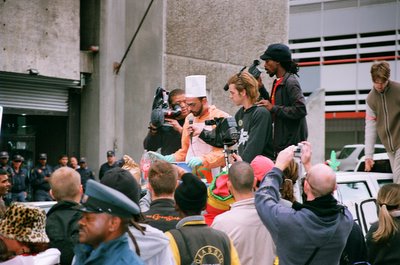 Peacefully Demonstrated outside the Department of Housing May 7 2005
- Plant a cannabis seed. Water and allow the plant to grow and produce seed. Plant and water these seeds. Your goal is to grow enough to build a house, you will need about 1 acre to build a 5 roomed home.
Tyala imbewu ntsangu (ye-cannabis). Nkcenkceshela imbewu uze uyinike ithuba lokuba ikhule ide ikhuphe eyayo imbewu. Uyothi ke uyityale nalembewu uyinkcenkceshele njalo. Injongo yakho kukukhulisa izityalo ezothi zonele ekwakheni indlu, uyakudinga i-acre (malunga nentsimi) enye ukuze wakhe indlu enamagumbi amahlanu.
Plant 'n hemp saad. Water en laat die plante om te groei en saad te produseer. Plant en water hierdie sade. Jou doel is om genoeg te groei om 'n huis bou, jy sal ongeveer een aker benodig om 'n 5-kamer huis te bou.
Sokutshala imbewu insangu njalo. Amanzi nokuvumela isitshalo ukuze zikhule futhi ukhiqize imbewu. Plant namanzi lezi zinhlamvu. Umgomo wakho iwukuba akhule ngokwanele ukwakha indlu, uzodinga 1 Acre ukwakha 5 roomed ekhaya.
- Consider the many relevant points presented in the guidelines of Build a house with hemp / Building with hemp.
Qwalasela yonke imigaqo oyibekelweyo kwincwadana i-Build a house with hemp / Building with hemp.
Oorweeg die baie relevante punte in die riglyne van die Build a house with hemp / Building with hemp.
Cabangela amaphuzu amaningi efanele evezwa neziqondiso of Yakha indlu nge insangu / Building nge insangu.


- Start planning where your house will stand. Consider everything about the environment you’ll be building in, like winter and summer sunshine, wind and rain – you don’t want to build on a floodplain, or your house will wash away. Be sure to plan all your water and waste requirements.
Ceba indawo ozokwakha kuyo indlu yakho. Qwalasela yonke into ngomhlaba lo uzokwakha kuwo indlu yakho, izinto ezinje ngemimoya, ilanga, neemvula zehlobo nobusika, akekho umntu ofuna ukwakha indlu yakhe emgxobhozweni okanye apho iyothi ibe lilifa lezikhukhula khona. Uqiniseke ukuba unamanzi akulungeleyo ukwenza oku.
Begin met die beplanning, waar jou huis sal staan. Oorweeg dit alles oor die omgewing en jy sal gebou in, soos winter en somer son, wind en reën - jy wil nie op 'n vloedvlakte bou nie, of jou huis sal wegspoel. Maak seker om te beplan al jou water en afval vereistes voldoen.
Qala uhlela kuphi indlu yakho eyokuma. Cabanga konke mayelana imvelo uyobe ngokwakha ku, efana ebusika kanye kwelanga ehlobo, umoya nemvula-ungafuni ukwakha ethile kwemfunda, noma indlu yakho iyoba basuse. Qiniseka ukuhlela konke amanzi kanye imfucuza izidingo zakho.
- Cut the grown cannabis plants down and leave in the field to rett for a week. The morning dew and natural rotting process will loosen the fibers from the plant.
a. Process the plant matter by cutting leaves and branches off, then hit small bundles the length of the plant over and upturned rake.
b. The long fiber parts that remain in your hand are good for weaving rugs and making various other items your skills can accomplish.
c. The seed can be gathered for more housing.
d. Gather the small woody bits (the hurd) that have fallen, this waste is what will be used in the construction material.
Sika / sarha izityalo uzibeke egadini ixesha elingangeveki ukuze zibole. Umbethe wasekuseni nezinye izinto zendalo ezibolisayo ziya kuyikhulula I-fibre ezityalweni.
a. Yikhawulezise ngohlukanisa intonga zezityalo namagqabi, uhlale uyiharika rhoqo.
b. Intonga ezi zinothi zincede kwezinye izinto ezifana nokwenza ingubo nezinye izinto onothi uzibonele zona ngokolwazi lwakho.
c. Imbewu inokuqokelelwe ukwakha ezinye izindlu.
d. Qokelela imithana ethe yaziwela njengokuba uzoyisebenzisa xa usakha indlu yakho.
Sny die gegroei hemp/cannabis plante af en in die veld verlaat om rhett vir 'n week. Die oggend-dou en die natuurlike verrotting proses sal die vesel van die plant los te maak.
a. Proses van die plantmateriaal deur te sny blare en takke af, dan is getref klein bundels die lengte van die plant oor en omgekeerde hark.
b. Die lang vesel dele wat in jou hand bly is goed vir die matte weef en die maak van verskeie ander items jou vaardighede kan bereik.
c. Die saad kan vir meer behuising ingesamel word.
d. Versamel die klein houtagtige bits (die hurd) wat gedaal het, die afval is wat sal in die konstruksie materiaal gebruik kan word.
Sika izitshalo insangu njalo. isikhule phansi endle ukuze rhett isonto lonke. Amazolo ekuseni inqubo lwemvelo ukubola kuzokwenza athambise imicu kulesi simila.
a. Ukucubungula udaba plant ukusika amaqabunga namagatsha ahambe ke hit izinyanda amancane ubude sitshalo phezu ne hala sokutakula.
b. I-long fibre izingxenye ezisele esandleni sakho kukhona okuhle ngokuba ihlanganisa omata kanye nokwenza ezinye izinto ezahlukahlukene amakhono akho kungaba afeze.
c. Imbewu kungenziwa babuthana izindlu xaxa.
d. Ubuthe izingcezu bok encane (i-hurd) ukuthi uwe, lokhu imfucuza okuzokusiza lisetshenziswe ukwaziswa yezokwakha
- Wash the hurd, dry it, then wash it again. Be careful not to allow the matter to rot or decay during this process, by turning, airing and allowing the African sun to dry the hurd properly. Now combine in proportions 10:2:3:3 combine the cannabis/ntsangu/dagga Hurd(10), washed river sand 0.5mm(2), hydraulic lime(3) and water(3) to make the mulch (This process may need tweaking depending on your geographic location, humidity, rainfall etc)
Hlamba ingqokelela yakho, uyomise, uphinde uyihlambe.Ulumkele ukuba lengqokelela ibole kwelithuba, yiguquguqule, uyivumele ibethwe ngumoya uvumele nelanga lase Afrika liyomise lengqokelela. Dibanisa ngokwalo mgaqo 10:2:3:3, dibanisa ke lemvuno yakho yomgquba wentsangu (10) kunye nesanti yasemlanjeni 0.5mm(2), ikalika (3) kunye namanzi (3) ukwenza udaka (Nale into ke iyokuthi ixhomekeke kwindawo leyo ukuyo nemvula zakhona njalo-njalo).
Was die kudde, droog dit af, dan was dit weer. Wees versigtig om nie toe te laat die aangeleentheid te verrot of verval gedurende hierdie proses, deur die draai, voorlê en laat die Afrika-son om droog die kudde goed. Nou kombineer in verhoudings 10:2:3:3 kombineer die cannabis / ntsangu / dagga Hurd (10), gewaste riviersand 0.5 mm (2), hidrouliese kalk (3) en water (3) aan die deklaag te maak (Hierdie proses kan tweaking nodig, afhangende van jou geografiese ligging, humiditeit, reën, ens)
Geza izinti, zome it ke geza futhi. Qaphela ukuba singavumeli udaba ukubola noma ukubola kulo msebenzi , ngokubhekisa , angabiki futhi sivumele ilanga Afrika ukuze ome le hurd kahle . Sebesebenzisa ngezabelo 10:2:3:3 hlanganisa insangu njalo. / ntsangu / insangu Hurd (10) , umfula wageza isihlabathi 0.5mm (2) , wokubacindezela umcako (3) kanye namanzi (3) ukwenza semboza ngabo izithombo zezihlahla (Le nqubo may badinga tweaking kuye ngokuthi indawo yokuhlala yakho, umswakama, imvula, njll)
- Now build your house! Ngoku ke yakha indlu yakho! Nou bou jou huis! Manje ukwakha indlu yakho!
- Teach others. Fundisa abanye. Onderrig ander.
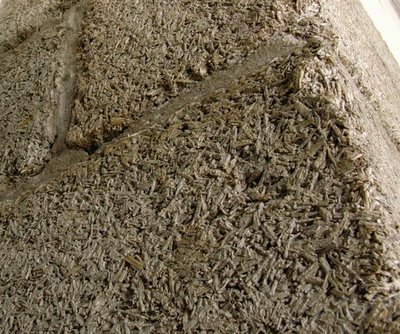
You can use this “dagga-cement” for making bricks, shutter casting or the proven “pole-and-dagga” method. This last method allows for a sturdy, warm, fireproof and water proof home – built with pride and intuitive engineering, not a ‘uniform box’.
Be sure to consider all aspects of your house design and structural requirements. Although the cannabis-cement will become stronger than steel in time, it is not advised to build over 2 floors high without considering structural implications. With planning this cement can be used to build up to 4 floors high.
The cannabis-cement will dry over a period of a month (depending on the weather). At this point you will be able to add the roof. Seal your home’s walls with lime; lime external walls annually. Decorate your house with masonry to make it unique, and paint with coloured lime as per custom.
Always PLANT A TREE in a place that will provide shade, to commemorate this accomplishment.
Council will plant trees if citizens care for them. Call (021) 689-8938 http://www.trees.org.za/
Assist your family, friends or neighbors with your experience and expertise. Share information and technique; you can uplift yourself and your community.

Friday, May 8, 2015
Hostels must fall, says housing minister
Lindiwe Sisulu wants to tear down South Africa’s notorious hostels – the scene of much of the xenophobic rioting in Joburg last month.
Indunas, the hostel leaders, have warned though that they won’t be part of anything that does not guarantee them proper houses – and they refuse to go into temporary shelters while the government breaks down existing hostels and builds new ones.
On Thursday, at a pre-budget vote, the human settlements minister said told MPs during her budget vote that hostels had to go because they had no place in a reconfigured state.
“Most of them (hostel residents) have spent a great deal of their time in cities. That they may have a holiday home in Mqanduli (in the Eastern Cape) doesn’t make them different from someone with a holiday home in Camps Bay who works in Brakpan,” she said.
Hostel residents would qualify either for a state-subsidised house, or community residential unit. It was time for South Africa to shed lingering legacy of apartheid and deal with the often atrocious living conditions in hostels: “They (hostels) are a very painful relic of our past... They (hostel residents) should live as part of society,” said Sisulu.
But in Alexandra’s Madala hostel, induna Bafowethu Sokhela said on Thursday ight: “What she’s saying has been said for years by many other politicians. Right now, they’re supposed to be developing the hostel as they said they would – but they’re doing nothing.”
He has lived in the hostel since the 1980s.
“The hostel has many people living in it. I don’t think they’ll have enough space to house us all. We won’t allow them to put us in temporary homes. We want houses just like other people in the country.”
Sokhela said the government must house every Madala hostel resident before it shut the place.
“They need to come in and get everyone’s information and move us into houses block by block if they have to. But they can’t close it till we have houses.”
The decision comes on the back of the refusal by residents of some Gauteng hostels to move into upgraded buildings, renovated from the apartheid-era single male accommodation into family units since 2009.
Following the upgrade, residents had to pay R750 a month.
Hostel residents complained they hadn’t been properly consulted and couldn’t afford the monthly rental.
Diepkloof, Soweto, hostel residents took to the streets to protest over housing on Monday.
This was the second protest by the hostel dwellers in Diepkloof following a protest in the area in June last year over lack of housing.
In Parliament, Sisulu said the government would like to “gradually abolish hostels in our towns, and hostel dwellers who have lived in our towns for a number of years would qualify for a Breaking New Ground house, or the CRU (community residential units) subsidy, depending on their specific circumstances”.
She said they had agreed with the mayors that upgraded hostels would be taken over by the Social Housing Regulatory Authority.
“This we will do in every town where we have upgraded hostels and hostel dwellers have not taken up residency.”
She said the government would accommodate hostel dwellers in temporary shelters while it put up permanent houses for them.
These social housing units would be given to young people under the age of 40 and who cannot afford to buy a house.
Sisulu said the recent raids on hostels in Jeppe and Alexandra in Joburg during xenophobic violence were not because they were targeting hostel dwellers.
The army and police raids at the hostels were a result of the violence emanating from those areas.
“We don’t associate them with evil,” she said.
The minister said there was no fixed date for the plan to complete the abolishment of hostels.
Surveys would be done on all the hostels throughout the country.
Subsequently, Gauteng Human Settlements MEC Jacob Mamabolo told The Star the survey had already been undertaken and would finalised by next Friday.
DA MP Makashule Gana said houses built for hostel dwellers in Diepkloof and Mzimhlophe in Soweto were still empty after more than 10 years.
The national Department of Human Settlements is shifting its focus to mega-projects in order to tackle the country’s 1.5 million-unit housing backlog.
About 150 project applications have been received from the public and private sectors.
These would be processed to get under way over the next four years.
Sisulu said 60 percent of work would be done by youth brigades, funded by a ringfenced R159m, in an effort to transfer skills and create employment opportunities for young people.
However, the Human Settlements Department is also undertaking a review of its tender processes, described as its “biggest headache”, to prevent corruption and fraud.
A new procurement system should prevent abuse.
- Political Bureau and The Star
Thursday, May 7, 2015
Foreigners here legally need housing too – Sisulu
Cape Town – If South Africa is to heal itself of the long-term effects of xenophobia, it must find a way to ensure that those who are in the country legally have somewhere to live.
Housing Minister Lindiwe Sisulu made the comment on Thursday at a news conference at Parliament before her budget speech and debate in the National Assembly.
She reiterated the promise that she made last year regarding the housing backlog – to build 1.5 million houses and to provide housing opportunities.
When the department counted the housing backlog, it counted South Africans, said Sisulu.
“It has become obvious with the unfortunate xenophobic outbreak that there are many people who need housing of all kinds.
“And if we are to heal over the long-term, we need to find a way to ensure that those people who are here legally have a place to live – either in rented accommodation or community housing units – because there is a tendency to buy houses from our beneficiaries. We must look further than last year, and try to find a measurable way to count our backlog.”
Sisulu called on people to look after their houses, because they were assets. The value of a low-cost house built by the state is currently R160 000.
The government was also committed to eradicating hostels – a remnant of the apartheid system.
“Those who have lived in hostels for several years will qualify for state housing or a subsidy for community dwelling, depending on their specific requirements,” said Sisulu.
- NEWS24
Thursday, April 23, 2015
Backyarders mark ‘their plots’ in Philippi
Cape Town - Backyarders from various townships marked plots on an open piece of land in Philippi on Wednesday, saying they were tired of waiting for housing.
The group used sticks, pangas and pegs to mark off pieces of land where they plan to erect structures near the Joe Gqabi transport terminus off Stock Road.
The residents were from Langa, Gugulethu, Samora Machel and Site C, and received help from community leaders.
One of the leaders, Joseph Makeleni, said they would continue to assist residents who wanted to invade open land.
“Law Enforcement and police came to remove us, but we were peaceful and some of the people left and others stayed.
“People have been waiting for housing for a long time, they are on the database for a long time and nothing is happening.”
Makeleni said they would continue to take land as a way to make the city notice them and their need for housing and proper service delivery.
“We feel rejected by the government and we will provoke them until they give us services.
“It is the only way to get their attention, by taking over the land that they boast about but don’t use.”
Makeleni said most of the privately owned land belonged to “rich white businessmen”, which was unfair.
Charmaine Mkoni, a community leader from the Marikana informal settlement, said they were forced to fight for themselves as their elected councillors were not doing much about their lack of housing and service delivery.
“We are planning on sleeping here because people are entitled to have spaces and housing.
“We will help each other to put up shacks and stay here,” Mkoni said.
City Law Enforcement spokesman Neil Arendse said they responded to the invasion but it was quiet and no serious incidents were reported.
Arendse said they remained in the area and officers were also focusing on other land invasion hotspots.
“Even though some of the land is privately owned, at some point it becomes a city problem. When the owner doesn’t do anything about it (invaders), the city has to step in,” Arendse said.
yolisa.tswanya@inl.co.za
- Cape Argus
Tuesday, April 21, 2015
Humble locations with exotic names
Cape Town - Ever wondered how exotic locations such as Barcelona, France and Taiwan became the names of local informal settlements?
Residents offered some explanation about the names last week, pointing out that conditions in them did not quite match the famous names.
Barcelona informal settlement in Gugulethu was named after the Spanish city because some residents wanted to draw international attention to the plight of the people in the area situated adjacent to the N2, said resident Mongami Mbili.
“It was around 1993 when I arrived here and there were several shacks, not many of them. This place was occupied by people who were mostly backyard dwellers from various areas, and some who were living with their parents and looking for their own place,” said Mbili.
A stone’s throw from Barcelona is the Europe informal settlement in Nyanga. Resident Thanduxolo Temba said the name simply surfaced - then it stuck.
“Europe has existed since 1992. It was formed by people who were mainly from the township area called Lusaka. This place was a dumping site, and people cleaned it up and erected their structures. Committees were then formed. It has grown fast over the years,” said Temba.
In Khayelitsha, France informal settlement was named after residents from Site B were given the go-ahead to occupy the open ground near OR Tambo Hall in 1997.
“People were told they could build on the land the same weekend Bafana Bafana qualified for the World Cup in France for the first time. There was a national campaign Siyaya eFrance (We are going to France).
“Residents were overjoyed and decided to name this place as a reminder of that moment,” said Sithembele Nongauza.
He said residents were promised development, but 18 years down the line the place is still the same.
The city also has its own Marikana, which is situated in Philippi. Marikana was informally named after the Rustenburg township where striking miners were killed during a clash with police almost three years ago.
“There were few shacks in that land before people from various places came and occupied it. Most of the people who stay here were backyarders,” said community leader Xolani Joja. He said it was named Marikana because residents were evicted many times and their building material taken away.
“We clashed with the police. They used rubber bullets, tear gas and stun grenades, but we never backed down. We kept fighting until the end. Now this place belongs to the people. This place is home to many people,” Joja said.
About a kilometre from France, backyarders from TR Section and Site C in Khayelitsha illegally occupied land and named it Azania.
Their occupation did not last long as the land owner, arms manufacturer Denel, obtained an eviction court order.
Xolani Jack, a former TR resident, said:
“I named the place Azania and other residents liked the name. We named it after Azania because this is our country. We are the people of Azania.”
Adjacent to Mitchells Plain is the Siqalo informal settlement, which is home to more than 1 200 families.
The settlement, on private land, has existed for less than five years.
“Siqalo means beginning. This place was a forest and people used to dump here.
“There were a few people from Tafelsig in Mitchells Plain living here too. People who were backyard dwellers could no longer afford rent and identified this land.
“It was named by residents. This land is not suitable for us to live on, but we have nowhere else to go,” said resident Sinazo Tempele.
siyavuya.mzantsi@inl.co.za
- Cape Times
Sunday, April 19, 2015
Five dead, scores displaced by fires
Cape Town - Five people were killed in three separate fires in the Cape Peninsula on Sunday morning, the City of Cape Town Fire Service said.
“Just before 3am this [Sunday] morning the City’s Fire and Rescue Service responded to an informal settlement fire, Salamander Road Command, Hout Bay,” said spokesman Theo Layne.
A man, a woman, and two minors were killed in the blaze which swept through the informal settlement, destroying 30 shacks.
Approximately 120 people were left displaced.
Police were on scene to investigate the cause of the fire.
An hour later, a man was killed when one shack was razed to the ground in Solomon street, Mfuleni.
Earlier on Sunday morning, 25 people were left displaced when seven shacks were destroyed during a fire at the Village Heights informal settlement in Lavender Hill.
- ANA
Monday, April 13, 2015
No case yet on gang building protection
Cape Town - Police say “information from ground level” about protection money being paid to the Hard Livings gang by city-contracted construction companies refurbishing flats in Manenberg is not enough to warrant an investigation.
On Sunday, Jeremy Vearey, head of Operation Combat, a police operation targeting gangsterism in the province, said he had been notified of the situation in Manenberg, but needed a statement under oath to officially investigate.
“We received information from ground level which indicated these activities were taking place, but information is information. We need a statement under oath to form the basis of a case docket and then we can investigate,” Vearey said.
Vearey mentioned a report published on Sunday in the Weekend Argus, the Cape Times’s sister newspaper, that revealed an e-mail from safety and security mayoral committee member JP Smith to other city officials, dated December 12, had been leaked.
Smith confirmed this on Sunday. He said he had been made aware of the allegations in December last year.
“In the e-mail, I basically said that all the information we have needs to go to the SAPS because it is a criminal offence in terms of the Prevention of Organised Crime Act and must be criminally prosecuted.
“I made it clear that the dossier be handed over and the complaint made to a senior police officer,” Smith said.
Vearey said: “We have not seen or received any dossier yet.”
Smith said he would be meeting with the city’s human settlements department and the construction companies this week.
“Either we will hire city law enforcement as security or we will select a panel of security companies and choose one to work there,” he said.
Mayco member for human settlements Benedicta van Minnen said the city was investigating two construction companies.
“Initially there was H & I Construction, and now there is Good Hope Construction. We are busy with our investigation and will be meeting again this week to discuss the way forward. The refurbishments will continue this week and we are on track to finish in June,” she said.
Good Hope Construction chief executive Raziek Rajah denied that his company was being investigated.
“It must be made clear that according to the city, we are not under investigation. They have made contact to confirm this.”
Rajah refused to be drawn on whether his workers were asked to pay gangsters protection money.
Attempts to reach H & I Construction for comment proved fruitless.
carlo.petersen@inl.co.za
- Cape Times
Church set alight during protest
Cape Town - A church was set alight during a violent protest in Kalkfontein, near Kuils River, on Sunday evening, Western Cape police said.
“It’s confirmed that the church has been set alight. Apparently it appears it was set alight by protesters,” said police spokesman Colonel Thembinkosi Kinana.
“As I understand it, it’s a continuation of the land invasion protests that were going on the weekend,” he said.
No injuries were reported.
“No arrests have been made so far. The investigation is still ongoing,” said Kinana.
Kinana could not confirm whether the protests were linked to similar protests late in March when a council home rented by a law enforcement officer was petrol-bombed, allegedly by a group of people evicted from land they illegally occupied.
Members of the public order policing unit would remain on the scene, Kinana said.
Since March, the area has seen an invasion to occupy a stretch of land belonging to the city council.
- ANA
Wednesday, April 8, 2015
Land invaders in face-off with cops
Cape Town - The loud bangs of stun grenades filled the air signalling the start of evictions outside the Nolungile train station in Khayelitsha on Wednesday morning.
While squatters threatened to stand their ground, waving tools they had used to erect 20 structures on the private property on Monday, they were quickly dispersed by a large police contingent.
Led by members of the Economic Freedom Fighters (EFF), squatters said they had taken over the land because of overcrowding in the township’s Site C.
Major Mali, who built a shack on Monday, said the land had been vacant since 1985.
Police arrived on Wednesday morning brandishing what appeared to be an eviction notice. There was resistance from the protesters, many waving crowbars, spades, sticks and pangas as they shouted for the police to leave.
While some of the shacks had been completed, many were nothing but skeletal wooden frames jutting from the pockmarked earth in between tufts of yellow grass.

When police moved to dismantle the structures they acted swiftly, firing rubber bullets at a group of people camped in the bushes with rocks in their hands.
Protesters at first stood their ground, but the first of two stun grenades sent them screaming towards the property’s boundary line with the township.
Within 20 minutes the shacks had been brought down, demolition crews pulling them apart and hammering at the tinder buried in the ground.
Residents watched from the train station. But as the last structure fell, their interest waned and the enthusiastic crowd began to thin.
However, some minutes later a band of protesters set tyres, rubbish and debris alight on a road nearby.
The City of Cape Town has outlined plans to clamp down on any land invaders attempting to occupy the vacant field in Khayelitsha.
Mayoral committee member for safety and security JP Smith vowed to take action against illegal occupants who erected shacks on privately owned land in the TR section on Tuesday morning.
“We will be laying charges against anyone who can be identified putting up shacks on the privately owned land. They have been warned about this on Monday,” said Smith.
He added that the land invasions weredrawing much-needed police resources away from gang flashpoints. “We had two very violent gang flare-ups in Manenberg and Ottery. There was machine gun fire. This land grab pulled resources away from that.”
Pockets of land across the city have been under threat from members of the EFF and Ses’khona People’s Rights Movement over the past two days. EFF Western Cape leader Nazir Paulsen said they supported residents’ invasion of the land.
“The EFF supports the residents as they deserve this land to build bigger housing. There is nothing wrong with what we are doing. The city can contact my lawyers if they have a problem,” said Paulsen
The DA condemned criminal acts of land invasion by the EFF and welcomed any charges against Paulsen. “As the ringleader of the EFF action and member of the Western Cape Parliament, Nazir Paulsen has encouraged and facilitated criminal conduct.
“The DA welcomes the City of Cape Town laying criminal charges against Nazir Paulsen, and urges the SAPS to investigate…”
Sunday, March 29, 2015
City Housing chaos erupts as protesters loot stalls
A mob of protesters who charged through Cape Town city centre yesterday mugged a bystander, looted vendors' stalls and vandalised property.
Hundreds of members of Ses'Khona, known as the "poo protesters", marched to the Western Cape legislature to demand that grievances about a lack of housing delivery be heard.
Ses'Khona leader Andile Lili urged the crowd to mobilise in townships and return to the city centre with 300000 people.
In St George's Mall, a man who had bought coffee was caught up in the melee and assaulted by a man believed to be a protester.
The attack was seen by The Times photographer Esa Alexander. "When the protesters came, the man with the coffee tried to run away. They got hold of him and pulled at his bag," he said.
"The man fought back and when one of the attackers pulled his bag out of his hand the victim fell to the ground. The thief ran into the crowd before the guy could get back up. It was chaos."
The protesters looted informal traders and took iron rods from stalls. They attacked bystanders, but dispersed when they were chased by police.
Police Captain FC van Wyk said one man had been arrested for possession of stolen goods from a vendor.
"We urge people to come forward with information," he said.
- Timelive
Friday, March 13, 2015
The RDP houses for sale scandal
Cape Town - Subsidy houses, formerly known as RDP houses, are being sold illegally for cash on classified sites such as OLX or Gumtree, leaving the beneficiaries to return to informal settlements or the street.
Often the properties are sold below market value with no guarantee that the buyers will get the title deed they need to be the legal owners.
While formal statistics are scant, the Western Cape’s human settlements department says the illegal sale of RDP housing is widespread, and difficult to prevent.
In Dunoon, for example, only four out of 10 RDP houses are occupied by the original beneficiaries.
The national Department of Human Settlements said it was illegal for the recipient of an RDP house, now known as a Breaking New Ground house, to sell it before having lived in the structure for at least eight years.
“We are of the view that RDP houses must never be sold,” said ministerial spokesman Ndivhuwo Mabaya. “They must be improved and handed over from generation to generation. Our research is that these houses are sold to satisfy short-term interest and for financial relief. This is a problem, as the (seller) either returns to informal settlements or becomes a street citizen.”
During the eight years the beneficiary may only sell the property back to the provincial human settlements department.
Most of the time the house is sold at a price that covers the debt owed, not a price that reflects the full value of the property.
The national department said subsequent buyers usually would not qualify for state housing subsidies.
Mabaya said many of the property sales were illegal, with the sellers returning to informal settlements to “instigate protests and violence at times against the people they have sold houses to”.
They were being sold to “anyone who has money”.
The Cape Argus contacted someone who was advertising several RDP properties on OLX. In WhatsApp correspondence about the advertised property, he insisted the transaction had to be cash only. Subsidies would not be accepted.
A quick search on other online classified websites showed he was selling several properties, ranging from R100 000 to almost R200 000. In some cases he specified that the houses were more than 10 years old.
Bonginkosi Madikizela, Western Cape MEC for Human Settlements, said the resale of subsidy houses was almost impossible to prevent.
“We can have as many laws as we want but this is difficult to prevent. We are giving houses to people who have nothing to put on the table. A house is not a substitute for a job. That is why people end up selling or renting their house.”
Madikizela said the eight-year restriction, or pre-emptive clause, was forcing people to sell their houses illegally or informally. This often meant the new buyers would not get title deeds or proper transfer of the property. Sales on the informal market were “impossible to police”.
In response to a parliamentary question last August, Human Settlements Minister Lindiwe Sisulu said there were no protocols to track the unlawful sale of subsidised houses. However, there was a record of cases reported to the respective provincial housing departments where the eight-year restriction had been waived.
Sisulu said the Western Cape government waived the eight-year pre-emptive right for 151 houses in the 2011-12 financial year, allowing the house to be sold after the beneficiary had lived there for two years.
In 2012-13, 389 houses were sold after only two years – 112 in the Eastern Cape, two in Limpopo and 275 in the Western Cape. The number increased to 2 852 in 2013-14, with most in the Eastern Cape. The Western Cape allowed for the sale of 154 houses after two years during this period.
Sisulu said the Eastern Cape provincial housing department reported the illegal sale of 112 houses in 2012, and 2 697 the following year.
Madikizela said the problem was widespread in the Western Cape. A recent study in Thembalethu, George revealed that out of 10 RDP houses, only one occupant was the original beneficiary. A study in Dunoon revealed only 40 percent of the RDP tenants were the original beneficiaries.
Many of the houses were being used as spaza shops.
Sisulu said in August last year the national department would conduct an occupancy audit of government houses.
“We have started auditing our waiting list in order to create the demand database to strengthen our allocation policies, to ensure that those who have benefited do not move to another municipality and benefit again,” said Mabaya.
An education campaign is to be launched next month, cautioning beneficiaries about the risks of selling their houses.
Mayoral committee member for human settlements Benedicta Van Minnen said the city dedicated “significant resources” to educating beneficiaries in financial management, basic legal advice, general home maintenance and repairs, and establishing food gardens to increase food security.
R165 000 cash, and three days later house is yours
At least seven RDP houses are listed “For Sale” on popular online advertising websites.
On Thursday a Cape Argus reporter, posing as a potential home buyer, met a man claiming to be a property developer who promised to have “the perfect house to sell”.
The man works for a company which advertises property on OLX and Gumtree.
He said he had properties in Khayelitsha, Eerste River, two in Happy Valley in Blackheath, two in Wesbank and one in Kuils River. The houses in Khayelitsha, Eerste River, Wesbank and Blackheath were RDP houses.
In an arranged house viewing visit to the house in Happy Valley, which was listed on sale for R165 000 cash, he warned about the condition of the house. “It’s not an ideal house unless you are looking into developing it and selling it later or renting it out.”
He attempted to persuade us to view the house in Eerste River, which he said was worth R400 000. “We are selling it for R200 000,” he quickly assured us.
The house in Happy Valley was semi-attached with barbed-wire fencing and two big trees in the front.
He told us: “I am a property developer. Normally a client approaches us to develop and then sell the property. But this particular client did not have money to develop the house – she just wants to sell it.”
He said the owner had a title deed and the company had received a document from the Human Settlements Department approving the sale of the house.
After viewing the house from the outside, we found that the home owner was in. The woman, who appeared to be in her fifties, said she was no longer living in the house and was renting it out.
She said she was tired of living in the area and wanted to get rid of it.
The house had one bedroom. It was empty inside except for a council rubbish bin. The ceiling needed a touch-up and the house needed repainting.
The owner left us with agent and did not take part in our talks. “The house is R165 000 – cash not subsidy,” he said. “That amount includes our transfer fees and client fees. Our lawyer takes care of the transfer.”
Once the amount was deposited into their account, the lawyer began processing the sale. “Our client moves out immediately the money is in her account and we give you a proof of transfer while the council is still processing it.
“Our lawyers and the department work very fast, it could be up to three days – but the council delays the process.”
He assured us that this was not the first time he had sold a house.
“If you guys sort your finances out I assure you, you can have the house, no hassles.”
anel.lewis@inl.co.za
- Cape Argus
Subscribe to:
Posts (Atom)