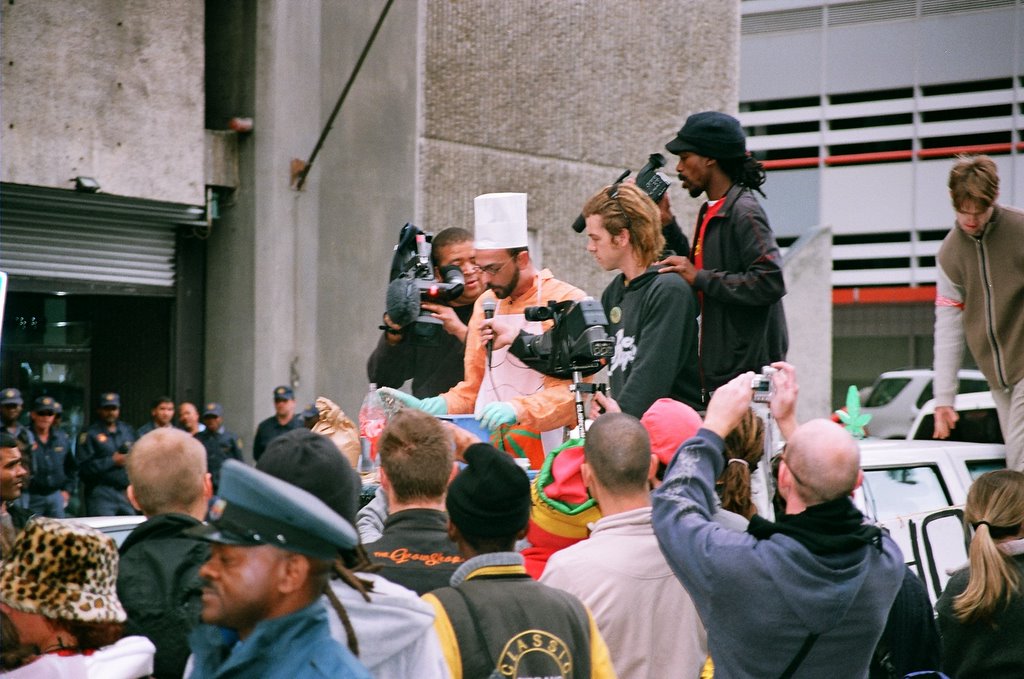
In the recent period mass protest by the poor – closing roads with burning tyres and throwing excrement from the bucket-system onto the streets -- has erupted through the townships of Cape Town: in Gugulethu, Khayelitsha, Happy Valley and elsewhere. Most recently protest has taken place in Ocean View, but more could erupt in other areas. There have been similar protests in the Free State, in Durban, in Port Elizabeth…. and in other provinces. People are fed up at the failure of the ANC government, nationally, in the province, in the city, to deliver. A young woman with a baby strapped to her back in Happy Valley, Blackheath, said it all on TV: the government makes ‘empty promises’. ‘We still live like pigs’ she said
In Khayelitsha, residents of SST area in Town Two marched on the magistrate ’s court bearing hand-written placards, ‘We cry for homes’. Scandalously, these protests have been met by the government with police bullets, arrests, and charges. Instead it is the government that should be charged – with non-delivery of needed services and housing.
In the Western Cape (and nationally) the ‘real estate’ business is booming. Houses are changing hands for millions of rands in Constantia, Camps Bay and Clifton. Prices of houses in the ex-white suburbs have already increased by some 25% in 2005 following on similar increases in 2004. Banks and estate agents are reaping rich profits from this boom in housing.
The black elite is participating in this ‘get rich quick’ rat-race. Last year the municipality sold 14 hectares of prime beachfront land at Big Bay to ‘black empowerment’ millionaire Tokyo Sekwale for R115 million, the lowest price of the three tenderers. This year mayor Nomaindia Mfeketo was forced to cancel sales of land in Big Bay to ‘black empowerment beneficiaries’ because there was no tender process. Seventeen companies bought land below the market price and some had already been put on the market for double what was paid the city for it. (Weekend Argus, 22/1/05) But now the tender process has been launched again, and no doubt the same people will get the land.
At the same time there is an acute housing crisis in the Western Cape for working people. There is an estimated shortage of 360,000 house – yet last year a mere 14, 542 new houses were built by the provincial government, and this year Housing MEC Marius Fransman has promised to build only16, 000. (Cape Times, 22/4/05)
On Tuesday night 24 May, after the protests, ANC MEC Mcebisi Skwatsha told residents in Guguletu that government would not be pressurised in its housing delivery programme. “The problem... is indicative of need to be patient. We can't promise houses in three months because of pressure that there will be violence.”
At the rate the provincial government is building this means some people would have to be “patient” for more than twenty years! That is how long it would take to clear the current backlog – by which time the population will have increased and much more housing will be needed! In metropolitan Cape Town the official housing backlog is 261,000. There are estimated to be 84,000 to 143,000 people living in shack settlements. Between 1994 and 2001 only 47,000 new houses were provided in the metropolitan area. (Business Day, 19/7/01; Cape Times, 15/2/05). In the 2003-4 financial year only 60% of the city’s capital budget was spent. Moreover a mere 4000 ‘housing opportunities’ were created, and only 342 new houses were built (the rest of the ‘opportunities’ were hostel conversions, site developments and transfers) ( Cape Times, 7/3/05). At this rate it would take the city some sixty five years to clear the current backlog….!!
This is like trying to clear a desert with a teaspoon. The Freedom Charter says “There shall be houses, security and comfort.” Section 26 of the constitution entrenches everyone’s right to adequate housing. The October 2000 ‘Grootboom’ decision of the Constitutional Court placed the responsibility on government to carry out the social right of housing. We elected the ANC to implement these demands of ours. Yet Western Cape ANC premier Rasool says that “illegal actions” cannot be condoned: “we will not be held hostage to burning barricades and illegal marches.” (Cape Times, 24/5/05) Instead, the ANC expects us to be patient for up to sixty-five years and wait for housing!
Rasool echoed President Mbeki’s state of the nation address this year, who claimed that the country had only limited resources and that “illegal violent demonstrations will not produce those resources.” (Business Day, 15/2/05) This is from a government that has drastically cut the resources at its disposal by reducing tax on companies, and by insisting on small budget deficits. Now Marius Fransman, MEC for Housing, says that the protestors are trying to stir up trouble before the local elections! There is some ‘third force’ operating, it is said – and the National Intelligence Agency is brought in to investigate. This attempt to criminalise protest is reminiscent of the apartheid government. In reality the only ‘force’ operating is the anger of people who remain deprived of their needs.
1. Housing is a basic need and a human right
Everyone needs housing, first and foremost for shelter, for physical protection from the elements. Together with that, people need housing to have privacy -- private space, for sleeping, for washing, for cooking, for children to find security in, for leisure.
Decent housing also requires a supply of clean water and the sanitary collection and disposal of garbage and sewerage. The fact that the ‘bucket’ system of sewerage disposal continues to exist in Cape Town’s townships, as in New Rest in Gugulethu and the SST section of Khayelitsha is a disgrace. Housing also requires accessibility to roads, shops, schools, clinics, recreational facilities, etc Without some form of shelter, workers would not survive for capitalism to employ. At the same time capitalism produces only to make a profit – and building housing for workers is not profitable.
The record of the banks
The fundamental reason for the shortage of housing in our society – is that the banks do not find it profitable to build or finance houses for working people. Under apartheid blacks were not permitted to own property in the towns. In the late 1980s, as apartheid crumbled, there was a burst of lending by banks to provide bonds for low-cost housing, in the range R25-65000 – which only a quarter of township dwellers could afford anyway. These houses were mostly of very poor quality.
This lending by banks came to an abrupt stop in 1991 as banks realized that they would not make profits from it. Initially bond-holders launched a boycott complaining against poorly built houses. Later, under the impact of the ANC’s neo-liberal GEAR policy, many bondholders were sacked from their jobs. Together with higher interest rates, this meant that more and more bondholders fell into arrears. Because of this the banks ‘red-lined’ – refused to grant any more loans to – black tonships. In addition, they began to evict those in arrears from their homes.
The banks make huge profits from their clients. Recently Barclays has paid R33 billion for a big stake in ABSA. As the press reports, this represents “a huge vote of confidence in the likelihood that the government will continue to allow the country’s four major banks – ABSA, Standard Bank, First National Bank and Nedcor – to enjoy a rate of profit that is consistently higher than that of major banks in most other parts of the world.” (Our emphasis) International banking experts apparently refer to South Africa’s banking sector as “Treasure Island” (Business Report 16/5/05)
A woman in Mandalay, Khayelitsha, bought in 1993 a house valued at R65, 000, and had by February 2005 paid more than R200,000 to ABSA bank for it. But ABSA told her she still owed R103, 000. That is, she would have to pay nearly six times the initial value of the house in order to own it! Instead ABSA sold the house over the woman’s head, and the agent for the new buyer has been trying to evict her.
Many such stories could be told about the cruelty of the banks, in evicting pensioners and the disabled from their homes because they cannot afford to pay what the banks demand.
Also it has been reported that banks illegally pocket the profits on the sales of repossessed properties, rather than using them to pay off the outstanding debts of homeowners. Banks are supposed by law to credit any profit to the borrower’s account. (Business Day, 2/1/04)
Together with all this, the record of the banks in providing low-cost housing has been abysmal. In May 2004 it was reported that Rand Merchant Bank allied with other companies intended to build 1500 houses in Khayelitsha in the R75, 000 to R150,000 bracket. (Cape Times, 7/5/04) Only a tiny minority of the black middle class could afford such houses, but the banks dig in their heels against providing anything else. The government drafted a Community Reinvestment Act, supposedly to compel banks to lend in the low-income housing market. But now, under the pressure of the banks, it has been withdrawn.
The banks have ‘promised’ to voluntarily commit money to the low-cost housing market. This is likely to prove another empty promise. Because of the record of the banks, the state is required to fill the vacuum. But what is the record of the state?
The record of the state
The 1994 RDP promised housing for all by 2003! The government promised to build 1 million houses in 5 years, but to do that has taken ten years. The present housing backlog, which was 1,5 million houses in 1994, has been estimated as high as 3 million units. Even an official agency estimates the backlog as 2,4 million houses.
Thus, after more than ten years of ANC government, about a quarter of the population are still without decent homes and live in shacks, backyards, in overcrowded houses or on the streets. Many of the houses that have been provided have serious defects, and they are mostly too small. Now we are told to be ‘patient’ and wait for perhaps another twenty or more years!
The national housing budget was R5, 191, 712,000 in 2005/6. This represents only 1,43% of government spending – and this has been the same or less throughout the last ten years. But the norm for the housing budget of a developing country is 5%. (Business Day, 19/7/01) The government is spending on costly weapons – and is being stingy in spending on housing.
For comfortable homes we need water, toilet facilities, and electricity. 13,5 million people still do not have on-site access to adequate water, and more do not have access to adequate toilet facilities. The government is giving some free water and electricity. But the 6 kl a month of free water is only enough for one bath and six toilet flushes a day. It lasts for only a week, or else there is no water for drinking, washing, or washing clothes. Rich white households use 30 times more than we use in the townships.
Water and electricity charges eat into the money we scrape together to live on. In the last ten years 1 million people have had their water cut off each year, and similar numbers have had their electricity cut off because they could not afford to pay.
Servcon: the banks, government and evictions
The government and the banks jointly established SERVCON to deal with the problems of bond-holders in arrears. From 1998 SERVCON administered a portfolio of 33, 384 houses nation-wide – 22,230 in Gauteng and 3964 in the Western Cape.
The August 2003 SERVCON report admits that “The overwhelming cause of the original default was economic. The main cause was loss of job through retrenchment/redundancy … Our current experience is that the majority of Servcon’s clients face economic hardship.”
Yet SERVCON has become notorious for its harsh eviction methods. Its August 2003 report itself admits “It is necessary to virtually run a military style operation (our emphasis) in order to succeed. Improved co-operation between the various role players (attorney, sheriff, police and security guards) has resulted in the success rate increasing to +/- 78%. The position is deteriorating on a monthly basis at present though.”
Residents of Mandela Park, together with those in Ikwezi Park, Elitha Park and Mandalay have particularly suffered from these evictions. It was on this basis that the Mandela Park Anti-Eviction Campaign was launched in 2001 and broadened into the Khayelitsha Anti-Eviction Campaign. The Western Cape Anti-Eviction Campaign was formed to unite these areas with those opposing evictions from municipal housing of those who could not afford to pay rates and service charges.
Evictions continue
Evictions continue this year – at least one in Ikwezi Park and five in Mandalay. The main culprit is ABSA bank. It is said that 60 more Mandalay families are to be evicted.
One old couple, the husband aged 74 and the wife aged 69, were evicted, but the community returned them to their homes. Another pensioner was also evicted, but was returned. Mr Pitole, a taxi-driver, and his family were evicted. When they were returned, his wife was arrested and released with a court order forbidding her to enter her home. Their furniture and belongings remain in the house: the estate agents refuse to return them. A 24 year old woman has been arrested for ‘trespassing’ in her mother’s home!
A family evicted in Ikwezi Park have won their home back as the prospective new owner, seeing the anger of the community, decided not to buy it. The mother of the family said they were saved by the ‘power of the people’. People need to organize to stop these evictions taking place on the orders of the banks. The government needs to legislate to prevent the banks from evicting poor people, pensioners, and so on from their homes.
2. The N2 Gateway project
The R2, 2 billion N2 Gateway project was conceived in September 2004 as the Western Cape’s ‘flagship’ housing project’ by the national housing department. Various reports say it is to build 7,200 houses, or 20,000 houses (Sunday Times, 12/9/04) In addition to housing subsidies, national government is reportedly providing R2,3 billion for this project. Cape Town city council is responsible for its implementation.
It is reported to be the first of 18 projects countrywide, two per province, under the new Sustainable Human Settlement Plan. (Mail and Guardian, 6-12/5/05) The areas targeted for development include the Joe Slovo shack settlement in Langa, and the areas of Barcelona, Kanana, Lotus Canal, Europe, New Rest and Bunga. It will also include 4000 houses to be built in District Six. (Cape Times, 15/2/05)
The major aim of this project however is not to house people but to ‘clean up’ the shack settlements along the N2 approach to Cape Town prior to hosting the football World Cup in 2010. Unprecedented measures led to its approval being rushed through by provincial and municipal government by February 2005.
The fire in January in the Joe Slovo shack settlement in Langa proved a boost to the N2 Gateway project. The victims were forbidden to rebuild their shacks and instead housed in tents. It was announced that they would be the priority beneficiaries of the N2 Gateway – since the fire cleared an area on which building could commence without having to (forcibly) remove people. The first tender of R60 million for 700 houses for the Joe Slovo fire victims was awarded in February to the Sombambisana consortium whose members include Asla Devco, Asla Magwebu, Citrine, Khayalethu Projects, Power Developments and the Khayelitsha Community Based Development Company. (KCBDC). (Business Day, 15/2/2005; Cape Times , 15/2/05)
Slow delivery creates divisions
This priority treatment accorded to the victims of the Joe Slovo fire meant the surfacing of all sorts of resentments of those who had been on the waiting lists for years. There are reported to be about 150,000 families on 21 different waiting lists for state-subsidised housing in Cape Town, many of whom have been on the list for more than ten years. (Cape Times, 7/3/05) But this must be an under-estimate. Another report says there are 60,000 families on the waiting list in Gugulethu alone (Cape Times, 23/5/05)
The ANC claimed that it was coloureds who opposed priority treatment for the African Joe Slovo fire victims, and pointed to the occupation of the Spes Bona hostel (earmarked as temporary accommodation for the fire victims) by coloured residents of Bokmakierie.
In the 1980s Bokmakierie was a UDF stronghold – but the solidarity which then existed between Africans and coloureds in the area is now being eroded by the shortage of housing.
But African residents of Langa have been just as angry. In February, “Mayor Nomaindia Mfeketo… was confronted by an angry woman questioning why Joe Slovo residents were benefiting from the N2 Gateway project while backyard squatters in the township [Langa] were getting no relief… “ ‘People from Joe Slovo only arrived recently in Cape Town’ [she said].
“ ‘Every year their shacks burn down, now look, they’re even being given houses by the government.
“ ‘I know we’re all black and we shouldn’t be fighting among ourselves but look at me I’m a 40-year old with three kids but I’m still living with my mother in her four-roomed house.’” (Cape Times, 14/2/05)
Siphiwo Thindleni, spokesperson of the Coalition for Langa Community Concerns, said in May that “their main concern as residents from Langa was that the government have given Eastern Cape migrants priority.” (Cape Times, 23/5/05) The crisis in housing causes potential divisions among the poor, in the competition for scarce resources. Instead of that we need to unite in a single struggle to compel the government to change its policies and implement a mass crash housing programme.
We need to beware of political opportunists who use housing shortages to stoke the fires of racial and ethnic conflict. No turning of our housing needs into a political football!
Let us remember the example of the United Democratic Front in the 1980s, which was able to unite working class communities in the struggle for housing. The range of protest – described below – is a good beginning for this struggle.
What sort of housing?
An artist’s impression of the N2 Gateway, according to a reporter in the Cape Argus (19/2/05) “shows attractive two-, three-, and four-storey houses built around central courtyards with landscaped streets and plenty of public spaces.”
But according to a confidential draft document obtained by the Mail and Guardian in May (6-12/5/05) “three people per bedsit and six to a one-bedroom flat is what Cape Town city officials are proposing as the standard” for the N2 Gateway housing! They will form two thirds of the housing stock. The only three bedroom units will be in Delft – 35 km from the city center!
In February Saths Moodley, special adviser to Housing Minister Lindiwe Sisulu, said: “Everyone will be taken care of – those living in existing townships and the backyarders… People can own them or rent them and there will be options like straightforward rental or rent-to-own.” Those who “could not afford to pay would be assisted with government housing subsidies.”
But the Cape Town city council document states that 70% of the accommodation will be rentals – and only 30% ownership. If one option – say ownership, is oversubscribed, “preference will be given to the length of time lived in an informal settlement or backyard and family size” – or else there will be a lottery! Here are more measures which can fuel competition over housing allocation.
The apartheid-era blocks of flats (‘courts’) dotted across the Cape Flats, from Lavender Hill to Elsies River to Hanover Park and Mannenberg, at least provided two bedrooms as a norm. Now the ANC wants to cram six people into one bedroom!!
“Where’s the improvement? It will only look better [than the shacks] from the highway” Ted Baumann, programme officer of the Urban Resource Centre, was reported as saying.
Even the national department of housing is not satisfied. “It’s nothing better than a hostel” said their spokesperson Thabang Chiloane. (Mail and Guardian, 6-12/5/05).
The design of the Cape Flats ‘courts’ was conducive to gangsterism. Professor Vanessa Watson of the UCT school of architecture says they were “examples of how not to build high-density suburbs.”
“ ‘They were all built along the same lines, as isolated blocks of flats with the space between them neither public nor private.’ ”
“Watson says this space then easily becomes a kind of no-man’s land which was occupied by gangsters. ‘If the space is not properly defined and is left open, anyone can occupy it.’” (Weekend Argus, 19/2/05) The present plans for the N2 Gateway housing seem no better in this respect.
The cost of the housing
The Sunday Times (8/5/05) reported that “Thamsanqa Macozoma, chairman of the hostels committee in Langa who is helping to organize the 12,000 fire victims, said he believed many of those living in tents would go directly from there into a smart walk-up Gateway flat within a year.
However Shanaaz Majiet, head of local government in the province, but a damper on these expectations. Not only did she say that the wait would be two years or more. She also said that, to own a unit in the N2 Gateway Project, people would have to finance the difference between their R31,000 subsidy and the projected cost of R68, 000 of the unit. In other words they would have to borrow R37,000 – from whom? The banks will not lend except to ‘assured repayers’ – who have to be people in a well-earning and guaranteed job. The rest will have to rent – and the city has not yet announced what the rent payments in N2 Gateway will be.
3. Protest
Gugulethu
On 6 April 10 protestors from New Rest shack settlement in Gugulethu were arrested on charges of public violence after rubbish bags were emptied on the main streets in the township. Police shot at protestors.
New Rest settlement is just opposite the crossroads on N1 where the Gugulethu 7 were mown down by apartheid police in 1985, and where a memorial has recently been built to them. It is one of the areas due to participate in the N2 Gateway rehousing project.
About 1000 residents were protesting against the actions of a committee tasked with moving people onto new serviced sites. The committee favoured certain individuals, leaving others without land. They said their ANC ward councillor Themba Sikutshwa was siding with the committee. They wanted to see the mayor.
“The problem many people have with the committee is that they have not consulted the community and have instead insulted us, saying objectors were ngamaqaba (uneducated)” a spokesperson for the protestors said. (Cape Times, 7/4/05)
Clearly many people are concerned about a lack of democratic process. This is likely to get worse as the N2 Gateway project is implemented, and there is a scramble to secure housing through corrupt councillors.
Over the weekend of 21/22 May residents in other parts of Gugulethu – mainly backyard dwellers – also engaged in protest. On Saturday they marched on the police station to protest their concerns about the slow provision of housing.
On their way they recognized city manager Wallace Mgoqi and demanded that he address them at the Gugulethu sports complex. He did so, and promised to return on the following day, which he did. But eight people were arrested early on Sunday for occupying a piece of land on which they wanted to build houses, and residents were angry. People at the meeting with Mgoqi were angry, demanded that those arrested should be released before the meeting continued. Mgoqi was heckled and walked out of the meeting.
Vuyane Manciya a backyarder, said they wanted homes and land on which to build. “There is a problem when we invade land [in Gugulethu] but when other people invade land and build their shacks there doesn’t seem to be a problem.” He was apparently referring to migrants from the Eastern Cape.
On the Monday barricades of burning tyres were established up and down NY1 in Gugulethu, disrupting traffic. Police opened fire on demonstrators, wounding several. 21 people were arrested on charges of public violence. They will appear in court on June 8. (Cape Times, 23/5/05; 24/5/05; 25/5/05
Town 2, Khayelitsha
In the so-called “SST” part of Town 2, Khayelitsha, over the weekend of 20-22 May and into the Monday night, barricades of burning tyres were set up, closing off Lansdowne Road to traffic. Protestors stated that their councillor had reneged on promises to provide a water-based sewerage system. They threw buckets of nightsoil into the street, and also took buckets into the councillor’s house. A resident, Jongikhaya Vanto, said that “we still don’t have toilets or any drainage and with the winter rain, the place will be flooded.”
Police opened fire, wounding several people. 16 were arrested on charges of public violence, and will appear in court on June 2.
Residents marched on the court on Tuesday and one, Mzonke Poni, said “If officials don’t come down to the people and speak the language of the poor we’ll take action.” He said that councillors seemed to have forgotten the people living in areas like SST. (Cape Times, 24/5/05; 25/5/05)
Happy Valley, Blackheath
Residents of the shack area of Happy Valley barricaded with burning tyres Wimbledon Road, a main road in the Blackheath industrial area opposite their homes on 24 and 25 May. Buses at the Golden Arrow depot could not move out.
Residents have access to only one tap and no toilets. They have to relieve themselves in the nearby bush. Elsa Mhlanyana said “We need homes, flush toilets, a school for our children, and a clinic. Premier Rassool, she added “came here asking that we vote ANC and promised that he would prioritise the area, now it seems he’s lost and doesn’t know the way to Happy Valley.” She spoke of empty promises by government. Police fired on the protestors, wounding 27 people on the Wednesday and arresting 36 people on the Monday. (Cape Times, 26/5/05)
Ocean View
On May 30 and 31 residents of Ocean View near Kommetjie took to the streets in a protest at lack of housing, erecting barricades. Riot police fired on them and arrested twelve people. A resident said police “ just started shooting at people. This is the answer we get from government after protesting about housing.”
“We don’t have homes, we don’t have toilets and we rent from other people” said Abraham Scholtz, a resident. (Cape Times, 31/5/05; 1/6/05)
Philippi
On February 8 residents of a shack settlement in Philippi demonstrated at the Department of Housing complaining that the ANC ward councillor, Mzwandile Matiwane, was giving sites to his relatives and friends.
A spokesperson, Owen Khatazine, said the problems dated back to 1999. “There is no proper process being followed when it comes to allocating sites or houses. When sites become available the councillor and sub-committee members sell them for R500 or R700.”
Phola Park resident Reginald Ncwango said “I’ve been without a serviced site since 2002 but others who came after me were given sites. It is very frustrating because where I am now conditions are bad. There are no toilets, running water or electricity.” (Cape Times, 9/2/05) Once again, there appears to be a lack of democratic process in housing allocation.
Ravensmead
On 30 March about 200 protestors from Ravensmead gathered outside the Western Cape legislature. “We want to pressure the government into allocating houses according to waiting lists” said Donovan Solomon, spokesperson for the Ravensmead Anti-Autocratic Civic Association.
“Thousands of people have been waiting for a home for many, many years. I know people who have waited since the early 1980s while others – like the people from Joe Slovo – skip the line and just get a home. They don’t have to wait and that is unfair. We want houses as well, just like the people of Joe Slovo.”
Genevieve Alexander, a Ravensmead community worker said “everyone deserves a house… Some people wait and live in someone else’s backyard, in shacks. Some yards have four or five shacks.” (Cape Times, 31/3/05)
Vrygrond and Valhalla Park
Some 200 protestors from Vrygrond and Valhalla Park, both near Muizenberg, marched on the Civic Centre on 11 May to draw attention to the lack of basic services in their communities. They chanted “Houses for All! Services for All! No sale of state land!”
Their grievances also included the lack of clinics, police services and schools. Civic Organisation chairman George Rosenberg said “the residents of 7de Laan in Valhalla Park have had no electricity for the last five years, while the residents of Phase 6 in Vrygrond have not received civic services for over three years.”
Vrygrond Action Committee secretary Macmillan Daniel said backyarders “were often being exploited or illegally evicted by their landlords.” He also complained that “people who were evicted from land under apartheid are forced to see the land now sold to private developers, while there is ‘no land’ for houses.” A Vrygrond resident, Moses Mthombeni said many people who had been on waiting lists for years were still homeless, and complained that poverty led to crime. (Cape Times, 12/5/05)
Mandela Park
On 7 March residents of Mandela Park in Khayelitsha marched on the provincial housing ministry. They have for years been fighting against the banks because of poorly-built housing followed by evictions when they ran up arrears because they could not pay. Now, to add insult to injury, the open spaces between the existing houses in their community are being filled up with houses built by the Khayelitsha Community-Based Development Company (KCBDC) – for people moved from Site C in Khayelitsha. 1000 new houses are projected to be built – of which Mandela Park residents have been allocated only 16 by the KCBDC!
Mandela Park residents recognize the need for decent housing for the shack-dwellers of Site C, but they also suffer from overcrowding and backyarders. They, the host community, were never consulted about this housing project – although the National Housing Code lays down that they should have been. There was not a single public meeting organized in the area to present the project to Mandela Park residents!
Through their organization, the Mandela Park Anti-Eviction Campaign, they are demanding 50% of these houses on a “one for Site C, one for Mandela Park” basis. (Cape Times, 8/3/05)
Mbekweni
On 15 March about 150 protestors from Mbekweni, Paarl, led by the Mbekweni Social Development Forum, occupied the provincial offices for nearly two hours. They charged that the Drakenstein municipality was not adhering to the terms of the People’s Housing Process, which is supposed to put recipients of government housing subsidies in charge of the building of their homes.
Spokesperson Nkosiyakhe Ngamlama said that the PHP “explicitly states that beneficiaries should make the final decision about building materials.” Instead, he claimed, the municipality had been “dumping” inferior building material at sites. “They’ve been cutting corners and keeping the money. What’s been happening with this money?” asked Ngamlama.
The MSDF claimed also that recipients had been given houses of 26 square metres instead of the 36 square metres stipulated by the PHP. (Cape Times, 16/3/05) A forensic audit has now been set up into the Chris Hani housing scheme in Mbekweni. It appears that the materials supplier, MANOL, and several ANC councillors have much to answer for.
Corruption?
Similar issues are raised by the PHP project conducted by the KCBDC in Mandela Park. This is a ‘developer-driven’ People’s Housing Project – a contradiction in terms. Neither the Site C residents nor those of Mandela Park have any control or influence over it.
Since the agreement secured from the provincial housing board to build on 7/9/03 the KCBDC has only managed to build 50 houses. It only submitted the names of 211 beneficiaries to the housing board, although it was given agreement to build 1000 houses. Those building the houses are not from Site C. At the start a few people were employed from Mandela Park but soon gave up in disgust when delivery of materials was delayed so that building could not continue, they were not paid on time, etc.
Instead the KCBDC hired all manner of people, including people from the Free State, etc. They continued not to supply building materials, keeping people hanging around, and not to pay on time.
4. Solutions
The mass of people who are without housing and services and without jobs need to follow the example of those already engaged in protest. For the first time there is the opportunity to link up in struggle those with homes (of poor quality, and without security of tenure) with backyarders, shack dwellers and the completely homeless.
There is a need to coordinate and link up actions. There needs to be continuous rolling mass action until a proper programme for solving the housing question is realized.
Rather than competing among ourselves for the scarce housing on offer we should demand housing for all! Don’t blame recent immigrants from the Eastern Cape for the shortage of housing! All of us are victims of the situation unless we stand up for our rights. The problem lies with the banks and the government! Beware of politicians who seek to exploit the housing shortage to stoke ethnic conflict!
•Abolish the bucket system immediately!
It is scandalous that, more than ten years after the election of an ANC government, people are still required to squat over a bucket to relieve themselves. It is an affront to their dignity, and it is unhealthy. The government’s Strategic Plan for water promises abolition of this system this year, but nothing has been done to implement this. Emergency spending must be allocated for decent sanitation facilities for all.
• Legislation to stop evictions by banks and the state
Working people need security of tenure in their homes.
•Against privatization of water and electricity! No pre-paid meters!
Privatisation means increased costs and loss of jobs for workers. Pre-paid meters deny us our basic human rights for water, light, and heating if we have no money.
• A flat rate of R10 for rents and services
We will pay what we can afford to pay.
• 12 kl of free water a month
The government’s 6kl of free water a month is not enough to provide basic needs and needs to be doubled.
• Fair payment of electricity
There must be cross-subsidisation. Presently the poor pay more for electricity than the rich. It should be the other way around.
• Transparent allocation of housing. Publish the waiting lists!
Councillors presently allocate houses or sites to their friends and cronies. The government keeps information on housing allocation to itself. There must be open and accountable allocation of housing.
• Public officials to be accountable
Public officials must be held to the promises they make, and must make reports to communities on progress, or else we must demand their recall.
• For a massive programme of public works to build houses and employ the unemployed!
More than 40% of the economically active population – some 8,2 million people are unemployed in South Africa. The government needs massively to expand its ‘Extended Public Works programme” to employ these people to make bricks and to build houses. On this basis the present backlog could be overcome in two or three years – rather than projected indefinitely into the future. This would simultaneously fulfill the demands of the Freedom Charter for jobs for all and housing for all.
•Local community involvement in approving plans for minimum social standards in all new housing projects
This would ensure that all new housing projects provide decent-quality houses, together with schools, clinics, crèches, and open spaces and recreation facilities.
• Nationalise the big banks and monopolies under democratic workers’ control and management
Our access to housing at present is in the hands of the profit system of capitalism. The banks control billions of rand necessary to the financing of homes. The government merely provides some ‘subsidy’ out of its budget which is derived from taxes. But the tax rate on companies has declined massively since 1994.
The solution is to take the big banks – as well as the big construction companies and other monopolies – into the ownership of the people, by nationalizing them under democratic workers’ control and management. Ending the profit system would unleash the forces of production in our country.
• Need for a workers’ party
Can we expect the ANC government to implement this programme? In fact the ANC has joined in wedlock with the capitalist class. Workers in COSATU need to compel their leaders to break from the Triple Alliance and link up with the social movements around the country to form a mass party of the working class and the poor.
This could attract as well the bulk of the middle class who are also exploited and oppressed by the banks. Many in the South African Communist Party are also dissatisfied with the Triple Alliance. The recent SACP conference in fact debated whether the SACP should stand independently in elections, but the leadership forced the continuation of the Alliance on the rank and file. The SACP campaign against the banks needs to be broadened to encompass the above demands. The rank and file of the SACP need to take the lead within COSATU in breaking with the Alliance and forming a mass workers’ party.
- Center for Civil Society