Tuesday, June 10, 2008

Masiphumelele's housing project gets green light

The much-publicised multimillion-rand Masiphumelele housing project has finally been approved by the Department of Local Government and Housing after long delays.

Lutz van Dijk, board member of NGO Amakhaya Ngoku, which initiated the development, said the organisation had received a letter of confirmation from Housing MEC Richard Dyantyi's office "as promised".

Institutional housing subsidies totalling R27,5-million have been allocated to the development of 352 sectional-title flats in the informal settlement near Kommetjie, near Cape Town.

Amakhaya Ngoku, meaning Homes Now, was established in 2006 after a fire destroyed the settlement, displacing more than 1,000 people.

Construction of a three-storey block of 12 flats was to start in September, but more money was needed to cover the shortfall of the R62-million development, due to be completed by October 2009.

Van Dijk said R17-million had already been raised.

He said the green light from government reflected a "sustainable partnership" between public housing agencies, private donors and communities.

The project has, in the past few months, been dogged by controversy after millionaire Lord Irvine Laidlaw threatened to withdraw R5,5-million he had pledged towards the project, after the government failed to meet him officially to discuss the project. But after an 11th hour meeting with Dyantyi in March, Laidlaw reaffirmed his contribution.

Laidlaw has interests in the area as he owns an estate in Noordhoek.

An anonymous donor has also pledged his financial commitment.

Pastor Patrick Diba, Amakhaya Ngoku spokesperson and deputy chairman, said the stamp of approval could not have been more timeous.

"This approval is the culmination of many months of hard work by many people towards the vision of creating homes for over 1,200 people living in appalling conditions," he said.

It was reported previously that the 1,200 residents of School Site, the area where the new development, had been forced to share 40 toilets.

Diba said the approval gave real hope to other communities, who, if organised properly, could assist housing authorities in alleviating the housing backlog in Cape Town.

- Cape Argus

Sunday, June 8, 2008

Housing agency in shambles

According to its financial statements for the previous financial year Thubelisha Homes is "technically insolvent", but it will continue with projects such as the N2 Gateway in the short term.

The Housing Development Agency will soon take over the Thubelisha's responsibilities, including the N2 Gateway.

The agency - a merging of Thubelisha Homes and Servcon - was announced last year by Minister of Housing Lindiwe Sisulu. It will have the job of finding suitable land for housing and management staff.

National housing spokesperson Xolani Xundu said Thubelisha Homes would continue with its work until the agency was launched, probably in August.

Thubelisha presented its dismal performance review to Parliament's portfolio committee last month. The presentation revealed that not a single target had been achieved.

Prince Xhanti Sigcawu of Thubelisha admitted the shortcomings of the company, but said the ineffective working relationship between the three spheres of the government was partly to blame.

"The reality of the matter is we did not deliver the mandate we had set for ourselves. And you cannot point fingers at Thubelisha Homes about that.

"The spheres of government contributed to that by not working together as initially agreed upon."

Sigcawu said when Thubelisha Homes presented its financial statements to Parliament it did not highlight "the monies still owed by the City of Cape Town" - said to be about R160-million - which would help its financial situation. Sigcawu said the company had formally claimed the money from the city, with the necessary supporting documents.

"Circumstances forced us to pay contractors from our own coffers and that led to the state of our finances," Sigcawu said.

But the city countered in a statement: "Thubelisha Homes consistently failed to provide the necessary documentation that would allow the city to legally pay it for work done in terms of the Municipal Financial Management Act.

"The city currently has R60-million in a discretionary fund that it has been waiting to pay Thubelisha, but which it cannot because Thubelisha has not carried out its contractual obligations."

Thubelisha's presentation to the portfolio committee revealed the company had targeted a profit of R49,5-million and instead made a loss of R67,5-million. The company had handed over only 2,889 of the 5,422 built houses. Its target had been to hand over 16,290 houses.

- Cape Argus

Saturday, June 7, 2008

Composites examined for potential use in aircraft interiors

State research and development organisation the Council for Scientific and Industrial Research (CSIR) is currently conducting a project to develop natural fibre- reinforced composites for potential use in the interiors of aircrafts.

The project follows South Africa’s resurgence in the global automotive industry and the interest of leading players in the aerospace industries for sourcing natural fibre reinforced composite products and technology from the country.

The Department of Science and Technology (DST) awarded the project to the CSIR’s materials science and manufacturing unit, in partnership with Airbus.

The project operates under the DST’s Advanced Manufacturing Technology Strategy (AMTS) programme, and aims to fulfil the need for demanding technical applications in structural and exterior components of aircrafts.

The project is divided into two phases and will be conducted over a three-year period. Phase one started in March 2008 and will continue for another 16 months. Phase two will be executed over 18 months, following the completion of phase one.

CSIR materials science and manufacturing chief researcher
Dr Rajesh Anandjiwala says that natural fibre composites are regarded as a substitute for traditional materials and may hold the key to successfully tackling some of the challenges facing the automotive and aerospace industries in the context of the end-of-life of vehicle laws and the European Union’s clean-sky initiative.

Natural fibre reinforced composites have witnessed considerable growth in the last decade. “This can be attributed to their unique properties,” says Anandjiwala. He explains that these materials have potential weight-saving and thermal recycling advantages as well as a lower raw material price. The materials also hold ecological advantages, as they are renewable resources.

Anandjiwala says that the most important of the natural fibres used in composite materials are flax, hemp, jute, kenaf and sisal. These are readily available and offer good performance-to-price ratio.

Anandjiwala comments that flax, hemp, jute and kenaf are bast fibres, or fibrous materials, from within the bast of the plant. He adds that these fibres have more or less similar morphologies and can have similar functions in the composite industry.

These fibres are composed mainly of cellulose, hemicellulose and some lignin and are sometimes called lignocellulosic fibres. As a result, many nonstructural components for the automotive and other sectors are now made from natural fibre composite materials. These materials are largely based on poly- propylene, polyester and polyamide matrices incorporating natural fibres, such as flax, hemp, jute and kenaf, into the mix.

“However, the current applications of natural fibre reinforced composites are somewhat limited to nonstructural automotive components, partly because of the low impact properties and poor moisture resistance,” he says.

A reinforced team
Anandjiwala works closely with three postdoctorate researchers and other researchers on the natural fibre reinforced composite project. The researchers are currently involved in research pertaining to reinforced natural fibres.

Dr Paul Wambua is closely involved in the development of natural fibre composites for use in the nonstructural components of aircraft as well as the use of these fibres in the automotive industry. His postdoctoral research work focuses on manu- facturing and mechanical testing of the blast response and low-velocity impact on natural fibre and hybrid composites.

The aims of this research are to investigate the fibre’s impact energy absorption properties and the failure mechanisms of woven natural fibre-reinforced polypropylene composites and their hybrids.

Fibre reinforced composites are processed by compression moulding using different combinations of woven fabric layers of natural, glass and carbon fibres.

Tests are carried out to determine the energy absorption, crack development and other failures of the natural fibre composites after low velocity impact and explosive blast impact. The effect of hybridisation is also investigated.

In addition to this research, Dr Maya John, with a polymer chemistry background, focuses on the chemical modification of natural fibres like flax, hemp and sisal through suitable compatibilisers and biological coupling agents. The influence of processing conditions on the physical and chemical characteristics of natural fibres is also researched.

John is also involved in the fabrication of composites from needle-punched nonwoven fibres such as flax and kenaf, and thermoplastics by compression moulding.

Meanwhile, Dr Asis Patnaik is involved in mathematical modelling and computer-aided simulations, which are used to monitor and predict the characteristics of the materials under different stresses and situations. This aims to develop computer-based models for different physical phenomena involved in the actual applications of textile materials.

Anandjiwala says that the fundamental work proposed here for flexible fibrous assemblies would benefit the cross-fertilisation of scientific disciplines, such as mechanics of reinforced composite structures and mechanics of bio- medical devices.

Patnaik is also active in the development of computer-driven theoretical models to predict mechanical properties of natural fibre-reinforced composites by using finite element analysis. These models will be incorporated into the analysis of real-life problems through component modelling to predict the failure mechanism of computer-aided designs for the aerospace industry.

- Engineering News

Friday, June 6, 2008

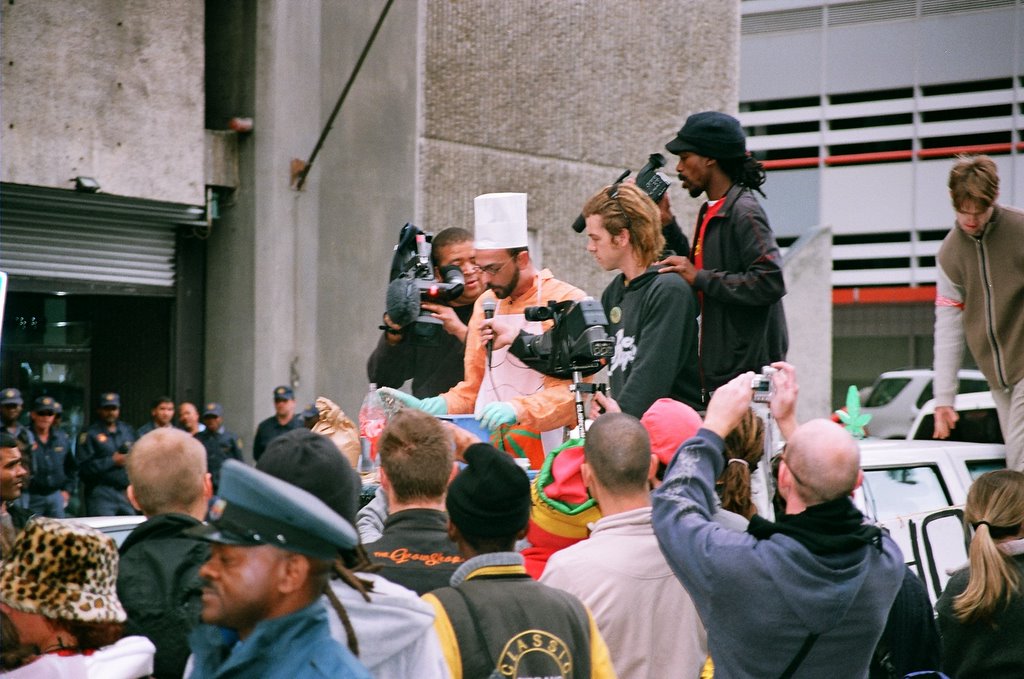
Kick the CO2 habit for World Environment Day - Cannabrick C02 Credits

Demonstrated outside the Department of Housing
  1. Plant a cannabis seed. Water and allow the plant to grow and produce seed. Plant and water these seeds. Your goal is to grow enough to build a house, you will need about 1 acre to build a 5 roomed home.

    Tyala imbewu ntsangu (ye-cannabis). Nkcenkceshela imbewu uze uyinike ithuba lokuba ikhule ide ikhuphe eyayo imbewu. Uyothi ke uyityale nalembewu uyinkcenkceshele njalo. Injongo yakho kukukhulisa izityalo ezothi zonele ekwakheni indlu, uyakudinga i-acre (malunga nentsimi) enye ukuze wakhe indlu enamagumbi amahlanu.

  2. Consider the many relevant points presented in the guidelines of Build your house step-by-step.

    Qwalasela yonke imigaqo oyibekelweyo kwincwadana i-Build Your House Step By Step.

    The Eastern Cape Government has developed a document titled:
    “A Basic Guide to Quality Housing Development”
    It is available here.

  3. Start planning where your house will stand. Consider everything about the environment you’ll be building in, like winter and summer sunshine, wind and rain – you don’t want to build on a floodplain, or your house will wash away. Be sure to plan all your water and waste requirements.

    Ceba indawo ozokwakha kuyo indlu yakho. Qwalasela yonke into ngomhlaba lo uzokwakha kuwo indlu yakho, izinto ezinje ngemimoya, ilanga, neemvula zehlobo nobusika, akekho umntu ofuna ukwakha indlu yakhe emgxobhozweni okanye apho iyothi ibe lilifa lezikhukhula khona. Uqiniseke ukuba unamanzi akulungeleyo ukwenza oku.

  4. Cut the grown cannabis plants down and leave in the field to rhett for a week. The morning dew and natural rotting process will loosen the fibers from the plant.

    a. Process the plant matter by cutting leaves and branches off, then hit small bundles the length of the plant over and upturned rake.
    b. The long fiber parts that remain in your hand are good for weaving rugs and making various other items your skills can accomplish.
    c. The seed can be gathered for more housing.
    d. Gather the small woody bits (the hurd) that have fallen, this waste is what will be used in the construction material.

    Sika / sarha izityalo uzibeke egadini ixesha elingangeveki ukuze zibole. Umbethe wasekuseni nezinye izinto zendalo ezibolisayo ziya kuyikhulula I-fibre ezityalweni.

    a. Yikhawulezise ngohlukanisa intonga zezityalo namagqabi, uhlale uyiharika rhoqo.
    b. Intonga ezi zinothi zincede kwezinye izinto ezifana nokwenza ingubo nezinye izinto onothi uzibonele zona ngokolwazi lwakho.
    c. Imbewu inokuqokelelwe ukwakha ezinye izindlu.
    d. Qokelela imithana ethe yaziwela njengokuba uzoyisebenzisa xa usakha indlu yakho.

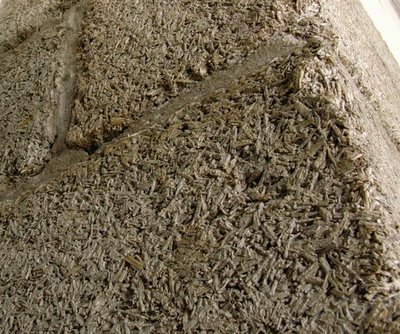
  5. Wash the hurd, dry it, then wash it again. Be careful not to allow the matter to rot or decay during this process, by turning, airing and allowing the African sun to dry the hurd properly. Now combine in proportions 10:2:3:3 combine the cannabis/ntsangu/dagga Hurd(10), washed river sand 0.5mm(2), hydraulic lime(3) and water(3) to make the mulch (This process may need tweaking depending on your geographic location, humidity, rainfall etc)

    Hlamba ingqokelela yakho, uyomise, uphinde uyihlambe.Ulumkele ukuba lengqokelela ibole kwelithuba, yiguquguqule, uyivumele ibethwe ngumoya uvumele nelanga lase Afrika liyomise lengqokelela. Dibanisa ngokwalo mgaqo 10:2:3:3, dibanisa ke lemvuno yakho yomgquba wentsangu (10) kunye nesanti yasemlanjeni 0.5mm(2), ikalika (3) kunye namanzi (3) ukwenza udaka (Nale into ke iyokuthi ixhomekeke kwindawo leyo ukuyo nemvula zakhona njalo-njalo).

  6. Now build your house! Ngoku ke yakha indlu yakho!

  7. Teach others. Fundisa abanye.


You can use this “dagga-cement” for making bricks, shutter casting or the proven “pole-and-dagga” method. This last method allows for a sturdy, warm, fireproof and water proof home – built with pride and intuitive engineering, not a ‘uniform box’.

Be sure to consider all aspects of your house design and structural requirements. Although the cannabis-cement will become stronger than steel in time, it is not advised to build over 2 floors high without considering structural implications. With planning this cement can be used to build up to 4 floors high.

The cannabis-cement will dry over a period of a month (depending on the weather). At this point you will be able to add the roof. Seal your home’s walls with lime; lime external walls annually.

Decorate your house with masonry to make it unique, and paint with coloured lime as per custom.

Always PLANT A TREE in a place that will provide shade, to commemorate this accomplishment.

Council will plant trees if citizens care for them. Call (021) 689-8938 http://www.trees.org.za/

Assist your family, friends or neighbors with your experience and expertise. Share information and technique; you can uplift yourself and your community.

Thursday, June 5, 2008

35 000 displaced refugees in the Cape

There are conflicting estimates of the number of displaced immigrants in the Western Cape - one relief agency says the number now stands at 35,000 while the City of Cape Town says the number is about 12,000.

Last week, the figure was widely estimated and accepted to be about 20,000 but on Wednesday the Mustadafin Foundation, which is working with the city's Disaster Management to assist immigrants, said the aftershock of the attacks had swelled the number to 35,000.

The foundation said it was feeding 13,850 of the displaced 35,000 immigrants, including one of the largest refugee camps, Soetwater.

"As the crisis continues ... conditions in the various refugee sites are becoming more and more unbearable.

"Furthermore, with no idea of the future or futures of their children, the refugees are becoming increasingly restless, calling on the UN for support," the organisation said yesterday.

Disaster Management's Wilfred Solomons said the 35 000 figure was incorrect, but in fact the number had dropped to about 12 000 as most of the immigrants had left the camps, reintegrated into communities and were "going to work".

According to statistics supplied by Disaster Management, safety sites such as Soetwater were at full capacity, housing close to 4,000 immigrants, while Blue Waters was accommodating nearly 200.

Youngsfield military base had almost reached its 1,500 carrying capacity and Harmony Park had reached its 2,000 capacity.

The city said Citrusdal farmers had offered employment and accommodation to some of the refugees.

On Wednesday, The Cape Argus reported that immigrants accommodated in temporary shelters have until next month to go back to their countries or return to their local homes.

They would be "temporarily exempt" from deportation, said Home Affairs Minister Nosiviwe Mapisa-Nqakula.

She also proposed a review of the current immigration laws to provide for "special dispensations" for immigrants, saying it was a waste of resources to deport them because they always returned.

Meanwhile, Zimbabwe was arranging for about 2,500 of its citizens to be repatriated, its state media said on Wednesday.

About 50,000 migrants have left South Africa, with the bulk crossing into neighbouring Zimbabwe and Mozambique. Some refused to go back to their communities in South Africa out of fear.

Safety and Security Minister Charles Nqakula said there had been no fresh attacks since shortly after soldiers were sent into the townships, though he added that President Thabo Mbeki might extend the army's deployment when it expired this weekend. - Cape Argus

UN representitives see Soetwater groups

Refugees at the Soetwater safety camp met UN representatives after calls for the world body’s intervention earlier this week.

Representatives from various groups based at the camp held a press conference at the His Kingdom Baptist Centre in Kommetjie on Wednesday and met UN representatives afterwards.

The delegates representing groups from Somalia, Congo, Ethiopia, Zimbabwe, Kenya and Burundi, insisted on urgent UN intervention a call echoed by groups in camps across the city, who held a press conference on Monday.

The displaced people called on the UN to step in and take
control, and have them moved back to their home countries or to a different country.

Ethiopia's Israel Abate said today: "We never said we wanted to go to the USA or Canada, but we would like to go anywhere where we would be welcomed and our rights are upheld."

He said a UN representative had handed out questionnaires to gauge the conditions at the camp.

Thousands of refugees have been staying at six emergency camps across the province since they fled their communities following xenophobic attacks two weeks ago.

Refugee Serge Bami Samba said yesterday that conditions at the Soetwater camp were deteriorating. He said they had had reports of 85 men suffering from diarrhoea.

"We believe the South African government cannot
control the situation. The UN and only the UN has enough
skills to control this situation," he said.

Samba said they had no freedom of movement, had to tag their belongings and had no money for transport. He said they were also worried about the safety of their women and children, particularly at night, as the women were separated from the men.

The group reiterated that not everyone wanted to be reintegrated as the government had planned.

Fatima Omar, who represents Somalis at Soetwater, said she had been living in South Africa for five years, but she "would rather die in her own country than die in this country."

She said despite problems back home, she would rather return there. - Cape Argus

Death threats to foreigners

Somalians who reopened their shops in Zwelihle on Monday after a week's absence were shocked when they were greeted by handwritten notes in Xhosa on Tuesday morning warning them to leave the township by 12:00 on Wednesday or be killed.

The notes were apparently pushed under the doors of the shops on Monday night or handed over to South African landlords of the Somalians.

The Hermanus Times discovered the notes when visiting the Somalian shops on Tuesday and immediately alerted the Overstrand municipality's housing manager, Bobby von Düring who in turn alerted the police and the Overstrand emergency services.

Hermanus police station commissioner Phumzile Cetyana then deployed police in the township while re-inforcements from the municipality's law and order department, traffic officers and security company ADT were put on high alert.

One of the community leaders Archie Klaas who was with the Hermanus Times when the notes were discovered, said that the Zwelihle Bambanani neighbourhood watch also patrol the streets throughout the night.

An emergency meeting was called between community leaders, the premier of the Western Cape's office and the police to discuss the situation. At midnight pamphlets were distributed in which commmunity leaders distanced themselves from the death threats and criminal acts and warn the perpetrators that they “will be rooted out of our society”.

Apparently the problem originated on the Sandbaai side of Zwelihle that is home to mainly new arrivals from the Eastern Cape who have not been longer in the township than two years and of whom many are known as trouble makers.

Meanwhile 11 people appeared in the Hermanus magistrate court on Monday on charges of public violence linked to xenophobic attacks in Zwelihle last week. Eight of the suspects were kept in custody while three under-aged suspects were put in the care of their parents.

Another four suspects who appeared in court on Monday last week on charges of theft and housebreaking linked to the xenophobic attacks were denied bail and therefore remain in custody.

One of the leaders of the foreigners in Zwelihle, Somalian Abdul Rashid Amat, said that most of the Zimbabweans and all the Angolans in Zwelihle have left.

An unknown Kenian woman had apparently helped a group of foreigners, mostly from Malawi and Angola, to go back to their countries of origin.

While most of the foreigners who sought shelter in the community hall in Zwelihle at the height of the xenophobic attacks on the foreigners last weekend, have returned to their homes, a small group stayed at the mosque in Mt Pleasant because they were afraid to go back to their vandalised homes.

One Somalian woman, Deka Abdi called the Hermanus Times on Friday night and reported that somebody threw paraffin on a mattress through a broken window in her living room on Thursday night and set it alight. The police were informed about the incident and she and her family returned to the mosque.

They left for Cape Town on Sunday and are now staying with relatives in Bellville.

Yusuf Moos of the Hermanus Islamic Society said they received blankets, groceries and bags full of new baby clothes from two Muslim charity organisations in Cape Town that they have distributed among the affected Somalians in Zwelihle.

He said there were still some goods left and wants to appeal to foreigners who have been affected by the attacks to get in contact with him.

The Hermanus Times informed the International Organisation for Migration (IOM) of the United Nations in Pretoria last Wednesday already that there were asylum seekers in Zwelihle who wanted to go back to their countries of origin but by Tuesday this week, no reply had been received.

A group of South Africans in Zwelihe have been working hard to restore vandalised homes of foreigners with the help of the Overstrand municipality who have donated doors and other material. Burglar bars have also been re-installed in some of the homes.

On Tuesday afternoon however, Hermanus Times visited a shop and attached home of one of the foreigners that is still deserted.

The gaping door openings and debris on the floors of the residence that has been stripped of all belongings is the only evidence of the spree of greed and violence that shattered Zwelihle last week. Even the electrical wires have been ripped out of the walls. - Hermanus Times

Water And Sanitation Undermines Health Efforts

South African health officials have failed to advocate for more free water while efforts to improve sanitation have been undermined by lack of funds, resulting in high levels of disease and mortality mainly among the poor.

This is according to Professor David Sanders, head of the School of Public Health at the University of the Western Cape and one of the world's public health leading experts.

Sanders said that the health department had been notably silent in raising any of these issues, even when the past cholera epidemic or the current food security crisis provided the opportunity.

Municipal environmental health officers that were supposed to facilitate the improvement of conditions were "inappropriate" and had been trained to "inspect restaurants in middle-class" suburbs, he added.

Speaking at this week's Public Health Association conference in Cape Town, Sanders revealed that almost one out of three (30%) residents in Khayelitsha did not have easy access to water while 80 percent live in shacks.

There is an average of 105 people per toilet in Site B and C in Khayelitsha, or one toilet per seven households where toilets have been provided.

A total of 14 521 households do not have access to water while the sanitation backlog is around 29 811 households.

Sanders showed that the country's health spending as a percentage of GDP had declined over the years and was set to continue this trend.

South Africa fares dismally when comparing health indicators to other middle and low income countries. In 2002 South Africa had a GDP per capita of U$10 070. Cuba's was much lower at U$5 259, Brazil U$7 770, Thailand U$7 010 and China U$4 580.

South Africa's expenditure on public health (as a percentage of GDP) was 3,6% in 2001, compared to 6,2% in Cuba and 3,2% in Brazil.

However, all these countries were getting better health returns on their investments. In 2002 98% of Cuban one-year-olds were fully immunized against Measles. In Brazil it was 93% and in Thailand 94%. At the same time South Africa had immunized 78% of its toddlers.

At birth, a baby in Cuba can expect to live to the healthy age of 76. In Brazil, life expectancy is 68 years, in Thailand 69 years and China 71 years. However, in South Africa it is a mere 47 years. In the other countries life expectancy had increased significantly since the seventies, but in South Africa it had plunged by six years.

By 2002 South Africa's infant mortality rate was at 52 per 1 000 births. Cuba's rate was 7, Brazil's 30, Thailand's 24 and China's 31 (down from 85 in 1975). South Africa now one of nine countries with an increasing under five mortality rate.

Sanders said health personnel numbers and skills were key in attempting to turn matters around. He revealed that the overall vacancy rate in the public health sector currently stood at 35 percent - 138 657 posts. The lowest vacancy rate was in the North West at 14% while the highest was in the Eastern Cape (47% - over 30 000 posts), Limpopo (45%) and Free State (41%).

In terms of skills, Sanders said senior managers were poorly oriented to public health care. "The health department stresses the 'public health care package' and selected activities in HIV/AIDS and TB programmes without corresponding emphasis on the preventative and promotive aspects such as lifeskills for youth, microcredit for women and advocacy for housing."

Sanders said that even in the best sub-districts such as those in the Western Cape the approach is very selective with emphasis placed on success in antiretroviral therapy and TB programmes but a dismal failure to address sanitation and water.

Human resource development was minimal and that the number of health workers remained totally inadequate in the peripheral areas. - Health-e News Service.

Refugees believe re-integration won't work

Some displaced foreigners staying at Soetwater near Kommetjie in the Western Cape say it could take up to 30 years for it to be safe for them to live in the areas they fled from because they fear locals' hatred is still too strong.

Representatives of Somalians, Ethiopians, Rwandans, Zimbabweans, Kenyans, Tanzanians, Burundians and people from the Democratic Republic of Congo gathered in Sun Valley on Wednesday.

Sergebami Samba-Bamikani, representing refugees from Tanzania, Burundi and Kenya, said the idea of re-integrating foreigners into informal settlements was good but too soon.

'Maybe it will work for the children of our children'
"We don't see it as a practical thing; there's no way it will work," he said. "Maybe in 30 years it will work. Maybe it will work for the children of our children but not for us.

"Re-integration is impossible because it will cause us to die."

Israel Abate, representing the Ethiopians at Soetwater, said they no longer trusted South Africans.

"It's not the first time South Africans have mistreated our brothers and sisters from other countries," Abate said. "We are forced off buses and trains. There is discrimination and hatred.

"We've lost trust, friendship and love for South Africa and South Africans. We've even lost the courage to start afresh."

'There is discrimination and hatred'
Somalian Fatiema Hosma said she would rather go back to her home country than "die like a dog" in Du Noon, where she had lived.

"We don't want to struggle any more. We don't want people to hurt each other like this but (the locals) say they are going to finish us. We don't accept that the government should send us back into our locations," she said.

Western Cape provincial premier Ebrahim Rasool said on Wednesday there were "many agendas" at work among displaced people. He appealed to people "to remain calm, reasonable and co-operative".

"We are encouraged by the progress in several communities across the province where re-integration has happened," he said. "We appeal to our communities and to foreigners who have been displaced to work together with the province's mediators so re-integration can take place." - Cape Times


Xenophobia: Govt focus on reintegration

Reintegration of displaced xenophobia victims into the communities where they come from is the government's priority, Cabinet ministers and provincial politicians said on Wednesday.

They were speaking in Cape Town at a media briefing on the recent wave of violence against foreign nationals.

"We would not encourage anybody to leave South Africa," Minister in the Presidency Essop Pahad said.

He said that where displaced people want to return to their countries of origin, South African authorities will not do anything to stop them, and will help international organisations involved in this process.

However, every effort will be made to reintegrate them into the communities from which they come, and this should be "our principal objective".

This will be pursued humanely, sensitively and with vigour.

Nor is there any question that the foreign nationals will be "ghettoised" in special living areas.

Gauteng minister of local government Dorothy Mahlangu said her provincial executive met on Tuesday and agreed that the tent camps set up for refugees in the Johannesburg area should be gone by the end of July.

For this reason, as the authorities put people into camps, they should simultaneously work on reintegration.

Her department will audit the camps on Monday to find out who is there, and to inform people of the two-month time limit, and that they should work with the authorities to make reintegration happen.

As to fears that the camps will lead to a mushrooming of shacks, she said: "The answer is a definite no."

Western Cape Premier Ebrahim Rasool said a provincial disaster declaration gazetted on Tuesday will expire after three months.

The provincial government hoped within this time to make a major impact on reintegration, which has already begun in several communities, or on repatriation.

There are over 18,000 refugees at camps and shelters around Cape Town.

Safety and Security Minister Charles Nqakula said the presidentially authorised deployment of the defense force to help police areas hit by the violence will end on Saturday.

This does not mean that President Thabo Mbeki might not be asked for another deployment, because police are still investigating cases related to the violence and might have to raid certain areas.

The troops have so far been used to help cordon off hostels targeted for police raids.

Rejecting suggestions that intelligence agencies had failed to predict the violence, he said there had been "a few assessments in the past" indicating tensions in some communities related to foreign nationals and service delivery.

However, the government could not react by simply throwing security forces into those areas to deal with the tensions, or flooding them with service delivery.

What the government had not known was that the tensions would rise to the level they did, or that the violence would erupt on May 11.

In the same way, though United States intelligence agencies had been aware that there were plans to attack the US, they did not know specifically that the September 11 2001 onslaught on the World Trade Centre was going to happen.

Nqakula said a total of 62 people, including nine South Africans, had died in the xenophobia violence, and by Monday, a total of 1 436 people had been arrested. -- Sapa

Wednesday, June 4, 2008

Migration hits housing delivery

The high rate of urban migration in South Africa is placing ever-increasing pressure on housing delivery, Housing Minister Lindiwe Sisulu said on Tuesday.

"The strain on the fiscus from migration is phenomenal," she told a parliamentary media briefing a day ahead of debate on her department's budget in the National Assembly.

The resources were not available "to do what we wanted to do".

The housing budget is set to grow to R10,6-billion this year (2008/09) from R9-billion last year. Budget estimates for 2009/10 and 2010/11 are R12,7-billion and R15,3-billion respectively.

Sisulu said urban migration in South Africa was currently about three percent of the population a year, well above the international average of 2,5 percent. This figure represented about 1,2 million people.

The high urban inflow was the reason for the rapid mushrooming of informal settlements around the country's cities and towns.

Although the clearing of informal settlements by 2014 was a government priority, the current budget was sufficient to provide only 266 000 houses, compared to an ever-growing backlog of 2,1 million units.

This figure comprised 1,1 million units to house those currently living in informal settlements, and a further million for so-called "backyard" dwellers.

The increase to this year's housing budget barely met the inflation rate.

"If we have not delivered as fast as some would have wanted us, it is because we simply do not have the money to do that," she said.

A 2006 audit had shown the amount needed to clear the current housing backlog over the next three years (by 2012) was R120-billion.

Sisulu noted South Africans had "run out of patience" when it came to housing delivery.

"I appeal to all who qualify and wait for houses: despite all the problems we face, we are on course within the limited resources at our disposal. I assure them their turn will come," she said. - Sapa

Thubelisha falls silent

THE victory dance of the controversial housing company, Thubelisha Homes after their favourable ruling in the N2 Gateway illegal occupants court case, proved to be shortlived after allegations of the company’s bankruptcy surfaced.

In contrast to the bold outspokeness of Thubelisha Homes in the media over the N2 Gateway saga during the past few months, the company this week evaded TygerBurger’s query into the alleged bankruptcy.

Phone calls to the Thubelisha offices proved useless as the woman answering the phone could not comment or supply the contact numbers of the manager or the media spokesperson to comment on the issue.

Mr Prince Xhanti Sigcawu, Western Cape manager of Thubelisha Homes, did not answer his cellphone.

Die Burger reported earlier this month that Prince denied the bankruptcy and said: “The company is not technically insolvent and just do not have enough funds for the 2008/9 book year.”

Thubelisha Homes, who earlier this year came in the spotlight for obtaining a court order to evict illegal occupants from the N2 Gateway houses in Delft, was contracted by the National Housing Department to build the low income houses.

It was a pilot project approved by Cabinet in 2004 as part of the newly developed human settlement plan and launched by the National Housing Department in 2005.

Thubelisha, who failed to complete the housing target for this project, will now merge with the housing company Servon to form the National Housing Agency.

Thubelisha was originally contracted to build 16 290 houses, of which only 2 889 was completed.

Mr Xolani Xundu, spokesman for the National Housing Department said the project will be taken over by the new Housing Development Agency.

Reasons as to why Thubelisha could not achieve its target, Xundu said: “We must point out that Thubelisha as an implementing agent of government has operated under very difficult circumstances of work stoppages due to political and other forces that slowed the building of the houses.

“Recent actions by the councillor of the DA of inciting communities to occupy incomplete houses in Delft Symphony and the court battles that ensued are but two examples of the very difficult environment faced by Thubelisha.”

The official concerned, DA councillor Mr Frank Martin, is still under disciplinary investigation for allegedly prompting local backyard dwellers to move into the unfinished houses.

Martin said the latest debacle surrounding Thubelisha was an “utmost shame”.

“Their corrupt and sly way of doing business have caught up with them.

“I welcome their bankruptcy, but we will have to wait and see whether the same crooks will not be appointed in the new agency company of the state,” he said.

Xundu further denied allegations that Thubelisha was bankrupt.

“Thubelisha is not bankrupt. What has happened is that in anticipation for its closure in June, it was not allocated the full annual budget to carry out its operational activities,” said Xundu. - TygerBurger

South Africa: Behind the Xenophobic Violence

What was it that led to around 100,000 foreigners being driven from homes in South Africa?

A man reads a newspaper under an advertising billboard in front of tents set by the United Nations to house victims of anti foreign violence in Midrand, South Africa, Sunday June 1, 2008.
Camps have been set up for people fleeing the attacks

One factor could be rising anger at allegations that foreigners have corruptly been given subsidised housing.

At first South Africa's Minister of Intelligence Ronnie Kasrils said that some kind of subversive "Third Force" was behind the attacks.

"We are not just seeing spontaneous xenophobic attacks," he said during a tour of the worst affected areas.

"There are many social issues at the root of the problem, but we have reason to believe that there are many other organisations involved in sparking the attacks," he added.

But later he withdrew the accusation, saying: "I accept that we have had a spontaneous outburst of xenophobia here."

So what really caused the attacks?

With the violence having been perpetrated across such vast areas of the country, there is no simple answer.

But one source of tension has been intense competition for the subsidised housing built by the government under its Reconstruction and Development Programme (RDP).

The problem with the RDP housing is that although the government now builds over 180,000 units a year, there are never enough.

They are allocated not by municipalities or officials, but by the locally elected councillors.

Bribery and corruption

For a number of years now this has led to allegations that they take bribes in return for housing and this has led to many protests.

In 2005, for example, residents in the town of Musina, close to the border with Zimbabwe, marched on the municipality to protest about the lack of action against certain councillors accused of giving houses to foreigners for money.


We must put a stop to this practice

Gwede Mantashe
ANC Secretary General

Sinkie Makushu, chairman of the Greater Musina Unemployment Forum complained that they had provided ample evidence of corruption, but that no action was taken.

"The police have every bit of information regarding corruption at the municipality, but they keep saying they are still investigating," he said.

The previous year angry residents chased about 50 people out of RDP houses after claims that they were foreigners, who were paying rent or had bought the homes outright from local councillors.

Some of those evicted from the RDP houses produced bank receipts proving they were paying rent of 50 rand ($6.5) or more to some councillors. Other occupants said they had bought the houses for 6,500 rand ($850) each.

'Fertile ground'

Anger at the allocation of housing in return for payments has been seen in several places during the xenophobic attacks carried out over the past two weeks.

People living in Alexandra, on the outskirts of Johannesburg where the violence originated, said foreigners had jumped the low-cost housing allocation lists by paying bribes.

New house
The government builds 180,000 houses a year but it is not enough

The housing department in the Gauteng region which surrounds Johannesburg said it had allocated nine houses to foreigners in Alexandra but argued in a report that those people had permanent resident permits.

The opposition Democratic Alliance said the government needed to clarify its housing policy and explain who qualified for state-owned houses.

Since most councillors are members of the African National Congress, it is the party that has been blamed.

The problems were acknowledged by ANC Secretary General Gwede Mantashe.

"Many people have taken occupation of more than one RDP house and sell their houses instead of living in them. We must put a stop to this practice and expose all who are corrupt," he wrote on the party's website.

A similar point was made by the leader of the ANC's ally, the South African Communist Party.

"Some of our own councillors illegally take bribes and allocate RDP houses to undeserving people who are South African and non-South African citizens," said Blade Nzimande, the SACP's general secretary.

"These corrupt practices create fertile ground for intra-community conflict and xenophobia," he said.

Taking action

The government has attempted to deal with this issue.

Recently the department of housing said that more than 7,000 civil servants have acquired RDP houses illegally.

Foreigners from Somalia and other African countries protest outside the South African Parliament, 2 June 2008
The attacks have prompted widespread demonstrations

"We have 7,363 pending cases of fraudulently acquired RDP houses by government officials throughout the country," says Simphiwe Damane-Mkhosana, head of an anti-corruption unit in the housing department.

"We intend to prosecute all the individuals who benefited."

But the practice has become so widespread that rooting it out is proving difficult.

The resulting tensions have only served to exacerbate differences between South Africans and foreigners living in the so-called Rainbow Nation.

Cape rains keep disaster teams alert

Cape Town's Disaster Risk Management remained on high alert on Tuesday after a night of heavy rainfall but said areas prone to flooding had not been badly affected.

Teams had been sent to Kosovo, in Philippi, where last month 500 shacks had been left standing in 15 centimetres of water, but on Tuesday Charlotte Powell, spokesperson for disaster management, said residents there had not needed assistance from the city.

"The metropole was obviously wet but there was no flooding. It wasn't as bad as (last month). We haven't had calls from the public or councillors of areas," she said.

Powell said if the SA Weather Service predicted the approach of a cold front or wet conditions, the relevant city employees would be notified in order to prepare to help residents who might be affected.

Meanwhile, one major accident was reported early on Tuesday and the city's traffic spokesperson, Merle Lourens, said the wet conditions may have played a role in it.

Seven people were slightly injured when a bus crashed into a taxi on Vanguard Drive near Heideveld. Lourens said police were investigating. No other incidents had been reported.

The weather service predicted a maximum temperature of 18°C for today with slight morning showers. - Cape Times