Tuesday, May 31, 2005

Hemp housing man lays complaint

Against a background of protests about housing delivery, the Western Cape office of the Public Protector confirmed on Tuesday that a complaint was lodged against housing MEC Marius Fransman. 

"We received a complaint of unreasonable delay in responding to the complainant," said provincial public protector Gary Pienaar. 

The complainant is housing innovator Andre du Plessis, who wants to build low-cost cannabis homes. 

In an electronic missive to Pienaar and obtained by Sapa, Du Plessis said he had been trying to develop his project for the past five years. 

Superficial response

Du Plessis said the department of housing and former Western Cape premiers had responded to his requests in a superficial manner. 

"This form of response is unacceptable," said Du Plessis, saying the demand for appropriate affordable fire- and water-proof housing outweighed everything. 

He said since he received the first response in 2001, he could have built 10,000 housing units of 80 square metres each. 

Du Plessis said during the same time he has endeavoured to build appropriate affordable housing, other countries such as Australia, Spain and the United Kingdom have proved that hemp houses could work. 

"As the housing crisis deepens, we can no longer afford delays on behalf of the housing minister or ministry, with regard to correspondence or delivery". 

Private investors keen 

Du Plessis said private investors keen to support his endeavours were being curbed. 

"We will consider the complaint and decide whether we can take action and what form that action will be," said Pienaar. 

Pienaar said Du Plessis would be informed of the decision, with the office possibly arranging a meeting between Fransman and Du Plessis. 

- Sapa 

Wednesday, May 11, 2005

HSRC Housing delivery report

Pretoria - Unemployment-induced poverty was causing many government housing beneficiaries to move back into shacks, a Human Sciences Research Council report revealed on Tuesday.

“Unemployment is undermining South Africa’s housing delivery strategy,” researcher Catherine Cross said in Pretoria.

Although the government’s housing delivery strategy had made many gains, and had the potential of success, “under the current situation of high unemployment, it is probably an expensive gamble”, she added.

The HSRC released a report on poverty in Gauteng, which Cross said was probably also an accurate reflection of trends elsewhere in the country.

“Serviced housing alone is not going to be enough to overcome poverty,” she said. “There will have to be jobs. It is becoming more and more difficult for people to stay in the houses they’ve got.”

Government housing delivery was supposed to enable beneficiaries to accumulate an asset base and invest in their future.

Permanent entrenchment of shack areas?

But because of unemployment and poverty, many were being unable to afford ordinary household running costs.

Even two social grants per household, in the absence of any other income, were often not enough to make a difference, Cross said.

She questioned the government’s ability to eradicate shack settlements by 2014, and predicted “a permanent entrenchment of shack areas” as the country’s worst case scenario.

She could not say when this point was likely to be reached at the current rate, but said it was not too late to turn the tide.

“I don’t think we are anywhere near the point of no return. We are in a sticky situation, but not lost,” said Cross.

Solutions included cities, the government, business and organised labour working together to create sustainable jobs — although she could not say how this would be achieved.

Easy savings options

The HSRC study found that 32% of “poverty pockets” in Gauteng were not in shack settlements but in metro areas with formal housing and services.

“Many poverty pockets already have formal housing and are still poor. A lot of them are so poor that they may lose their houses and slide back into shacks.”

The study revealed that rural-to-urban migration was not the only cause of poverty in cities, as many policy makers seemed to think.

A bigger problem was cities’ inability to generate sustainable employment.

But urban migration by people seeking a better life threatened to bankrupt cities, Cross said. An accumulating burden of poverty alleviation programmes may undermine city budgets, with subsidies attracting even more migrants.

“Is there a reason to be afraid? To some extent probably.”

Possible solutions included the use of incentives like easy access to housing and service sites, to steer migration to “sustainable” places.

Ways should also be found to make it easier for people who have received government houses to keep them, perhaps through offering easy savings options.

The report is to be presented to Gauteng policy makers and politicians to be used in service delivery plans for the future. - News24

Saturday, May 7, 2005

How to build a Cannabrick Home


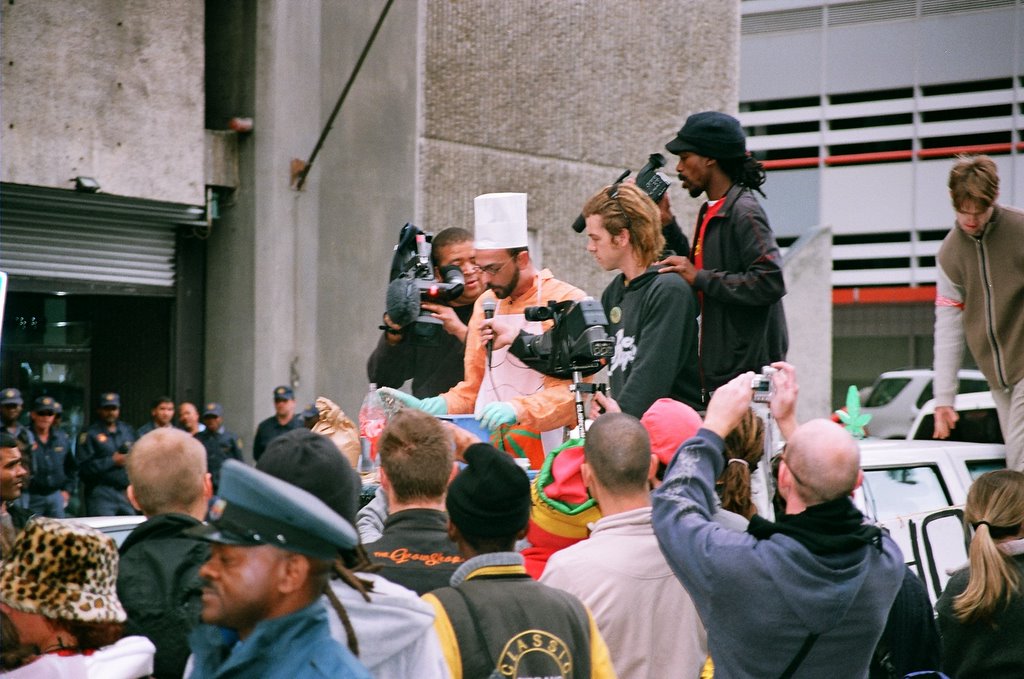
Peacefully Demonstrated outside the Department of Housing May 7 2005
  1. Plant a cannabis seed. Water and allow the plant to grow and produce seed. Plant and water these seeds. Your goal is to grow enough to build a house, you will need about 1 acre to build a 5 roomed home.

    Tyala imbewu ntsangu (ye-cannabis). Nkcenkceshela imbewu uze uyinike ithuba lokuba ikhule ide ikhuphe eyayo imbewu. Uyothi ke uyityale nalembewu uyinkcenkceshele njalo. Injongo yakho kukukhulisa izityalo ezothi zonele ekwakheni indlu, uyakudinga i-acre (malunga nentsimi) enye ukuze wakhe indlu enamagumbi amahlanu.

    Plant 'n hemp saad. Water en laat die plante om te groei en saad te produseer. Plant en water hierdie sade. Jou doel is om te groei genoeg is om 'n huis bou, jy sal ongeveer een aker benodig om' n 5-kamer huis te bou.

  2. Consider the many relevant points presented in the guidelines of Build your house step-by-step.

    Qwalasela yonke imigaqo oyibekelweyo kwincwadana i-Build Your House Step By Step.

    Oorweeg die baie relevante punte in die riglyne van die bou van jou huis stap aangebied-vir-stap.


  3. Start planning where your house will stand. Consider everything about the environment you’ll be building in, like winter and summer sunshine, wind and rain – you don’t want to build on a floodplain, or your house will wash away. Be sure to plan all your water and waste requirements.

    Ceba indawo ozokwakha kuyo indlu yakho. Qwalasela yonke into ngomhlaba lo uzokwakha kuwo indlu yakho, izinto ezinje ngemimoya, ilanga, neemvula zehlobo nobusika, akekho umntu ofuna ukwakha indlu yakhe emgxobhozweni okanye apho iyothi ibe lilifa lezikhukhula khona. Uqiniseke ukuba unamanzi akulungeleyo ukwenza oku.

    Begin met die beplanning, waar jou huis sal staan. Oorweeg dit alles oor die omgewing en jy sal gebou in, soos winter en somer son, wind en reën - jy nie wil bou op 'n vloedvlakte, of jou huis sal wegspoelen nie. Maak seker om te beplan al jou water en afval vereistes voldoen.

  4. Cut the grown cannabis plants down and leave in the field to rhett for a week. The morning dew and natural rotting process will loosen the fibers from the plant.

    a. Process the plant matter by cutting leaves and branches off, then hit small bundles the length of the plant over and upturned rake.
    b. The long fiber parts that remain in your hand are good for weaving rugs and making various other items your skills can accomplish.
    c. The seed can be gathered for more housing.
    d. Gather the small woody bits (the hurd) that have fallen, this waste is what will be used in the construction material.

    Sika / sarha izityalo uzibeke egadini ixesha elingangeveki ukuze zibole. Umbethe wasekuseni nezinye izinto zendalo ezibolisayo ziya kuyikhulula I-fibre ezityalweni.

    a. Yikhawulezise ngohlukanisa intonga zezityalo namagqabi, uhlale uyiharika rhoqo.
    b. Intonga ezi zinothi zincede kwezinye izinto ezifana nokwenza ingubo nezinye izinto onothi uzibonele zona ngokolwazi lwakho.
    c. Imbewu inokuqokelelwe ukwakha ezinye izindlu.
    d. Qokelela imithana ethe yaziwela njengokuba uzoyisebenzisa xa usakha indlu yakho.

    Sny die gegroei hemp/cannabis plante af en in die veld verlaat om rhett vir 'n week. Die oggend-dou en die natuurlike verrotting proses sal die vesel van die plant los te maak.

    a. Proses van die plantmateriaal deur te sny blare en takke af, dan is getref klein bundels die lengte van die plant oor en omgekeerde hark.
    b. Die lang vesel dele wat in jou hand bly is goed vir die matte weef en die maak van verskeie ander items jou vaardighede kan bereik.
    c. Die saad kan vir meer behuising ingesamel word.
    d. Versamel die klein houtagtige bits (die hurd) wat gedaal het, die afval is wat sal in die konstruksie materiaal gebruik kan word.

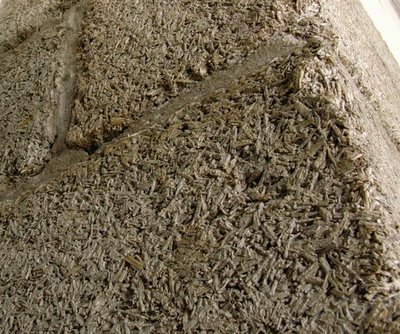
  5. Wash the hurd, dry it, then wash it again. Be careful not to allow the matter to rot or decay during this process, by turning, airing and allowing the African sun to dry the hurd properly. Now combine in proportions 10:2:3:3 combine the cannabis/ntsangu/dagga Hurd(10), washed river sand 0.5mm(2), hydraulic lime(3) and water(3) to make the mulch (This process may need tweaking depending on your geographic location, humidity, rainfall etc)

    Hlamba ingqokelela yakho, uyomise, uphinde uyihlambe.Ulumkele ukuba lengqokelela ibole kwelithuba, yiguquguqule, uyivumele ibethwe ngumoya uvumele nelanga lase Afrika liyomise lengqokelela. Dibanisa ngokwalo mgaqo 10:2:3:3, dibanisa ke lemvuno yakho yomgquba wentsangu (10) kunye nesanti yasemlanjeni 0.5mm(2), ikalika (3) kunye namanzi (3) ukwenza udaka (Nale into ke iyokuthi ixhomekeke kwindawo leyo ukuyo nemvula zakhona njalo-njalo).

    Was die kudde, droog dit af, dan was dit weer. Wees versigtig om nie toe te laat die aangeleentheid te verrot of verval gedurende hierdie proses, deur die draai, voorlê en laat die Afrika-son om droog die kudde goed. Nou kombineer in verhoudings 10:2:3:3 kombineer die cannabis / ntsangu / dagga Hurd (10), gewaste riviersand 0.5 mm (2), hidrouliese kalk (3) en water (3) aan die deklaag te maak (Hierdie proses kan tweaking nodig, afhangende van jou geografiese ligging, humiditeit, reën, ens)

  6. Now build your house! Ngoku ke yakha indlu yakho! Nou bou jou huis!

  7. Teach others. Fundisa abanye. Onderrig ander.


You can use this “dagga-cement” for making bricks, shutter casting or the proven “pole-and-dagga” method. This last method allows for a sturdy, warm, fireproof and water proof home – built with pride and intuitive engineering, not a ‘uniform box’.

Be sure to consider all aspects of your house design and structural requirements. Although the cannabis-cement will become stronger than steel in time, it is not advised to build over 2 floors high without considering structural implications. With planning this cement can be used to build up to 4 floors high.

The cannabis-cement will dry over a period of a month (depending on the weather). At this point you will be able to add the roof. Seal your home’s walls with lime; lime external walls annually. Decorate your house with masonry to make it unique, and paint with coloured lime as per custom.

Always PLANT A TREE in a place that will provide shade, to commemorate this accomplishment.

Council will plant trees if citizens care for them. Call (021) 689-8938 http://www.trees.org.za/

Assist your family, friends or neighbors with your experience and expertise. Share information and technique; you can uplift yourself and your community.


Tuesday, May 3, 2005

How 'Cannabricks' Can Ease Housing Problem

Cape Town, South Africa -- A Cape Town-based housing innovator who propagates using hemp to curb South Africa's growing housing problem has not ruled out Constitutional Court litigation to compel the government to revise its dagga legislation.

"There is a strong possibility we will initiate litigation, hopefully within this year," said Andre du Plessis. Du Plessis said Cape Town will on Saturday join about 180 cities across 37 nations to highlight the many uses of cannabis. 

Du Plessis said South Africa faces a massive housing backlog, with cost being the biggest prohibitive factor.


"The solution must be safe, fireproof, bio-friendly and it should trigger sustainable development and wealth creation from grassroots up. Cannabis is a proven industrial ingredient, and when used to make bricks it provides the best value for money, while meeting all requirements," said Du Plessis in a statement.

He said cannabis has a traditional history in Africa going back almost 5 000 years.

Du Plessis said Saturday's march will be for an end to the prohibition of industrial cannabis use in housing and agriculture.

He said it is important to acknowledge and legitimise the cannabis farming already happening in the country's rural, impoverished areas.

"We will ask our minister of housing to give this legitimate solution a chance."

Du Plessis said dagga, a common name for cannabis, was banned in South Africa in 1909.

South Africa is one of the world's largest producers of dagga, with approximately 120 000ha a year cultivated, using local strains.

At Saturday's march, a memorandum will be delivered to a representative from the Department of Housing, highlighting the use of cannabis in housing and agriculture, and everyone's right to secure ecologically sustainable development.

A five-minute demonstration of "how to build a cannabrick" will follow. -- Sapa

Monday, May 2, 2005

Housing scandal man advising Sisulu

The man who presided over South Africa's biggest housing scandal eight years ago is back -- as special adviser to Minister of Housing Lindiwe Sisulu.

Saths Moodley resigned as executive chair of the Mpumalanga Housing Board in May 1997 as the Mail & Guardian exposed what became known as the Motheo scandal.

In subsequent reports by the auditor general and a provincial commission of inquiry, Moodley shouldered much blame for the irregular award of a R190-million low-cost housing contract to Motheo Construction, a company formed by a friend of then-housing minister Sankie Mthembi-Mahanyele.

Questions about the minister's role remained unanswered. She failed in a R3-million defamation claim against the M&G after it implicated her in the scandal.

Moodley this week referred questions to Sisulu. She was in Brazil and could not be reached for comment, but her spokesperson, Thabang Chiloane, said: "I can safely say that [Sisulu] would have applied her mind to Moodley's appointment.

"The minister would have given due consideration to Moodley's wide national and international experience and would also have taken into account that she needed a candidate to match her own energy."

Chiloane added that Moodley's position was not administrative in nature and was unrelated to the awarding of construction contracts, as that was not a function of Sisulu and her ministry, but of the provinces.

Political analyst Richard Calland said special advisers were "lieutenants" to ministers. "They are appointed only where they are politically trusted by the minister. They enjoy ... access that allows them to exert a considerable level of influence."

Moodley appears to have a wide brief, but has taken a special interest in the N2 Gateway Project, the government's most ambitious housing project to date. Sisulu has called it the "spearhead" of the government's revamped Comprehensive Housing Plan.

N2 Gateway is a R1,6-billion fast-track effort to house tens of thousands of Cape Peninsula squatters. Moodley is the project's -spokesperson.

Moodley joined the ministry in June last year, but has stayed on as chairperson of Webnet, an IT company he co-founded in 2000. His partners in Webnet include Granny Seape, another key player in the Motheo scandal.

In late 1996 and early 1997 when Moodley headed the Mpumalanga housing board, Seape, as head of affordable housing at Nedcor, helped put the Motheo deal together. Her sister, Thandi Ndlovu, headed the beneficiary company, Motheo Construction. Ndlovu was Mthembi-Mahanyele's friend from exile days.

Seape quit Nedcor before the scandal became public. Company records show that Moodley joined Seape as partner in a "facilitation and lobbying" company, Ahanang Agency, in May that year” before his resignation from the housing board was announced.

He insisted at the time that he did not resign because of the scandal, but to pursue a new career.

Moodley's teaming up with Seape came two months after he, on the housing board's behalf, had -counter-signed the contract awarding about R190-million state funds to -Seape's sister's company. Motheo Construction was to build 10 500 houses in rural Mpumalanga.

An auditor general report in September that year ripped into the deal, saying the housing board had not properly considered Motheo's application and had sanctioned funding millions of rands more than allowed. Moodley, although unnamed, was the implicit target of much criticism.

The Dreyer commission, appointed by then-Mpumalanga premier Mathews Phosa, later reported that Moodley had personally driven the deal at the housing board. It blamed him for a string of irregularities:

# Insufficient information was provided to the housing board executive and the board to make an informed assessment of the Motheo application. From evidence, it appeared board members were unaware they were approving such a large deal” or any deal at all;

# The board "approved" the deal without a quorum, meaning the contract was invalid;

# Deficiencies in the contract itself.

- M&G

Sunday, April 17, 2005

People in grass houses won’t get stoned

AN ENTREPRENEUR is touting dagga as the answer to the Western Cape’s housing woes.

Andre du Plessis, a former IT specialist from Cape Town, has proposed turning dagga (cannabis) plants into bricks to build low-cost homes at a fraction of the price of conventional building materials.

Du Plessis said about 10% of the plant — the leaves and flowers which are smoked — was “illegal” because of its intoxicating effect.

But parts of the stalk, which is also used to make rope, could be crushed and mixed with substances like lime, water and river sand to manufacture bricks.

Du Plessis, 35, claimed that the homes built from cannabis bricks would be fire-, water- and soundproof.

Du Plessis insisted that the bricks would be “impossible to smoke” as they would not contain the flowers or leaves of the weed.

He is not the only supporter of cannabis homes.

In Australia this year, close to 2.5 million plants were harvested by Dr Keith Bolton from the Southern Cross University to construct two homes, according to the university’s website.

Magnus de Jongh, spokesman for Western Cape Housing MEC Marius Fransman, said more than 300,000 homes were needed in the province.

“It is a challenge we are faced with. The minister instructed a housing reference group to look at alternatives.

“Cannabis bricks are an alternative. But we must have alternatives that are in line with legal requirements,” said De Jongh.

Du Plessis said a 23m² RDP house cost about R17000 to build and that, “I can build an 82m² house for the same price”.

He said that instead of being destroyed by police, the plants could be used to help thousands of homeless people.

In 1999, Du Plessis applied to the Agricultural Research Council for a permit to grow the plants to start his housing project — but he is still waiting for a decision.

Thursday, February 10, 2005

Zuma's mansion 'sold'

Johannesburg - The upmarket Johannesburg house that former deputy president Jacob Zuma lives in now has a new owner, a company run by a former personal assistant of his ex-wife.

Hola Recruitment & Selection Services, a recruitment agency based in Johannesburg, bought the Forest Town house from its previous owner, Mohamed Sayed Hoorzook, for R3.6m last month.

According to the registrar of companies, Hola has only one active director by the name of Zephroma Sizani Dubazana.

When contacted by City Press, Dubazana - who has now changed her surname to Dlamini - refused to comment about the purchase.

"I am the chief executive officer of this company. It is a private company and I would therefore not want to comment about its activities.

"My advice is that you go back to the people who told you about this for more information. I really do not want to say anything more," she said.

The relationship between her, her company and the former deputy president is still unclear.

But City Press has established that Dubazana worked as private secretary for minister Nkosazana Dlamini-Zuma when she was still the national health minister in the 1990s.

When Dlamini-Zuma was appointed foreign affairs minister, Dubazana joined private business. She became a director of Hola Recruitment on July 18 2000.

Other company directors at the time were cellphone company MTN's current chief executive Phuthuma Nhleko and connected businessman Max Maisela.

According to the deeds office, Hola Recruitment took up a R3.6m bond with Absa to buy the house.

The property was purchased on June 22, eight days after Zuma's axing from cabinet, but was only transferred to Hola Recruitment on September 16.

Hoorzook, whose business interests include picture-framing enterprises, had bought the house in 1998 for R845 000.

Zuma moved into the house about two months ago and the property was in the news a few days later when it was raided by the Scorpions, as part of a nationwide search-and-seizure operation linked to their probe into the ANC deputy president's business dealings.

The popular ANC leader is scheduled to appear before the Durban Regional Court on October 11 in connection with charges arising from his relationship with his former financial adviser and friend Schabir Shaik who was convicted of corruption and fraud in July.

The Shaik trial did not only find a "generally corrupt relationship" between Zuma and Shaik, but also portrayed the former deputy president as a financially-ruined individual who could hardly make ends meet.

That is why news that he had moved into a R3.6m house at a leafy Johannesburg suburb, less than two months after President Thabo Mbeki axed him as his deputy, came as a surprise to many who wondered how he could afford such an expensive property.

When City Press visited the area, police were still guarding the house, indicating that Zuma was still living there. Zuma was unavailable for comment. - NEWS24

Friday, December 3, 2004

State mulls creation of own cement, brick factories

The Department of Housing's far-reaching plan to provide housing for all South Africans will not only affect issues such as service delivery and access to credit and subsidies, but will also have implications for developers and material suppliers, a senior government official revealed.

Saths Moodley, adviser to Housing Minister Lindiwe Sisulu, said yesterday that government would establish State-owned cement and brick factories as a response to the practice of 'hoarding' by many material suppliers.

Moodley argued that many suppliers hold back building materials, creating a shortage and inflating prices, before releasing them in tranches and exploiting high prices.

While government does not wish to pass legislation to discourage this practice, it is set to pursue a research programme through the Council for Scientific and Industrial Research (CSIR), focusing on building and material technology. Moodley commented that it is envisaged that the CSIR would also be involved in the evaluation and monitoring of government's building-material production programme.

In regard to developers, he revealed that a recent agreement between the State and developers will facilitate a 30% black economic empowerment partnership with established developers.

Interestingly, as part of the agreement, developers will also be required to provide a minimum 20% of their profits from upmarket and lucrative developments for 'hardcore' housing - with 'hardcore poor' including pensioners and the indigent. This is similar to models found in countries such as the UK, and government will facilitate the enabling environment for this.

Meanwhile, Moodley reiterated government's aggressive and ambitious plan to eradicate informal settlements, and said the first results of this would be seen in Gauteng in two months.

He explained that government would immediately upgrade suitable land, and relocate people who live in informal settlements on unsuitable land.

Part of this plan also includes the provision of access to proper services, security, choice and formal top structures.

In addition, the State is set to provide access to subsidies of up to R28 500 to the hardcore poor, with no savings requirement; and access to a home for rental or ownership, valued R28 500, and a cash or 'sweat equity' contribution for the poor (those with access to some sort of employment).

For those earning between R3,500 and R7,000 a month, government will provide a contribution to the deposit required for mortgages.

In order to successfully implement government's overall housing plan, Moodley pointed out that the Department of Housing's role has been redefined - from being a department of 'low-cost housing' to being a department responsible and responsive to the entire residential market, which will strive to reverse apartheid spatial planning.

- Engineering NEWS

Wednesday, September 15, 2004

Don't Bank On Hemp

A hemp growing project which offers hope to small farmers in the poverty stricken Eastern Cape could be derailed because hemp is still an illegal substance.  

Department of Health rules which lump hemp together with dagga could scupper plans for the effective mass production and marketing of the fibrous hemp plant.  

"The status of the hemp plant is still ( in South Africa ) exactly the same as dagga, but the narcotic ingredient of the hemp plant is much less than the dagga plant," said Andreas Pluddemann, a scientist at the Medical Research Council.  

Pluddemann said it was time for a review of legislation, especially as special permits were being granted in the Eastern Cape.  

"There is no real reason not to revisit the legislation other than it might be technically difficult to administer," he said.  

Amendments to the 1965 Medicine and Related Substances Act, which would insert a section dealing with industrial hemp regulations, also have to be approved by the Medicines Control Council ( MCC ).  

The MCC currently authorises two special permits, one for importing seeds and the other for growing hemp, for the Eastern Cape pilot project.  

The provincial agriculture department said hemp cultivation in South Africa started in 1999 through collaboration between the Agricultural Research Council, the Centre for Scientific and Industrial Research, the Development Bank of Southern Africa, government and the private sector.  

"Hemp is foreign to us and we were using hemp cultivars from Hungary, Yugoslavia, France, Hungary and Poland," said Monde Sotana, a provincial agriculture official.  

Sotana said the current phase began after initial trials showed hemp could be grown in local conditions.  

The latest phase includes large-scale hemp cultivation by pioneer farmers, training and development skills, co-operative agreements with hemp producing countries, commercialisation and marketing, and a "hemp seed multiplication scheme".  

Sotana said about 180 small-scale farmers are involved, an area of about 50ha is under cultivation, and farming equipment including tractors had been bought.  

"Hemp breeding has progressed to a level on which we can register a South African cultivar.  A multiplication scheme on local hemp seed can be done then, and seed will be affordable to the farmers," said Sontana, adding that 10 oil pressing machines and ten oil filters had been bought to help farmers produce hemp oil.  

The versatile hemp plant is grown mainly for fibre, and secondly for oil, and has a variety of other uses, including composite building materials, bio-fuel and textiles.  

DaimlerChrysler was mentioned by Agriculture Minister Thoko Didiza last year as being interested in using local hemp to manufacture dashboards.  

Didiza said there would be no drive for "massive production" until the pilot project trials were finalised and unless the Department of Health removed hemp from the cannabis schedule of drugs.  

According to self-styled housing innovator Andre du Plessis, who has been on a one-man crusade for the past four years to get government to consider building cannabis homes for the poor, an "economic platform" was created when using these materials.  

"When building housing from an agricultural product, an economic platform is created in the rural areas, which in turn could impact on rural-to-urban migration," he said, adding that government should consider the agricultural benefits to be gained if the law on cannabis was changed.

Thursday, August 12, 2004

Radical housing plan to go before parliament

"I did not know housing was such a crisis in the Western Cape."

This was the stark admission by Housing Minister Lindiwe Sisulu on Wednesday during her one-day housing imbizo.

Grapevine SA Alumni - The University of York Autumn 2006
Lindiwe Sisulu (PhD Centre for Southern African Studies, 1989) has been South Africa’s Minister of Housing since 2004. The daughter of ANC veterans Walter and Albertina Sisulu, Dr Lindiwe Sisulu is promoting a ten-year plan to eradicate the squatter camps that are home to 2.4 million families and instead to create non-racial communities nearer to where people work and play.

She also promised the government would "drastically reduce" informal settlements within the next 10 years.

Sisulu was accompanied by premier Ebrahim Rasool, Housing MEC Marius Fransman and mayor Nomaindia Mfeketo, who addressed communities in Wallacedene, Paarl and Khayelitsha.

'I did not know housing was such a crisis in the Western Cape'
Sisulu announced to the media yesterday that her comprehensive plan on settlements - a housing plan requested by President Thabo Mbeki during his state of the nation address on May 21 - would be tabled before cabinet by next Wednesday. This includes plans for housing and upgrading the informal settlements along the N2 where about 12,000 people live.

Sisulu remained tight-lipped about the contents of the plan, but said it was an "extensive programme with business plans" that could be a blueprint for housing issues for the next 50 years.

"We had enough time to learn from our mistakes, as well as what we got right," she said.

Asked how long it would take to build formal housing and do away with informal settlements, Sisulu said: "Within the next 10 years, South Africa will have drastically reduced its informal settlements. Informal settlements are a health and safety hazard for the people living there.

"Every year we will go back to our business plans to check up on our delivery."

Sisulu said the visit to Wallacedene had shocked her.

"There was a woman from Wallacedene who really touched my heart. She said the floods deprived her of her home, and also affected her children's education.

"They could not attend school because their books were wet and their school clothes were wet. It has effects beyond what we can imagine."

Eight thousand homes are planned for Wallacedene within the next three years.

The recent flooding of informal settlements which affected 14,740 people in the City of Cape Town, provided the backdrop to Sisulu's visit.

"We are unfortunately faced with a situation where people will go to areas convenient for them to put up their shacks. Some areas along the N2 are former rubbish dumps that people have now settled on, and others have high water tables."

Meanwhile Mfeketo reiterated that the city council has moved into action with a short-term plan to deal with the flooding and will move about 300 families from the worse affected areas - Gxagxa, Kanana and New Rest informal settlements in Gugulethu - to land close to Nyanga Junction and elsewhere. Families in Wallacedene are also likely to be moved.

Relocation will be discussed with communities this week.

The province has 155 informal settlements with 92,000 shacks.

Fransman said yesterday the biggest challenge facing the province was the 310,000 housing backlog.

"This backlog is estimated to grow at a rate of 18,000 houses a year as a result of new families, rapid urbanisation and the migration of 48,000 people from other provinces to the Western Cape each year."

The Western Cape housing department came under the spotlight when it announced it had underspent its budget by R150-million last year.

Fransman said this financial year the province would build 14,542 houses and develop sites in the metropole, Boland, Overberg, Central Karoo and the Southern Cape.

"We have built 1,500 houses in the past three months. My department has been allocated R587-million for housing. This money is not enough for us to deal with the present housing backlog, but with smart planning, we will be able to make a dent," said Fransman. - Cape Times


Wednesday, May 5, 2004

Propaganja aims to clear up the haze about dagga

Despite the rain, May Day saw about 120 people make their way to the closed gates of Parliament in Cape Town.  This was South Africa's attempt at joining 160 other cities in the Global Marijuana March. 

The numbers were telling of the obscurity of the dagga debate but did not nearly represent South Africa's estimated 1-million smokers. 

The turn-up was nevertheless colourful: barefooted youth with little hope in their eyes rolled joints while soft-skinned beauties with dirty hair brandished "legalise it" posters.  Rasta brothers with bling-bling outfits zealously shared their views with a journalist from the Canadian Broadcasting Corporation.  Numerous self-styled gurus clutched research documents on dagga as an alternative energy resource, dagga as medicine, and dagga for building houses.  Joints, bottled water and ganja muffins were passed around while the police kept their pose. 

Rightly so, says organiser of the march, Andre du Plessis, because there is more to dagga than dope. 

The emphasis on the narcotic qualities of a herb that for centuries has been a matter-of-fact feature of life in southern Africa, has obscured its economic potential as a source of oil, paper, fabrics, the ingredient for soaps and wax and - mixed with lime - as a cheap, strong brick. 

This potential, Du Plessis and others argue, highlights the need to think differently about a substance that is the subject chiefly of criminal investigation, while taking too much blame for social ills.  At the end of last year 4,269 people found themselves in South African jails for the use or possession of cannabis, and 1,207 for the trade or cultivation of cannabis. 

Yet the focus is on waging what is arguably an apparently wasteful war on an "enemy" that just won't go away.  The sums involved are immense.  Just last year, the SA Police Service's organised crime unit seized about 5,038kg of dagga from individuals, 99,939kg from traders and 754,913kg from plantations.  This excluded cannabis confiscated by uniformed police. 

Cannabis, for the police, has the lure of a siren: Parliament was told last year how Philippi residents, having failed to get attention from the Nyanga police to report a rape case, fabricated a "tip-off" about a stash of dagga.  The police sent five cars.  But for all their bravado, police seem to be fighting a losing battle.  An estimated 1-million South Africans regularly break the law with impunity.  And raids fail to reduce the demand.  A decline in supply merely means consumers have to pay a bit more. 

And that bit more doesn't go to the rural growers, whose livelihood often depends on their crop, but to drug lords.  Some argue that more vigorous policing of the dagga trade, far from curbing its use, hikes profits and indirectly stimulates syndicate crime. 

Prohibition has created a black market.  Why, then, was dagga made illegal in the first place? 

Was it because it posed a health risk? 

Was it because it threatened the textile industry? 

Or because international conventions compelled South Africa to outlaw it? 

The answer is complex, and in many ways obscure.  Assumption-buster Du Plessis, a systems engineer in the IT industry, has been pursuing the answer since 1998.  He found that the initial reason for outlawing dagga had nothing to do with the plant's narcotic qualities, but with the threat it posed to cotton and other industries. 

Numerous laws on dagga in the 20th century were possibly racially discriminatory, and thus - or so Du Plessis thinks - unconstitutional.  When Minister of Information Connie Mulder introduced the Dagga Act in 1971, he described dagga as a national emergency, arguing that white army conscripts would be demotivated, and social interaction between black and white youth would occur, if dagga was not criminalised. 

Du Plessis also found out that, if legalised, cannabis could take its place as a competitive product in the petrochemical, construction, paper, pulp and textile industries.  Believing that dagga could significantly contribute to reducing the housing backlog, and generate jobs, he set out to share his findings, to spread, as he puts it, "propaganja".  He was not well received. 

In 2001, Du Plessis approached the Innovation Fund with a proposal as thick as a Bible.  In light of the housing shortfall, estimated to be 400,000 units per year, he pointed out that houses could be built using bricks made of shredded cannabis stalks - or hurd - and lime.  The Department of Arts, Culture, Science and Technology, which then managed the fund, thought he was crazy. 

According to Du Plessis, it would be possible to build a hurd-brick house three times the size of a typical RDP house, for the same price.  Besides being cheaper, bricks made from cannabis are, he argued, stronger, more sound-proof and a better thermal insulator than clay bricks.  Du Plessis says his vision of a socially-uplifting cannabis industry was seen as nothing more than the pipedream of a dopehead.  Hoping to inspire dialogue around cannabis, Du Plessis led a similar march last year and handed over a petition of 800 signatures to Western Cape Public Protector Gary Pienaar urging the government to rethink their "fundamentalist" approach to dagga.  He has yet not heard from the authorities.  This year's march, he says, was to remind government that the sharing of information with the people was an essential part of democracy. 

Ten helium balloons filled with hundreds of dagga seeds were released into the air.  They were supposed to pop at altitude.  But with the help of the wind, they ended up unspectacularly in Parliament's gardens.  Du Plessis was not concerned.  For him it was a sign that, one way or another, dagga would get government's attention. 

Eastern Cape administration spokesman Manelisi Wolela says approval has been given for cultivating 2,000ha of hemp.  The Department of Trade and Industry has promised R55-million for a hemp-processing plant. 

The province's hemp specialist, Monde Fotana, hopes the research permit for the project will in time be extended to a commercial permit.  The department is also working with Mercedes-Benz in the hope of supplying the car manufacturer with hemp fibre for door panels and biodegradable dashboards.  Ultimately the department hopes to persuade the Department of Health to de-schedule "hemp" from the cannabis schedule of drugs and to introduce "industrial hemp regulations". 

Key laws are the Drugs and Drug Trafficking Act of 1992 and the Medicines and Related Substances Control Act of 1965 which state that cannabis is illegal: the whole plant or any portion or product thereof, except dronabinol.  Dronabinol is the pharmaceutical name for the active compound THC ( tetrahydrocannabinol ), which has been patented and sold as Elevat and Marinol to combat nausea following chemotherapy and to boost appetite in anorexics and HIV-positive patients. 

Given that THC is the only legal part of the plant, it is odd that it is the level of THC that is decisive in seeds being permitted for research.  THC is indeed responsible for producing the "high" when cannabis is smoked, but the level of THC as a means of differentiating between cannabis grown for smoking ( dagga ) and cannabis grown for industrial purposes ( hemp ) is arbitrary and artificial. 

The seeds approved by the Medicines Control Council for the Eastern Cape research project have a THC content of less than 1% and are of European origin.  At 4 euro per kilogram and 50kg per ha, this will cost the government over R3-million a year, a price they say they will pay until farmers become established in the market, or until the Agriculture Research Council ( ARC ) develops a South African hybrid with a European level of THC. 

Because of the commercial considerations, and the patent and intellectual property rights involved, the development of new varieties is a secretive business.  Despite pressure from certain interest groups, including Du Plessis, the research council has not published any evidence of progress.  Fotana says such information is only shared with "responsible" farmers.  After applying for a research permit, the council supplied "responsible" farmer Russel de Beer with 750kg of European seeds which were planted in 2002 and 2003 on his farm in Northwest Province. 

It was a failure. 

De Beer says that "the ARC throws stars in your eyes".  He simulated rural farming and did everything by hand but found that, because the European cannabis needed to be fertilised and irrigated, it would not be commercially viable for rural farmers.  As the European seeds were acclimatised to 18 hours of sunlight in summer and the South African sun provided only 13, De Beer found they delivered poor-quality hemp. 

Local varieties, producing more THC because of the shorter exposure to daylight, are more resistant to boll-worms and stink-bugs, and can be harvested twice a year.  De Beer believes the best seed for cultivating hemp should have a South African origin. 

In the hope of "helping the rural farmer to have real power in the market", he began researching the creation of a native hybrid, which could meet industrial demands.  But he ran into trouble: unexpectedly, his permit failed to come through, and he was arrested, appearing in court on April 19. 

Samples of De Beer's "suspicious" crop are being analysed at a forensic sciences laboratory to determine the level of THC. 

The ARC is to give evidence in the case at the Brits Magistrate's Court on June 10.  Meanwhile the exploitation of this valuable and prevalent shrub remains the monopoly of druglords.  Many argue that more effective monitoring of any negative effects of dagga abuse will be possible if it is legalised, partly by destroying the allure of doing something forbidden. 

It will also free cannabis to take its place in the economy as a versatile commodity.  

Monday, May 3, 2004

'Dagga is not only about smoking'

A group of about 150 Capetonians, waving posters proclaiming "Cannabis can make petrol and paper", "Go Green" and "Grow with the flow", marched to the gates of parliament on Saturday, calling for the legalisation of dagga.

The marchers released about a dozen green balloons with alien faces drawn on them. They flew over the wall and into the grounds of the parliamentary complex and were gathered up by police.

The organisers said the march was intended to highlight "the many uses of the plant cannabis", including applications in the agricultural, building and health sectors.

Organiser André du Plessis said cannabis, or dagga, "is not only about smoking".

'There are more than a thousand other historically documented uses for this plant' 
"There are more than a thousand other historically documented uses for this plant, going back thousands of years. More applications are found daily."

"These go across the board, and if we tackle this issue wisely, we can help solve a lot of South Africa's social and health problems."

"We cannot any longer ignore this plant simply because of its historical association with the drug problem," he said.

Du Plessis, an IT engineer, said it was clear from television and newspaper reports there was a thriving rural agricultural cannabis market in South Africa.

"This market, although illegal, has been in existence for at least 15 years," he said.

Two marchers tried to hand a petition - titled "The Importance of cannabis as an industrial resource" - to the police but they refused to accept it, saying parliament was closed at weekends. "See, I told you we should have done this on Friday," one marcher said to the other.

The whole group dispersed soon after while police tried to fit the balloons into the back of a squad car. It was unclear what they planned to do with them. 

- Sapa

Saturday, May 1, 2004

In defence of cannabis

Over 600 South Africans are marching in Cape Town to call for the legalisation of cannabis and highlight its potential use in low-cost housing and medicine, the main organiser said.

Andre du Plessis on Saturday said the aim was also to highlight the many uses of cannabis and stressed that the vast majority of the marchers were professionals and not beatniks or hippies.
Cannabis, or marijuana, is colloquially called "grass" in several countries.
  
"We will be discussing cannabis and its potential in South Africa's industrial sector, in agriculture and in health and from the criminal and police perspective."
  
Du Plessis, an information technology engineer, said he had undertaken a six-year study and found that it could be used in low-cost housing.
Great insulation
  
"My research shows that we can deliver a 82 sq metre house for 15,000 rand ($2,188) which is three times the size of a house which is being currently built using conventional methods.
  
"These houses can be built with bricks made out of the stalk of the hemp and mixed with lime and sand. The houses will be thermal with great insulation."
  
"But the most interesting information is that it can help in fighting cancer tumours ... and lead to remission in various parts of the body but most importantly in the brain."
  
"But the most interesting information is that it can help in fighting cancer tumours"

Du Plessis said there would be similar marches in other countries on Saturday, organised under the umbrella of three organisations - Million Marijuana March, Cannabis Culture and Cures Not Wars.
  
He deplored the fact that Cape Town was the only city in Africa participating in the event.
  
"It's important that Africa catches up to the rest of the world. Agriculture is a very important sector here - we have the land, we have the farmers, we have the sunshine and we have the rain."
  
He slammed South African laws on cannabis as being muddled and almost "defunct".
  
He stressed there were few convictions for cannabis use anyway due to "overcrowded prisons" and called for its decriminalisation.
  
But he underlined that nobody would be allowed to smoke at the march, saying: "I don't want to start a civil disobedience movement on the streets."